What Material Is Best for Tie Dye in Architectural Shade Sails?
Learn what material is best for tie dye when specifying custom architectural shade sails, tensile membranes, and acoustic fabric panels for modern builds.
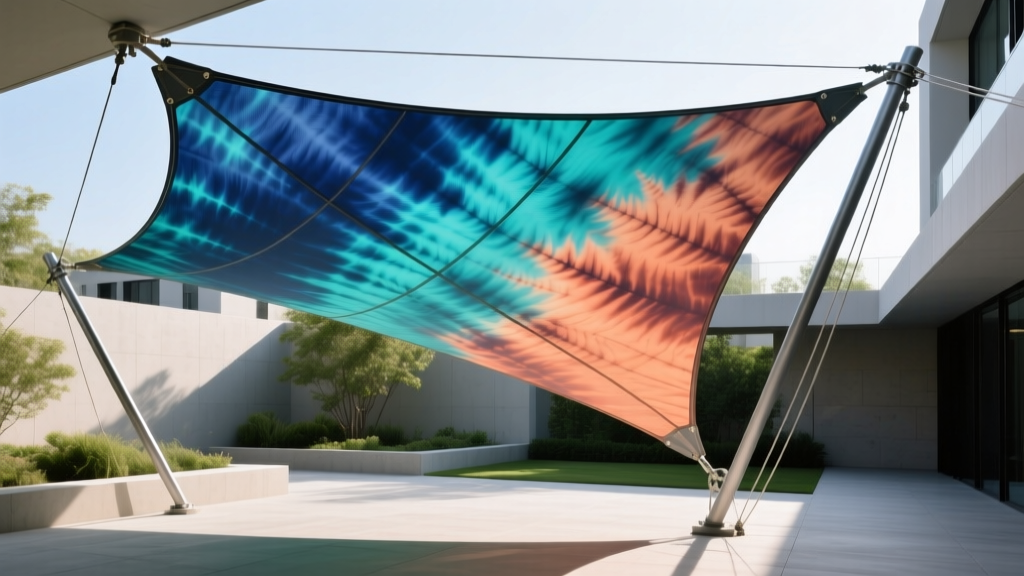
The Engineering Challenge of Dyeing Structural Textiles
When architects and fabricators specify bespoke tensile structures, glamping pavilions, or custom acoustic baffles, the question of surface finishing becomes critical. While factory solution-dyed fabrics dominate the commercial market, high-end hospitality and art-installation projects increasingly demand bespoke, patterned textiles. This leads contractors to a highly specific technical question: what material is best for tie dye when structural integrity, UV resistance, and fire ratings are on the line?
Applying traditional resist-dyeing (tie-dye or shibori) techniques to architectural fabrics is not a simple craft project; it is a chemical and mechanical engineering challenge. Structural fabrics are designed to withstand high tension, wind loads, and prolonged UV exposure. The hot water, chemical fixatives, and mechanical binding required for tie-dyeing can alter the denier of the yarn, weaken tensile strength, or cause uneven shrinkage that ruins a pre-calculated tensile membrane pattern. Furthermore, the chemical coatings that make architectural fabrics waterproof or fire-retardant often act as a barrier to dye penetration.
What Material Is Best for Tie Dye? A Structural Textile Matrix
To determine the optimal substrate for custom dyeing, we must evaluate common architectural textiles based on their polymer chemistry and structural application. According to polymer testing guidelines from the NC State Wilson College of Textiles, synthetic polymers require vastly different dye classes and thermal fixation methods than natural cellulose fibers.
| Material | Common Architectural Use | Required Dye Class | Tie-Dye Viability | Post-Dye Shrinkage |
|---|---|---|---|---|
| 18oz Cotton Duck Canvas | Interior Acoustic Baffles, Temporary Pavilions | Fiber-Reactive (Procion MX) | Excellent | 5% - 8% |
| High-Tenacity Uncoated Polyester | Tensile Shade Sails, Canopies | Disperse Dyes | Moderate (Requires High Heat) | 2% - 4% |
| Nylon 6,6 Mesh | Scaffolding Netting, Safety Debris Screens | Acid Dyes | Good | 3% - 5% |
| HDPE Knitted Mesh (e.g., Coolaroo) | Exterior Shade Sails, Privacy Screens | N/A (Requires Industrial Pigment) | Poor (Rejects Water-Based Dyes) | Less than 1% |
| PVC-Coated Polyester (e.g., Ferrari 602) | Permanent Tensile Membranes, Roofs | N/A (Coating Blocks Dye) | Impossible | N/A |
Fiber-Reactive vs. Disperse Dyes: Chemistry for the Job Site
The answer to what material is best for tie dye depends entirely on your ability to control the thermal and chemical environment on the job site or in the fabrication shop.
Heavy-Duty Cotton Canvas (Interior & Temporary Structures)
For interior acoustic panels, theatrical scrims, and temporary event pavilions, 100% natural cellulose (12oz to 18oz cotton duck canvas) is the undisputed best material for tie dye. Cotton readily accepts fiber-reactive dyes (such as Procion MX), which form a permanent covalent bond with the cellulose molecule at room temperature. This eliminates the need for massive industrial heating vats. The primary structural drawback is shrinkage; cotton canvas will shrink 5% to 8% upon its first complete wet-out. Fabricators must pre-wash and shrink the canvas before cutting the tensile pattern, or mathematically compensate for the take-up in the CAD model.
Architectural-Grade Polyester (Permanent Shade Sails)
Uncoated, high-tenacity polyester is the standard for permanent exterior shade sails. However, polyester is hydrophobic and requires disperse dyes. To achieve colorfastness that meets American Association of Textile Chemists and Colorists (AATCC) standards for exterior light exposure, disperse dyes must be thermally fixed at temperatures exceeding 200°F (93°C). Achieving this uniformly across a 400-square-foot shade sail in a dye bath is logistically difficult for most custom fabricators, making polyester a secondary choice unless the shop is equipped with industrial steam-aging autoclaves.
Step-by-Step Application: Dyeing Canvas for Tensile Pavilions
When executing a large-scale resist-dyeing application on 18oz cotton canvas for a structural pavilion, follow this engineered workflow to maintain fabric integrity.
- Scouring the Substrate: Factory canvas is treated with sizing agents, waxes, and sometimes mildew inhibitors. Boil the fabric in a solution of sodium carbonate (soda ash) and a heavy-duty textile detergent (like Synthrapol) for 60 minutes to strip these barriers. Failure to scour will result in patchy, structural-weak dye penetration.
- Architectural Binding: Traditional rubber bands will degrade and snap under the tension required for heavy canvas. Instead, use stainless steel hose clamps, PTFE (Teflon) tape, and heavy-duty nylon masonry line to bind and resist the fabric. This ensures sharp resist lines without introducing degrading elastomers to the job site.
- The Dye Bath & Fixation: Submerge the bound canvas in a fiber-reactive dye bath. Maintain a pH of 11 using soda ash to facilitate the covalent bonding process. Allow the fabric to circulate in the bath for a minimum of 4 hours to ensure saturation through the dense 18oz weave.
- Neutralization and Rinsing: Rinse with cold water until runoff is clear, followed by a hot water wash. This removes unfixed dye that could later bleed onto adjacent building materials or stain concrete patios during the first rain event.
Fastener and Hardware Compatibility Post-Dyeing
Once the bespoke tie-dyed membrane is fabricated, the attachment hardware must be selected with the dye chemistry in mind. Residual salts from the dyeing process can accelerate galvanic corrosion if incompatible metals are used in the tensioning system.
- 316 Marine-Grade Stainless Steel: The only acceptable metal for D-rings, turnbuckles, and cable swages on dyed exterior textiles. It resists the slight alkalinity that may remain trapped in the deep weave of heavy canvas.
- PTFE-Coated Hardware: For sliding track systems or tensioning rails, specify PTFE-coated aluminum to prevent any chemical reaction between the metal and the dyed fibers.
- Avoid Zinc-Plated Steel: Standard zinc-plated hardware (commonly found in big-box stores) will rapidly degrade and leave black oxidation streaks down the face of the custom dyed fabric within the first season of UV and moisture exposure.
Cost Analysis: Factory Solution-Dyed vs. Custom Site Dyeing
Specifying custom tie-dyed architectural textiles is a premium service. Below is a comparative cost breakdown per square foot for a standard 200 sq. ft. commercial shade structure, factoring in material, labor, and chemical overhead.
| Cost Factor | Factory Solution-Dyed HDPE (Standard) | Custom Tie-Dyed 18oz Canvas (Bespoke) |
|---|---|---|
| Raw Material Cost | $1.50 - $2.50 / sq. ft. | $4.00 - $6.50 / sq. ft. |
| Dye & Chemical Overhead | $0.00 (Pre-dyed at extrusion) | $1.20 - $2.00 / sq. ft. |
| Labor (Binding, Dyeing, Rinsing) | $0.00 | $8.00 - $15.00 / sq. ft. |
| Fabrication & Hardware | $3.00 - $5.00 / sq. ft. | $6.00 - $9.00 / sq. ft. (Requires post-shrink cutting) |
| Total Estimated Cost | $4.50 - $7.50 / sq. ft. | $19.20 - $32.50 / sq. ft. |
While the cost multiplier for custom dyeing is significant, the information gain for designers is the ability to create site-specific, non-repeating patterns that integrate seamlessly with landscape architecture and interior branding—something impossible to achieve with off-the-shelf extruded HDPE or PVC membranes.
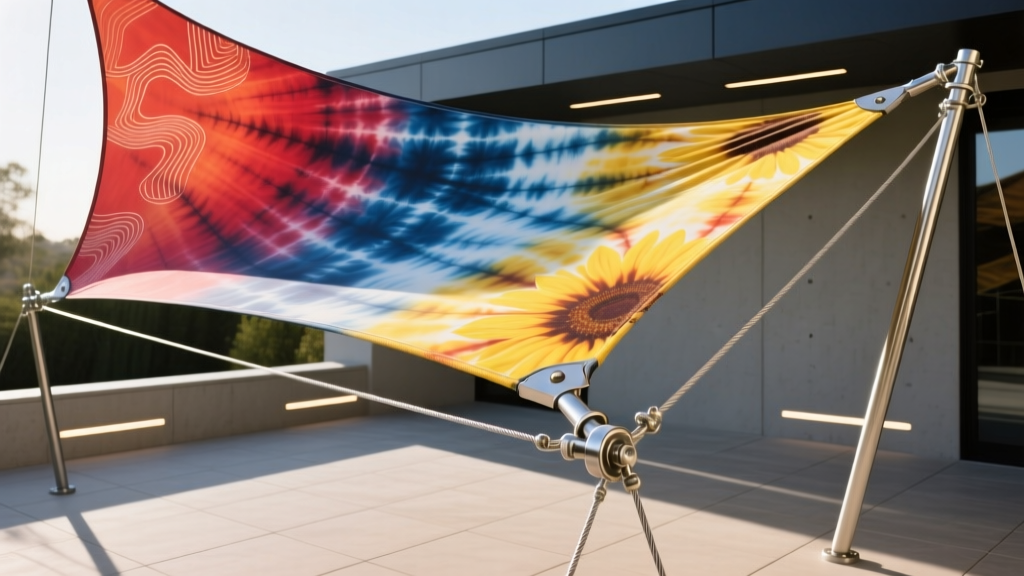
Maintaining Colorfastness in Exterior Applications
The ultimate failure mode of any dyed architectural textile is UV degradation. According to testing standards published by FabricLink, fiber-reactive dyes on cotton, while highly wash-fast, possess moderate to poor resistance to prolonged, direct ultraviolet radiation compared to solution-dyed acrylics or polyesters.
To mitigate UV fading on custom tie-dyed exterior pavilions, the fabric must be treated post-dyeing with a commercial-grade UV inhibitor and water-repellent finish, such as a fluoropolymer-based textile sealer. This must be applied only after the fabric is 100% dry and all dye fixatives have been completely neutralized. For permanent, high-tension exterior shade sails where a 10-year UV warranty is contractually required, contractors should abandon aftermarket dyeing entirely and instead specify custom-woven, solution-dyed yarns from the mill, reserving tie-dye techniques strictly for interior acoustic treatments, temporary event structures, and semi-protected hospitality canopies.
Written by
Marcus ChenMarcus Chen is a licensed structural engineer (PE) and building materials analyst with over 12 years of experience across residential, commercial, and industrial construction. He holds a Master of Science in Civil Engineering from UC Berkeley and spent six years at Thornton Tomasetti before transitioning to independent consulting and technical writing. Marcus specializes in material selection for seismic-prone regions, concrete reinforcement strategies, and lifecycle cost analysis. His work has been cited by the American Concrete Institute (ACI) and the Structural Engineers Association of California (SEAOC). When he is not on a job site or at his desk, you will find him hiking the Sierra Nevada or restoring a 1920s craftsman bungalow in Oakland, CA.
More from Marcus Chen
View all
Construction Cost
How Much Did the Eiffel Tower Cost to Build?
How much did the Eiffel Tower cost to build in 1889? We adjust for inflation and compare its budget to modern skyscraper construction.
Aug 4, 2026

Fire Resistance
What Is a Fire Resistant Material? Testing & Certification Guide
Discover what is a fire resistant material through ASTM and UL testing. Learn how fire ratings, certifications, and assemblies work in construction.
Aug 4, 2026

Construction Cost
How Much Did the Burj Khalifa Cost to Build?
How much did the Burj Khalifa cost to build? We break down the $1.5B project and extract 5 money-saving strategies for your next build.
Jul 30, 2026