Best Crawl Space Insulation Material for Acoustic Sound Control
Discover the best crawl space insulation material for sound control. Compare mineral wool, spray foam, and MLV to block plumbing and HVAC noise.

The Hidden Acoustic Problem in Crawl Spaces
Most builders treat the crawl space strictly as a thermal and moisture boundary, ignoring its massive impact on interior acoustics. Uninsulated or poorly insulated crawl spaces act as giant resonance chambers. When plumbing lines drain, HVAC ducts vibrate, or occupants walk on the floor above, the hollow cavity amplifies these structure-borne and airborne noises, transmitting them directly into the living space. Selecting the right crawl space insulation material is not just about R-value; it is about mass, density, and decoupling.
According to the U.S. Department of Energy, while thermal sealing is critical for energy efficiency, the acoustic performance of the floor assembly relies heavily on the specific material density and installation technique used within the joist bays. Standard thermal batts often fail to dampen low-frequency rumble or high-frequency impact noise.
Evaluating Crawl Space Insulation Materials for Sound
Acoustic performance is measured by Sound Transmission Class (STC) for airborne noise and Impact Insulation Class (IIC) for structure-borne noise. To improve these ratings from the crawl space side, the insulation material must either absorb sound waves within the cavity or add mass to the assembly. Here is how the primary materials compare.
| Material | Density (pcf) | NRC Rating | Primary Acoustic Benefit | Drawback |
|---|---|---|---|---|
| Mineral Wool Batts | 2.5 - 3.0 | 0.95 - 1.05 | Superior high-frequency absorption; fire resistant. | Heavier, requires tight friction fit. |
| Acoustic Fiberglass | 1.2 - 1.5 | 0.90 - 0.95 | Cost-effective cavity damping. | Lower mass; less effective on low frequencies. |
| Mass Loaded Vinyl (MLV) | N/A (1-2 lb/sqft) | 0.05 | Adds limp mass to block low-frequency HVAC rumble. | Expensive; difficult to install overhead. |
| Closed-Cell Spray Foam | 1.8 - 2.2 | 0.10 - 0.20 | Excellent thermal and air sealing. | Rigid; transmits impact vibration (terrible for IIC). |
Why Mineral Wool Dominates Acoustic Applications
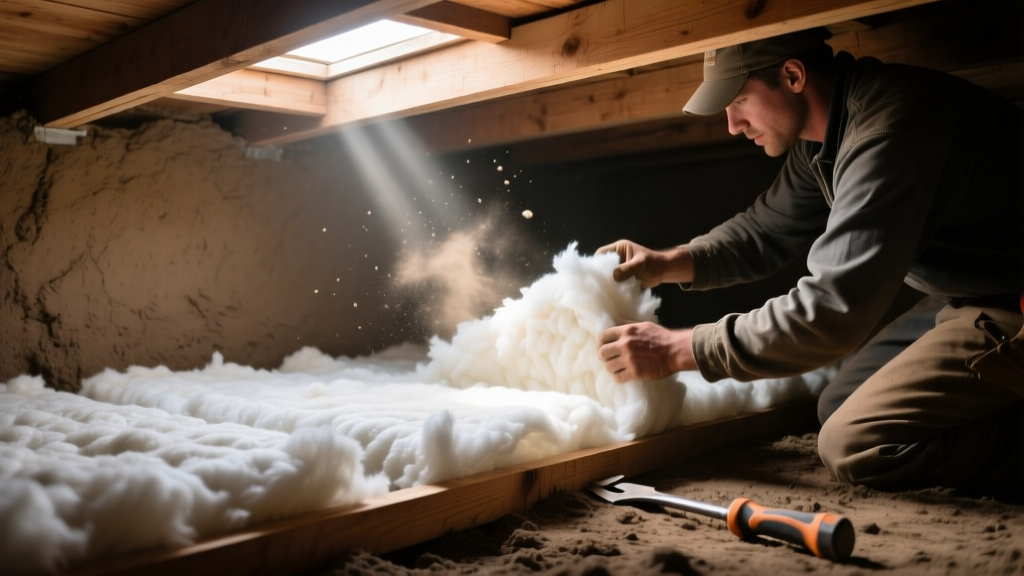
For pure sound dampening within the joist cavity, mineral wool (such as ROCKWOOL Safe'n'Sound) is the undisputed industry standard. Its non-directional, high-density fiber structure traps and dissipates sound waves far more effectively than standard fiberglass. The Insulation Institute notes that high-density mineral fiber can improve the STC rating of a standard wood-frame floor assembly by 8 to 10 points when installed correctly, effectively neutralizing conversation and television noise from the room below or above.
Targeted Solutions for Specific Crawl Space Noises
Insulating the bays is only half the battle. To achieve true sound control, you must identify the specific noise source and apply a targeted treatment.
1. Plumbing Rattle and Drain Noise
PVC and cast-iron drain lines routed through crawl spaces are notorious for transmitting the sound of rushing water. Do not just stuff insulation around the pipes. Instead, wrap the drain lines with a specialized acoustic pipe wrap (like Lag-100 or a 1 lb MLV pipe sleeve) to add mass and dampen the pipe wall vibration. After wrapping, fill the surrounding joist bay with mineral wool to absorb the residual airborne noise.
2. HVAC Duct Rumble and Airflow Noise
Sheet metal ducts vibrate and transmit low-frequency fan noise. Line the interior of the ducts with acoustic duct liner where code permits, or wrap the exterior of the plenum and main trunk lines with 2 lb/sq ft Mass Loaded Vinyl. Secure the MLV with acoustic caulk and mechanical fasteners to prevent flanking vibrations.
3. Footsteps and Impact Noise (IIC)
If the issue is footsteps from the floor above, cavity insulation alone will not solve the problem. Impact noise travels through the structural framing. While treating the floor from above (using an acoustic underlayment like cork or rubber) is the most effective fix, you can improve the crawl space side by applying a damping compound like Green Glue between a secondary layer of 5/8-inch drywall or cement board fastened to the bottom of the joists. This creates a constrained layer damper that dissipates vibrational energy as heat.
Step-by-Step Installation Protocol for Maximum Isolation
Improper installation destroys the acoustic value of even the most expensive materials. Follow this sequence to ensure optimal performance:
- Air Seal the Subfloor: Before insulating, use acoustic sealant to fill all gaps, cracks, and penetrations in the subfloor sheathing from the crawl space side. Sound behaves like water; it will exploit the smallest air leak to bypass your insulation.
- Friction-Fit the Batts: Cut mineral wool batts exactly 1/2 inch wider than the joist spacing. Compressing the material reduces its thickness and alters its density, degrading its Noise Reduction Coefficient (NRC). It should press firmly against the subfloor without sagging.
- Support the Insulation: Use acoustic-grade wire supports or rigid furring channels to hold the heavy mineral wool tight against the subfloor. Avoid standard wire 'tiger teeth' if they rattle against the joists.
- Isolate the Rim Joists: The rim joist is a massive flanking path for exterior noise. Seal the rim joist with 2 inches of closed-cell spray foam for air/moisture control, then cover it with a layer of mineral wool for acoustic damping.
2026 Cost Breakdown: Acoustic vs. Thermal Insulation
Upgrading from standard thermal insulation to a dedicated acoustic system requires a higher upfront investment. Below are the current market rates for materials and professional installation in a standard 1,000 sq. ft. crawl space.
| Material / System | Material Cost (per sq. ft.) | Installed Cost (per sq. ft.) | Best Application |
|---|---|---|---|
| Standard Fiberglass Batts (R-19) | $0.45 - $0.65 | $1.20 - $1.80 | Basic thermal, budget builds |
| Acoustic Fiberglass (e.g., QuietZone) | $0.75 - $0.95 | $1.60 - $2.20 | Mid-range airborne sound control |
| Mineral Wool (e.g., Safe'n'Sound) | $1.10 - $1.50 | $2.10 - $2.90 | High-performance airborne/impact damping |
| Mass Loaded Vinyl (1 lb) + Mineral Wool | $2.50 - $3.20 | $4.50 - $6.00 | Severe HVAC/plumbing noise mitigation |
Moisture Management and Building Code Compliance
When prioritizing acoustics, you cannot ignore moisture dynamics. Most high-density acoustic batts are unfaced (lacking a kraft paper vapor retarder) to allow the wood framing to dry. If your crawl space is vented, local building codes typically require a vapor retarder on the warm-in-winter side of the assembly.
Applying a Class I vapor retarder (like polyethylene sheeting) directly against the subfloor in a humid climate can trap moisture in the joist bays, leading to rapid wood rot and mold. Always pair unfaced acoustic batts with a comprehensive ground vapor barrier (minimum 10-mil poly) and, ideally, transition to a sealed, conditioned crawl space design to eliminate moisture risks entirely.
By selecting high-density mineral wool, addressing specific mechanical noise sources with mass and damping, and meticulously sealing flanking paths, you transform a problematic crawl space into a highly effective acoustic buffer, ensuring a quiet, comfortable living environment above.
Written by
David NakamuraDavid Nakamura is a licensed architect (AIA) and construction technology writer focused on sustainable building methods, mass timber engineering, and high-performance building envelopes. He holds a Master of Architecture from the University of Washington and is a certified Passive House Consultant (CPHC). David spent eight years at the Seattle firm Mithun, where he led the design of three LEED Platinum projects, before founding his own practice specializing in net-zero residential design. He serves on the editorial advisory board of GreenBuilder Magazine and has authored peer-reviewed papers on cross-laminated timber (CLT) connections for the Journal of Structural Engineering. In his spare time, David teaches woodworking at Pratt Fine Arts Center and kayaks the Puget Sound.
More from David Nakamura
View all
Construction Cost
Labor Cost to Build a Deck Per Sq Ft: 2026 Installation Guide
Discover the exact labor cost to build a deck per sq ft in 2026. This installation guide breaks down contractor rates, complexity factors, and hidden fees.
Aug 4, 2026

Construction Cost
How Much Does It Cost to Build a 3 Bedroom House? Financing Guide
Learn exactly how much it costs to build a 3 bedroom house and explore 2026 financing options, construction loan types, and budget frameworks for your build.
Aug 4, 2026

Construction Cost
Cost to Build a Tennis Court: 2026 Guide
How much does it cost to build a tennis court in 2026? Breakdowns for asphalt, concrete, and synthetic surfaces plus fencing and lighting.
Jul 30, 2026