Aerospace Insulation Materials: R-Value & Building Performance
Discover how aerospace insulation materials like silica aerogels deliver R-10 per inch for ultra-thin, high-performance building envelopes and retrofits.

The Crossover: From Orbit to Building Envelopes
When engineers design spacecraft, thermal management is a matter of survival. The extreme temperature differentials of low-Earth orbit necessitated the development of advanced aerospace insulation materials, most notably nanoporous silica aerogels and polyimide foams. Today, these same technologies have crossed over into the commercial and high-performance residential building sectors. For architects and builders facing severe space constraints or stringent energy codes, aerospace-derived insulation offers a paradigm shift in R-value density.
Unlike conventional batts or rigid foams that rely on trapped gas within large cellular structures, aerogel blankets achieve their thermal resistance through nanoscale physics. As building envelopes become tighter and passive house standards become the baseline for commercial construction in 2026, understanding the exact R-value performance, moisture dynamics, and installation protocols of these materials is critical for specification.
Decoding the Physics: The Knudsen Effect
To understand why aerospace insulation materials outperform traditional options, you must look at the pore structure. Silica aerogel blankets, such as those manufactured by Aspen Aerogels, consist of a silica nanoparticle matrix with pore sizes typically under 20 nanometers.
The mean free path of an air molecule at standard atmospheric pressure is approximately 70 nanometers. Because the aerogel pores are significantly smaller than the distance an air molecule can travel before colliding with another molecule, gaseous conduction is virtually eliminated. This phenomenon, known as the Knudsen effect, stops heat transfer in its tracks. The result is a flexible blanket that achieves an R-value of R-10.3 per inch, effectively doubling the performance of closed-cell spray foam and tripling that of standard fiberglass.
R-Value & Performance Comparison Matrix
When evaluating aerospace insulation materials against conventional building products, the metric that matters most is R-value per inch, especially in retrofit scenarios where wall thickness cannot be altered. Below is a performance matrix comparing top-tier insulation categories based on current 2026 market data.
| Material Type | R-Value / Inch | Vapor Permeability | Compressive Strength | Approx. Cost (per sq ft at R-20) |
|---|---|---|---|---|
| Silica Aerogel Blanket (e.g., Spaceloft) | R-10.3 | High (Vapor Open) | Low (Flexible) | $38.00 - $45.00 |
| Closed-Cell Spray Polyurethane Foam (ccSPF) | R-6.5 | Low (Vapor Closed) | High (Rigid) | $12.00 - $16.00 |
| Polyisocyanurate Rigid Board (Polyiso) | R-5.8 | Low (Foil Faced) | Medium (Rigid) | $8.50 - $11.00 |
| Mineral Wool Board (High Density) | R-4.2 | High (Vapor Open) | Medium (Semi-Rigid) | $14.00 - $18.00 |
| Fiberglass Batt (High Density) | R-3.8 | High (Vapor Open) | Low (Flexible) | $6.00 - $9.00 |
According to the U.S. Department of Energy, while aerogels carry a significantly higher upfront material cost, their ability to maintain high R-values in ultra-thin profiles (often 10mm to 20mm) saves thousands of dollars in architectural detailing, structural framing adjustments, and lost leasable floor space in commercial high-rises.
Real-World Building Applications
Historic Masonry Retrofits
Insulating the interior of historic solid masonry walls is notoriously difficult. Adding thick rigid foam traps moisture against the brick, leading to freeze-thaw spalling in cold climates. Aerospace-derived aerogel blankets are highly vapor-permeable. A 20mm layer of aerogel (R-8.2) applied to the interior of a historic brick wall provides substantial thermal resistance while allowing the masonry to dry inward, preventing structural degradation.
Thermal Bridge Mitigation
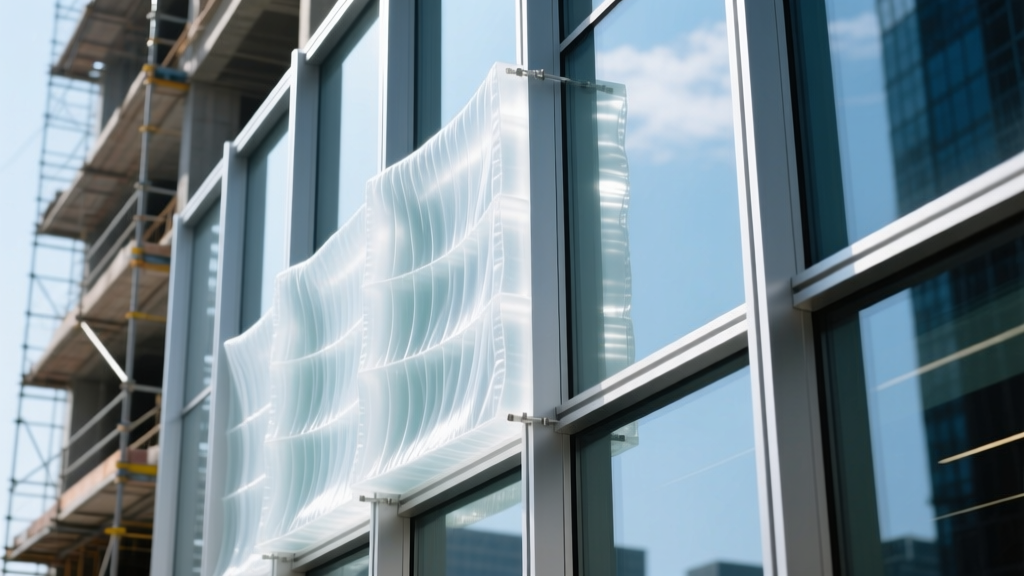
In modern curtain wall construction, the structural connections at balconies, parapets, and window reveals create massive thermal bridges. There is rarely enough physical depth to install 4 inches of XPS foam. Wrapping these structural penetrations in a 10mm aerogel blanket breaks the thermal bridge effectively without altering the exterior cladding dimensions or requiring custom-engineered structural offsets.
Decision Framework: When to Specify Aerogel
- Specify Aerogel When: Space constraints limit insulation depth to under 2 inches; historic preservation requires vapor-open interior insulation; complex geometric thermal bridges cannot be resolved with rigid boards.
- Specify Conventional Insulation When: Standard 2x6 or 2x8 framing is used; budget constraints cap material costs at under $3.00/sq ft; high compressive strength is required for below-grade applications.
Moisture Dynamics and Vapor Permeability
A common misconception is that ultra-high R-value materials must be closed-cell foams. The Whole Building Design Guide (WBDG) emphasizes the importance of matching vapor permeability to the specific hygrothermal profile of the wall assembly. Silica aerogel blankets are hydrophobic (they repel liquid water) but highly vapor-open. This means they will not absorb bulk moisture if a leak occurs, but they allow water vapor to pass through freely. This dual characteristic makes them uniquely suited for exterior continuous insulation (ci) applications in mixed-humid climates where drying potential in both directions is required.
Installation Protocols and Edge Cases
Handling aerospace insulation materials requires strict adherence to manufacturer protocols. Aerogel blankets shed fine silica particulate when cut or compressed.
Step-by-Step Installation for Interior Masonry:
- Surface Prep: Parge or level the interior masonry surface. Aerogel blankets are flexible but will telegraph severe undulations if placed behind drywall.
- Adhesive Application: Apply a continuous bead of low-VOC, aerogel-compatible construction adhesive (e.g., specific polyurethane-based adhesives approved by the manufacturer) in a serpentine pattern.
- Mechanical Fastening: Secure the blanket using cap washers and masonry anchors. Do not over-compress the blanket; compressing a 10mm blanket down to 7mm will collapse the nanoporous structure, permanently reducing its R-value by up to 30%.
- Joint Treatment: Stagger all seams. Seal joints with 2-inch wide aerogel-compatible weatherization tape to prevent thermal bypass at the edges.
- Framing: Install standard metal or wood furring strips over the blanket to create a service cavity and provide a mounting surface for the interior finish.
Sourcing, Standards, and Specifications
When writing specifications for aerospace insulation materials, architects must reference the correct industry standards to ensure quality control. The primary standard governing these products is ASTM C1728 (Standard Specification for Flexible Aerogel Thermal Insulation). This standard dictates the minimum requirements for thermal resistance, surface burning characteristics, and dimensional stability.
For commercial projects, ensure the specified product carries a Class A fire rating per ASTM E84. Leading manufacturers like Aspen Aerogels (Spaceloft) and Armacell (EnPro) provide fully tested assemblies that meet these stringent commercial fire codes. Always request the manufacturer's latest Environmental Product Declaration (EPD) to verify the embodied carbon footprint, as the supercritical drying process used to manufacture aerogels is energy-intensive, though it is rapidly being offset by advancements in manufacturing efficiency as of 2026.
Written by
James ThorntonJames Thornton is a construction industry veteran with 25 years of hands-on experience in wood framing, lumber grading, and residential building codes. He started as a framing carpenter in rural Oregon, earned his ICC Residential Building Inspector certification, and eventually became a senior plan reviewer for the City of Portland Bureau of Development Services. James holds a B.S. in Wood Science & Technology from Oregon State University and is a certified lumber grader through the West Coast Lumber Inspection Bureau (WCLIB). He has inspected over 3,000 residential construction sites and authored the city's internal guide on advanced framing techniques (2x6 at 24" O.C.). James lives in Bend, OR, where he builds custom timber-frame cabins and competes in lumberjack sports.
More from James Thornton
View all
Insulation
Best Home Insulation Materials: Complete 2026 Guide
Compare top home insulation materials for 2026. Find R-values, installed costs per square foot, and best uses for fiberglass, spray foam, and mineral wool.
Aug 4, 2026

Sustainable Building
Certify Your Green Building Material for LEED and WELL
Step-by-step guide to certifying a green building material for LEED v5 and WELL v2. Master EPDs, HPDs, and VOC limits for 2026 project specifications.
Aug 4, 2026

Stone & Masonry
Veneer Stacked Stone Panels: Interior Design & Style Showcase
Discover how veneer stacked stone panels transform interiors. Explore modern design profiles, material pairings, and technical installation specs.
Aug 4, 2026