Top Sound Insulating Material Options for Energy Efficiency
Discover the best sound insulating material options that maximize both STC ratings and R-values. Compare costs, densities, and wall assembly strategies.

The Intersection of Acoustics and Thermodynamics
When architects and builders design high-performance building envelopes, they often treat acoustic control and thermal resistance as separate engineering challenges. This siloed approach leads to redundant material costs, lost floor space, and compromised wall assemblies. Selecting a dual-purpose sound insulating material that simultaneously maximizes Sound Transmission Class (STC) and thermal R-value is critical for modern energy-efficient construction. According to the U.S. Department of Energy, optimizing cavity insulation not only reduces conductive heat loss but also dampens airborne noise, provided the material density and installation techniques are correctly matched to the wall framing.
Thermal insulation relies on trapping stagnant air to slow conductive heat flow (measured via ASTM C518). Acoustic insulation, however, requires friction and mass to convert sound wave energy into trace amounts of heat (measured via ASTM E90). While both benefit from trapped air, acoustics demand higher material density and specific fibrous structures to absorb low and mid-frequency vibrations. Understanding this physical distinction is the key to selecting the right product.
A common and costly mistake in residential construction is specifying Rockwool Safe'n'Sound for exterior energy-efficient walls. Safe'n'Sound is engineered specifically for interior partitions to maximize acoustic absorption; it is less dense than exterior batts and does not carry an official R-value rating. Using it on exterior walls will result in failed energy code inspections and increased HVAC loads. For exterior dual-performance, you must use products like Rockwool Comfortbatt or Thermafiber UltraBatt.
Dual-Performance Material Matrix
The following matrix compares the top cavity insulation materials based on their combined acoustic and thermal metrics. STC ratings reflect a standard 2x4 wood stud wall with 1/2-inch drywall on both sides, without resilient channels or decoupling clips.
| Material Type | R-Value / Inch | STC Rating (2x4) | Density (pcf) | Material Cost / sq ft |
|---|---|---|---|---|
| Mineral Wool Batts | R-4.2 | 45 - 52 | 8.0 - 12.0 | $1.65 - $2.10 |
| Dense-Pack Cellulose | R-3.5 - R-3.8 | 44 - 48 | 3.0 - 3.5 | $1.20 - $1.55 |
| High-Density Fiberglass | R-4.0 - R-4.2 | 39 - 43 | 1.5 - 2.5 | $0.95 - $1.30 |
| Closed-Cell Spray Foam | R-6.5 - R-7.0 | 35 - 38 | 2.0 | $2.50 - $3.25 |
Deep Dive: Top Sound Insulating Material Options
1. Mineral Wool Batts (The Acoustic-Thermal Hybrid)
Mineral wool (stone wool) remains the undisputed leader for combined STC and R-value performance in standard framing. Products like Rockwool Comfortbatt and Thermafiber UltraBatt feature a rigid, high-density fibrous matrix that creates immense internal friction for sound waves while maintaining excellent thermal resistance. Because mineral wool is dimensionally stable and slightly oversized from the factory, it friction-fits tightly against studs, eliminating the micro-gaps that cause both thermal convection and acoustic flanking.
Furthermore, mineral wool is inherently non-combustible, achieving a fire-resistance rating that allows builders to eliminate fire-blocking in certain concealed spaces, saving labor costs. The primary drawback is the higher material cost and the physical stiffness of the batts, which requires installers to use serrated insulation knives rather than standard utility blades for clean cuts around electrical boxes.
2. Dense-Pack Cellulose (The Mass Master)
For retrofit projects or net-zero builds utilizing advanced framing, dense-pack cellulose offers exceptional acoustic mass. Blown into wall cavities at 3.0 to 3.5 pounds per cubic foot (pcf), cellulose completely fills irregular cavities, wiring chases, and plumbing penetrations that batt insulation often misses. The EPA's ENERGY STAR program heavily advocates for comprehensive air sealing, and dense-pack cellulose naturally restricts air movement better than unfaced batts, reducing convective heat loss and airborne noise transmission simultaneously.
While its R-value per inch (approx. R-3.7) is lower than mineral wool, the complete elimination of cavity gaps often results in a higher whole-wall R-value and superior low-frequency sound dampening. Installation requires specialized blowing equipment and mesh netting, making it strictly a professional application.
3. High-Density Fiberglass (The Budget Compromise)
Standard pink or yellow fiberglass batts are poor sound insulators due to their low density; sound waves easily pass through the large air pockets. However, high-density architectural fiberglass boards, such as Owens Corning 703 or high-density ProCat Max batts, compress more glass fibers into the same cavity space. This increases the friction coefficient for sound waves, bumping the STC rating of a standard wall from the low 30s to the low 40s, while maintaining an R-4.2 per inch thermal rating.
Wall Assembly Decision Framework
Choosing the right sound insulating material requires analyzing your specific wall assembly and acoustic targets. Use this framework to guide your specification:
- Scenario A: Standard 2x6 Exterior Wall (Code Minimum + Comfort). Specify R-23 Mineral Wool Batts. Combine with a continuous exterior layer of 1-inch mineral wool board to break thermal bridging and dampen exterior traffic noise.
- Scenario B: Interior Home Theater or Bedroom Partitions. Thermal R-value is irrelevant. Specify Rockwool Safe'n'Sound, paired with decoupled resilient channels and two layers of 5/8-inch Type X gypsum board. Refer to the Gypsum Association's sound control guidelines for exact STC 55+ assembly details.
- Scenario C: Historic Retrofit / Existing Closed Walls. Specify Dense-Pack Cellulose. Drill 2-inch access holes through the exterior sheathing or interior drywall to blow cellulose into closed cavities, drastically improving both draft reduction and street noise attenuation without demolishing finishes.
Critical Installation Failure Modes
Even the most expensive sound insulating material will fail if installation protocols ignore acoustic flanking and compression. Avoid these three critical errors:
The Compression Fallacy: Forcing a 5.5-inch R-23 batt into a 3.5-inch 2x4 cavity does not yield an R-23 wall. It compresses the air pockets, dropping the thermal R-value to roughly R-13 while marginally increasing acoustic mass. Always match the batt thickness to the cavity depth, or use high-density R-15 batts specifically manufactured for 2x4 framing.
Flanking via Rigid Connections: Sound travels through solid structures much faster than through air. If drywall is screwed directly to both sides of a stud, the stud acts as a mechanical bridge, bypassing the cavity insulation entirely. To maximize the performance of your sound insulating material, apply a continuous bead of ASTM C920-compliant acoustic sealant (such as OSI SC-175 or Tremco Acoustical Sealant) along the top and bottom wall plates before installing drywall. This decouples the rigid assembly and seals airborne leaks.
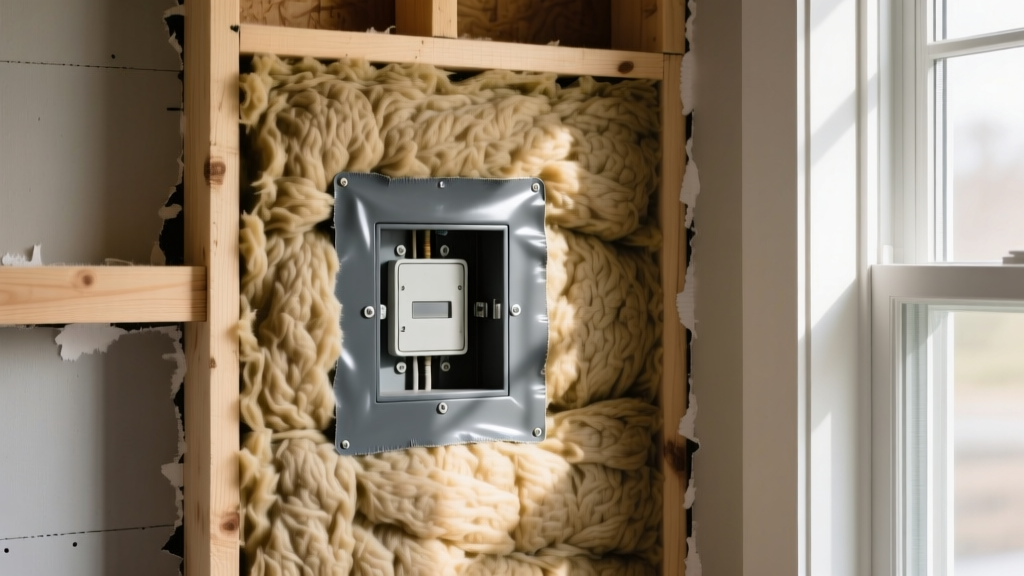
Electrical Box Back-to-Back Placement: Installing electrical outlets back-to-back on opposite sides of an interior partition creates a direct acoustic tunnel. Offset electrical boxes by at least 24 inches horizontally, and wrap the boxes in acoustic putty pads to restore the mass lost by cutting the drywall.
2026 Cost and ROI Analysis
Upgrading from standard R-13 fiberglass batts to a high-performance sound insulating material like mineral wool adds approximately $0.75 to $1.15 per square foot in material costs. For a 2,500-square-foot home, this translates to a premium of roughly $1,800 to $2,800. However, when factoring in the reduction in HVAC tonnage requirements (due to superior thermal envelope performance) and the measurable increase in property value tied to acoustic comfort ratings, the dual-purpose material approach yields a positive return on investment within the first five years of ownership. Builders who market verified STC ratings alongside HERS (Home Energy Rating System) scores consistently command higher premiums in competitive residential markets.
Written by
David NakamuraDavid Nakamura is a licensed architect (AIA) and construction technology writer focused on sustainable building methods, mass timber engineering, and high-performance building envelopes. He holds a Master of Architecture from the University of Washington and is a certified Passive House Consultant (CPHC). David spent eight years at the Seattle firm Mithun, where he led the design of three LEED Platinum projects, before founding his own practice specializing in net-zero residential design. He serves on the editorial advisory board of GreenBuilder Magazine and has authored peer-reviewed papers on cross-laminated timber (CLT) connections for the Journal of Structural Engineering. In his spare time, David teaches woodworking at Pratt Fine Arts Center and kayaks the Puget Sound.
More from David Nakamura
View all
Construction Cost
Labor Cost to Build a Deck Per Sq Ft: 2026 Installation Guide
Discover the exact labor cost to build a deck per sq ft in 2026. This installation guide breaks down contractor rates, complexity factors, and hidden fees.
Aug 4, 2026

Construction Cost
How Much Does It Cost to Build a 3 Bedroom House? Financing Guide
Learn exactly how much it costs to build a 3 bedroom house and explore 2026 financing options, construction loan types, and budget frameworks for your build.
Aug 4, 2026

Construction Cost
Cost to Build a Tennis Court: 2026 Guide
How much does it cost to build a tennis court in 2026? Breakdowns for asphalt, concrete, and synthetic surfaces plus fencing and lighting.
Jul 30, 2026