Best Aircon Insulation Material to Maximize HVAC SEER
Discover the best aircon insulation material for 2026. Compare elastomeric foam, fiberglass, and PIR to maximize HVAC SEER ratings and stop energy loss.

The Hidden Energy Drain in Unconditioned Spaces
When evaluating HVAC performance, contractors often fixate on the condenser unit's SEER2 rating while ignoring the distribution network. According to the U.S. Department of Energy, typical duct systems lose 20% to 30% of their conditioned air due to leaks, thermal transfer, and poor insulation in unconditioned spaces like attics and crawlspaces. Selecting the correct aircon insulation material is not merely about wrapping pipes; it is a critical thermodynamic intervention required to realize the efficiency your equipment was engineered to deliver.
In 2026, with energy costs continuing to fluctuate and building codes enforcing stricter thermal envelope standards, the choice of insulation dictates both your monthly utility overhead and the lifespan of your air handling components. The wrong material leads to compressed R-values, vapor barrier breaches, and catastrophic condensation drip.
Comparative Matrix: Top Aircon Insulation Material Types
The market offers several distinct chemical and structural formulations. Below is a technical comparison of the primary aircon insulation materials used in residential and light commercial applications.
| Material Type | Best Application | R-Value per Inch | Vapor Permeability | 2026 Avg. Cost |
|---|---|---|---|---|
| Elastomeric Foam (Closed-Cell) | Refrigerant lines, exterior pipes, tight chases | R-4.2 | Near Zero (< 0.05 perms) | $1.80 - $3.20 / LF |
| Fiberglass Duct Wrap (FSK Faced) | Main trunk lines, large rectangular supply ducts | R-4.2 to R-8.0 | Zero (with intact FSK) | $0.90 - $1.50 / Sq Ft |
| Polyisocyanurate (PIR) Rigid Board | Commercial AHUs, exterior ductwork, plenums | R-6.0 to R-6.5 | Near Zero (Foil-faced) | $1.20 - $2.00 / Board Ft |
| Phenolic Foam Board | High-fire-rating commercial zones, marine HVAC | R-7.0 to R-8.0 | Near Zero | $2.50 - $4.00 / Board Ft |
Material Deep Dives: Specifications and Edge Cases
1. Elastomeric Foam (Closed-Cell)
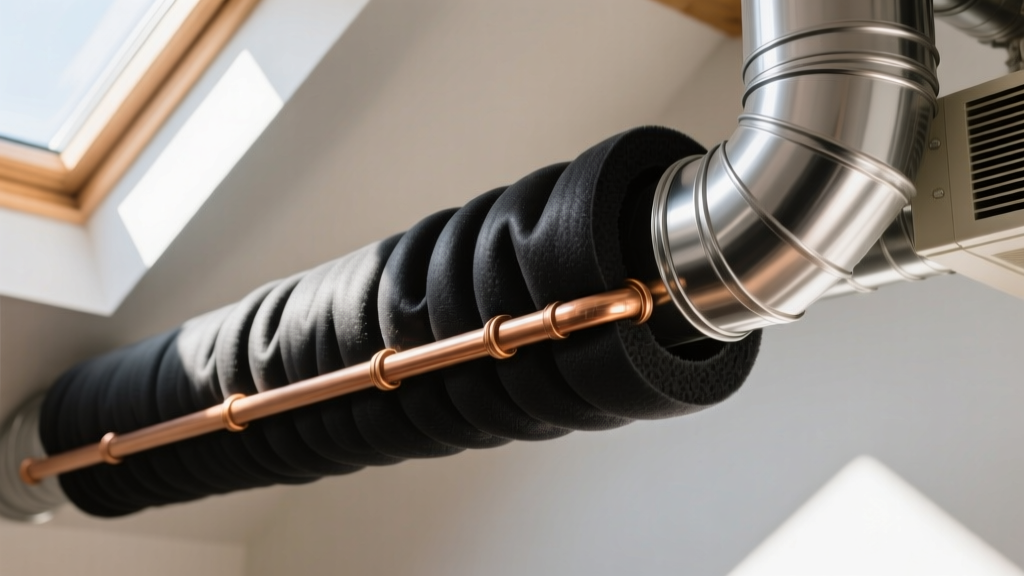
Products like AP ArmaFlex or Rubatex represent the gold standard for refrigerant line sets and chilled water pipes. Because it is a closed-cell elastomeric nitrile rubber, it inherently resists moisture vapor transmission without requiring an external jacket.
Expert Insight: When insulating the suction line (the larger, colder copper pipe), always use pre-slit elastomeric tubes with self-seal lap closures. If you use standard wall insulation and wrap it around the pipe, the compression at the bends will reduce the R-value by up to 40%, guaranteeing condensation drip at the elbow joints.
2. Fiberglass Duct Wrap with FSK Facing
For large rectangular and round sheet metal ducts, fiberglass blanket insulation (such as Owens Corning Duct Wrap or Knauf Insulation) remains the most cost-effective aircon insulation material. However, the critical component is the FSK (Foil-Scrim-Kraft) facing.
Edge Case: Fiberglass derives its R-value from trapped air. If an installer pulls the wrap too tight around a 24x12 inch rectangular duct, the fiberglass compresses. A 2-inch thick R-8 blanket compressed to 1 inch effectively drops to R-4. Always calculate the wrap length using the formula: 2 x (Width + Height) + 2 inches for overlap to ensure a loose, uncompressed fit.
3. Polyisocyanurate (PIR) Rigid Boards
When insulating exterior air handling units or ductwork running through tight, unconditioned commercial chases, rigid PIR boards (like Johns Manville CI MaxPlus) offer the highest R-value per inch. The foil facers act as a Class I vapor retarder. PIR must be mechanically fastened or adhered using specialized HVAC mastic, and all joints must be sealed with foil tape to maintain the continuous thermal envelope.
2026 IECC Compliance and Climate Zone Requirements
The International Energy Conservation Code (IECC) and regional adaptations dictate minimum R-values for ductwork located in unconditioned spaces. According to ENERGY STAR guidelines and updated 2026 building codes, the baseline requirements are:
- Climate Zones 1, 2, and 3 (Warm/Humid): Minimum R-6 for supply ducts; R-4 for return ducts.
- Climate Zones 4, 5, and 6 (Mixed/Temperate): Minimum R-8 for supply ducts; R-6 for return ducts.
- Climate Zones 7 and 8 (Cold/Extreme): Minimum R-8 for supply ducts; R-8 for return ducts (with strict vapor retarder requirements on the exterior face).
Note: Ducts located entirely within the conditioned thermal envelope (e.g., dropped ceilings inside the insulated living space) do not require thermal insulation, but acoustic lining may still be specified for noise attenuation.
Step-by-Step Installation Protocol for Maximum Thermal Seal
Even the highest-grade aircon insulation material will fail if the substrate is not prepared correctly. Follow this sequence for a permanent, code-compliant installation:
- Substrate Sealing: Before applying any insulation, all duct joints, seams, and takeoffs must be sealed. Do not use standard cloth 'duct tape' (which degrades in 18 months). Apply UL 181B-FX listed mastic paste with a stiff brush, or use UL 181A-P listed foil-backed tape.
- Hanger Isolation: Where metal hanger straps support the ductwork, install high-density neoprene or rigid foam isolation pads between the strap and the duct. This prevents the metal strap from slicing through the insulation and creating a thermal bridge.
- Wrap Application: Roll the insulation over the duct. Ensure the FSK or foil facing is on the outside to act as the vapor retarder.
- Seam Sealing: Overlap the longitudinal seam by 2 inches. Seal the entire length with 3-inch wide aluminum foil tape. Press firmly with a plastic squeegee to activate the pressure-sensitive adhesive.
- Puncture Repair: Any tears or staple holes in the vapor facing must be immediately patched with foil tape or mastic to prevent ambient humidity from entering the fiberglass matrix.
2026 Retrofit Cost Estimates (2,000 Sq. Ft. Home)
Upgrading uninsulated or degraded ductwork in a standard single-family home attic requires a specific budget allocation. Below is a realistic pricing matrix for 2026, assuming approximately 60 linear feet of main trunk and branch ducts.
| Project Component | Material Cost | Labor Cost | Total Estimated Cost |
|---|---|---|---|
| Mastic Sealing & Air Sealing (Prep) | $85 - $120 | $250 - $400 | $335 - $520 |
| R-8 Fiberglass Duct Wrap (60 LF) | $220 - $310 | $450 - $650 | $670 - $960 |
| Refrigerant Line Insulation (ArmaFlex) | $60 - $90 | $100 - $150 | $160 - $240 |
| Total Project Average | $365 - $520 | $800 - $1,200 | $1,165 - $1,720 |
Troubleshooting Common Insulation Failures
If your HVAC system is short-cycling, struggling to reach the thermostat setpoint, or producing water stains on the ceiling below the attic, investigate these specific failure modes:
- Symptom: Water dripping from supply registers.
Cause: The vapor barrier (FSK facing) on the exterior of the duct wrap is breached, or the insulation was installed inside-out. Humid attic air penetrates the fiberglass, hits the cold metal duct, and condenses.
Fix: Strip the saturated section, dry the metal, re-wrap with the foil facing outward, and seal all seams with mastic. - Symptom: Ice formation on the exterior of the refrigerant line insulation.
Cause: The elastomeric foam is undersized (e.g., using 1/2-inch wall thickness for a high-efficiency variable-speed compressor running at ultra-low suction temperatures) or the system is low on refrigerant charge.
Fix: Verify refrigerant charge. If charge is correct, upgrade to 3/4-inch or 1-inch thick ArmaFlex for extreme low-temp applications. - Symptom: High attic ambient temperatures and degraded efficiency.
Cause: Radiant heat gain. Standard fiberglass reflects very little radiant energy. In hot climates (Zones 1-3), the attic can reach 140°F, overwhelming the R-8 conductive resistance.
Fix: Install a radiant barrier (perforated aluminum foil) over the duct wrap, or switch to foil-faced PIR rigid board which inherently reflects up to 97% of radiant heat.
Choosing the correct aircon insulation material requires matching the thermodynamic properties of the insulation to the specific temperature differentials and humidity levels of your climate zone. By prioritizing vapor impermeability on cold lines and uncompressed loft on supply trunks, you ensure your HVAC system operates at its engineered peak.
Written by
Priya KapoorPriya Kapoor is a real estate market analyst and construction economics researcher with expertise in housing affordability, development feasibility, and infrastructure investment. She holds a Master of Regional Planning from Cornell University and previously worked as a senior analyst at CBRE's Investment Properties group, where she modeled returns for $4B in mixed-use development pipelines. Priya now runs an independent research practice advising developers, municipalities, and REITs on construction cost forecasting and market timing. She publishes the quarterly "BuildMat Market Pulse" report tracking material price indices across 12 commodity categories. Based in Austin, TX, Priya serves on the board of Habitat for Humanity Austin and is a marathon runner.
More from Priya Kapoor
View all
Construction Cost
Cost to Build a 1600 Sq Ft Home in 2026: Full Breakdown
Accurate 2026 cost to build a 1600 sq ft home—material, labor, and regional pricing breakdowns included. Plan your budget with real-time estimates.
Aug 11, 2026

Wood & Lumber
Name the Types of Wood for Pressure Treatment and Preservation
Learn how to name the types of wood best suited for pressure treatment. Compare species treatability, chemical retention levels, and 2026 preservation costs.
Aug 4, 2026

Stone & Masonry
Stone Veneer Suppliers Lindenhurst: 2026 Cost Analysis
Analyze 2026 stone veneer costs in Lindenhurst, NY. Compare local supplier pricing, delivery fees, and Suffolk County installation labor rates.
Aug 4, 2026