Auto Sound Insulation Materials: The Selection Framework
Master our selection framework for auto sound insulation materials. Compare mass loaded vinyl, butyl, and closed-cell foams for optimal acoustic control.

The Physics of Vehicle Noise: Structure-Borne vs. Air-Borne
Selecting the correct auto sound insulation materials requires abandoning the misconception that a single product can solve all vehicular noise issues. Automotive acoustics are governed by Noise, Vibration, and Harshness (NVH) principles. To build an effective selection framework, you must first categorize the noise source. Structure-borne noise occurs when mechanical vibrations (engine harmonics, exhaust resonance, tire slap) travel through the vehicle's metal chassis, causing large sheet metal panels to act as acoustic diaphragms. Air-borne noise, conversely, consists of high-frequency sound waves (wind rush, tire tread hiss, passing traffic) that penetrate the cabin through gaps, glass, and thin sheet metal. According to research from Purdue University's Ray W. Herrick Laboratories, treating air-borne noise with structure-borne dampers yields near-zero acoustic benefit. A robust selection framework matches the material's physical mechanism—damping, blocking, or decoupling—to the specific frequency and transmission path of the target noise.
The 4-Tier Auto Sound Insulation Materials Matrix
The table below maps the four primary categories of acoustic treatment to their physical mechanisms and ideal application zones. Use this matrix as the first filter in your selection framework.
| Material Category | Primary Mechanism | Target Noise Type | Ideal Vehicle Zones |
|---|---|---|---|
| Constrained Layer Dampers (CLD / Butyl) | Shear-induced kinetic-to-thermal energy conversion | Low-frequency structure-borne resonance | Floor pans, firewall, trunk wheel wells |
| Mass Loaded Vinyl (MLV) | Acoustic impedance and mass law blocking | Mid-to-high frequency air-borne noise | Doors, roof, rear deck, under carpet |
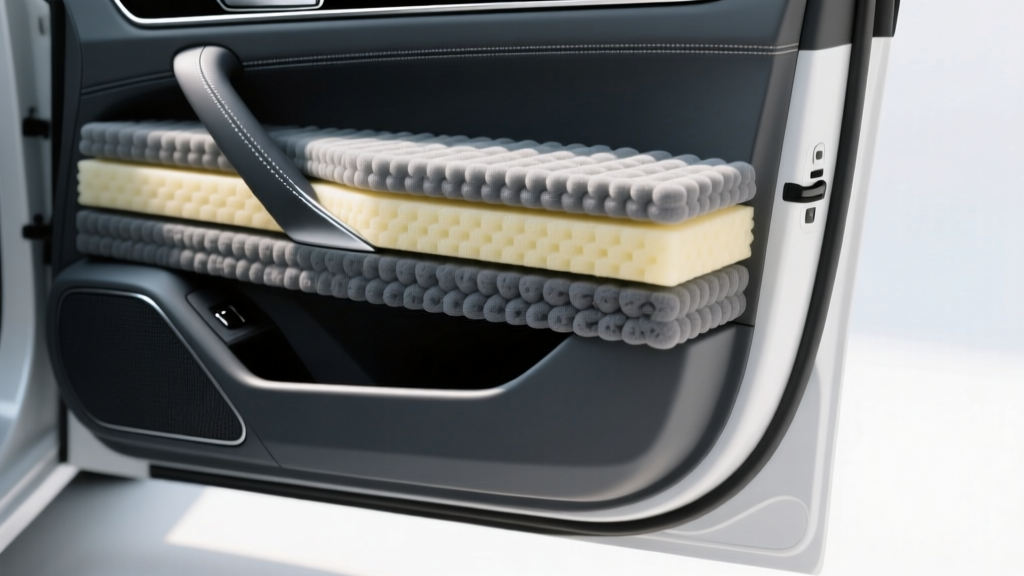
| Closed-Cell Foam (CCF) | Mechanical decoupling and high-frequency absorption | Rattling, panel-to-panel contact, wind hiss | Door skins, headliners, behind trim clips |
| Open-Cell / Thermo-Acoustic Absorbers | Friction-based sound wave dissipation (porous) | High-frequency cabin reflections and HVAC noise | Headliners, dash interior, pillar cavities |
Decision Framework: Matching Material to Noise Frequency
Low-Frequency Rumble (Engine & Exhaust: 20Hz - 150Hz)
Low-frequency noise is exclusively structure-borne. The framework dictates using a Constrained Layer Damper (CLD), typically composed of a viscoelastic butyl rubber base topped with an aluminum constraint layer. When the sheet metal vibrates, the butyl layer shears, converting kinetic energy into trace thermal energy. Crucial Specification: Use 80-mil (2mm) thick butyl for floor pans and firewalls where low-frequency exhaust drone is most prominent. For roof panels and upper door skins, drop to 50-mil (1.25mm) to conserve weight while still shifting the panel's resonant frequency out of the audible rumble range.
Mid-Frequency Road Noise (Tires & Suspension: 150Hz - 1000Hz)
Tire roar and suspension impacts generate a mix of structure-borne and air-borne noise. The framework requires a composite approach. First, apply CLD to the inner wheel wells and trunk pan to stop the metal from ringing. Second, install a 1 lb/sqft Mass Loaded Vinyl (MLV) barrier over the floor pan beneath the carpet. MLV relies on the 'mass law' of acoustics—doubling the mass of a barrier increases transmission loss by roughly 6 decibels. However, MLV must be tested for sound transmission class (STC) ratings per the ASTM E90 standard to ensure the calcium silicate or barium sulfate fillers are properly distributed for consistent acoustic impedance.
High-Frequency Wind & Hiss (Aerodynamics: 1000Hz+)
Wind noise bypasses heavy mass barriers by exploiting microscopic gaps and thin glass. To combat this, the framework shifts from mass to absorption and decoupling. Apply Closed-Cell Foam (CCF) behind door cards and headliners. CCF prevents plastic trim panels from vibrating against the metal chassis (which creates secondary high-frequency rattles). For the headliner and A/B/C pillars, utilize hydrophobic open-cell thermo-acoustic absorbers (like 3M Thinsulate) to trap and dissipate high-frequency wind shear noise before it reflects into the cabin.
Weight vs. Acoustic Gain: The Diminishing Returns Curve
A common mistake is covering 100% of a vehicle's sheet metal with butyl CLD. Acoustic engineering data cited in SAE International Standards demonstrates that applying CLD to just 25% to 30% of a flat panel's surface area reduces its resonant amplitude by up to 90%. Covering the remaining 70% adds dead weight with less than a 2% additional acoustic benefit. For a mid-size sedan, adhering strictly to the 25% rule for CLD saves approximately 35 to 45 lbs of unnecessary mass, preserving suspension geometry, braking distances, and fuel efficiency while achieving identical NVH reduction.
Real-World Product Specifications & Cost Breakdown
When procuring auto sound insulation materials, evaluate products against these specific metrics and current market pricing tiers:
- Premium Butyl CLD (e.g., Second Skin Damplifier Pro, Dynamat Xtreme): 100% butyl rubber, no asphalt fillers. Withstands temperatures up to 250°F without melting or off-gassing. Cost: $2.50 - $3.50 per sq. ft.
- Economy Butyl CLD (e.g., Kilmat, Noico): Often a butyl/asphalt blend. Adequate for doors and roofs, but prone to off-gassing VOCs in hot climates if applied near the firewall or transmission tunnel. Cost: $1.20 - $1.80 per sq. ft.
- Mass Loaded Vinyl (1 lb/sqft): Yields an STC rating of roughly 26. Flexible enough to drape over floor pan contours. Cost: $1.80 - $2.20 per sq. ft.
- Mass Loaded Vinyl (2 lb/sqft): Yields an STC rating of roughly 32. Too rigid for complex door interiors; best reserved for flat floor pans under thick carpet padding. Cost: $3.50 - $4.50 per sq. ft.
- Closed-Cell Foam (CCF): Typically 1/8-inch to 1/4-inch thick cross-linked polyethylene. Cost: $0.80 - $1.20 per sq. ft.
Installation Edge Cases & Failure Modes
Even the best materials fail if the installation framework is ignored. The most critical failure mode is mechanical bridging. If you install MLV directly against a vibrating metal floor pan without a decoupling layer of CCF, the MLV will physically transfer the vibrations into the cabin, negating its mass-blocking properties. Always sandwich a 1/8-inch CCF layer between the metal chassis and the MLV.
Another severe edge case involves adhesive thermal failure. The interior of a car parked in direct summer sunlight can easily exceed 160°F (71°C) on the dashboard and rear deck. Asphalt-based 'sound deadeners' lose their adhesive shear strength at these temperatures, peeling away from the metal and trapping moisture, which accelerates rust formation. Always verify the material's data sheet for a high-temperature adhesive rating exceeding 200°F for any application above the window line or near the exhaust tunnel. Finally, never apply CLD over existing factory sealants, undercoatings, or rust; the viscoelastic layer requires a direct, solvent-wiped bond to bare metal to function as a constrained layer damper.
Written by
David NakamuraDavid Nakamura is a licensed architect (AIA) and construction technology writer focused on sustainable building methods, mass timber engineering, and high-performance building envelopes. He holds a Master of Architecture from the University of Washington and is a certified Passive House Consultant (CPHC). David spent eight years at the Seattle firm Mithun, where he led the design of three LEED Platinum projects, before founding his own practice specializing in net-zero residential design. He serves on the editorial advisory board of GreenBuilder Magazine and has authored peer-reviewed papers on cross-laminated timber (CLT) connections for the Journal of Structural Engineering. In his spare time, David teaches woodworking at Pratt Fine Arts Center and kayaks the Puget Sound.
More from David Nakamura
View all
Construction Cost
Labor Cost to Build a Deck Per Sq Ft: 2026 Installation Guide
Discover the exact labor cost to build a deck per sq ft in 2026. This installation guide breaks down contractor rates, complexity factors, and hidden fees.
Aug 4, 2026

Construction Cost
How Much Does It Cost to Build a 3 Bedroom House? Financing Guide
Learn exactly how much it costs to build a 3 bedroom house and explore 2026 financing options, construction loan types, and budget frameworks for your build.
Aug 4, 2026

Construction Cost
Cost to Build a Tennis Court: 2026 Guide
How much does it cost to build a tennis court in 2026? Breakdowns for asphalt, concrete, and synthetic surfaces plus fencing and lighting.
Jul 30, 2026