Rigid Insulation Material Comparison: EPS vs XPS vs Polyiso
Compare EPS, XPS, and polyiso rigid insulation materials. Explore R-values, moisture resistance, pricing, and best applications for modern building codes.

The Core Trio: EPS, XPS, and Polyisocyanurate
Selecting the correct rigid insulation material dictates the thermal performance, moisture management, and fire compliance of your building envelope. While all three primary rigid foams—Expanded Polystyrene (EPS), Extruded Polystyrene (XPS), and Polyisocyanurate (Polyiso)—resist heat flow, their cellular structures and chemical compositions create vastly different behaviors in real-world applications. This guide dissects the technical specifications, failure modes, and 2026 market pricing for each.
- Below-Grade / High Moisture: XPS (or high-density EPS Type IX)
- Above-Grade Exterior Continuous Insulation (ci): Polyiso (Coated Glass Facer)
- Budget-Conscious / Interior Masonry: EPS
Expanded Polystyrene (EPS): The Budget-Friendly Workhorse
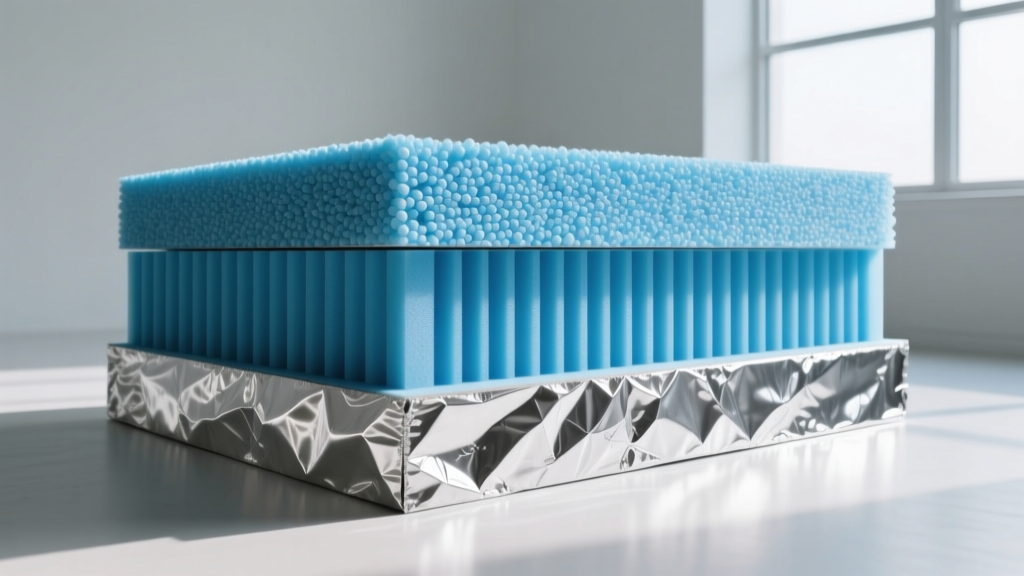
EPS is manufactured by expanding spherical polystyrene beads using steam and a blowing agent (typically pentane), then fusing them into large blocks that are cut into boards. Its open-cell bead structure makes it vapor-permeable, which is a critical advantage for drying potential in certain wall assemblies.
Technical Specs & Product Spotlight
- Baseline R-Value: R-3.6 to R-4.2 per inch (increases slightly with higher density).
- Compressive Strength: 10 psi (Type I) up to 60 psi (Type IX).
- Featured Product: Insulfoam EPS, widely available in custom thicknesses up to 40 inches.
- Current Pricing: $0.30 to $0.45 per square foot (1-inch thickness).
Failure Modes & Edge Cases
EPS is highly susceptible to physical degradation from UV exposure and certain chemical solvents. If left exposed on a job site for more than 30 days, the surface beads will yellow and chalk, requiring sanding or removal before adhesive application. Furthermore, EPS cannot be used in direct contact with waterproofing membranes containing asphalt, coal tar, or PVC plasticizers, as these chemicals melt the polystyrene beads on contact.
Extruded Polystyrene (XPS): The Moisture Champion
XPS is created through a continuous extrusion process that yields a closed-cell structure with a smooth, impermeable plastic skin. This cellular makeup makes XPS the undisputed leader in moisture resistance and long-term water absorption metrics.
Technical Specs & Product Spotlight
- Baseline R-Value: R-5.0 per inch.
- Water Absorption: Less than 0.3% by volume (ASTM C272).
- Featured Product: Owens Corning FOAMULAR NGX. The 'NGX' designation is critical for 2026 compliance, as it utilizes next-generation blowing agents.
- Current Pricing: $0.75 to $1.10 per square foot (1-inch thickness).
The HFC Blowing Agent Phase-Down
Historically, XPS relied on hydrofluorocarbon (HFC) blowing agents like HFC-134a, which possess a Global Warming Potential (GWP) nearly 1,400 times greater than CO2. Under the EPA's AIM Act, the manufacturing of high-GWP HFCs is being aggressively phased down. When specifying XPS today, you must verify the product uses low-GWP alternatives (like HFOs or hydrocarbons). Legacy XPS stock sitting in lumberyards may still contain high-GWP agents, but new production from major manufacturers like Owens Corning and Kingspan has transitioned to compliant formulations.
Failure Modes & Edge Cases
Despite its moisture resistance, XPS suffers from thermal drift over time. The high-performance blowing agents trapped in the closed cells slowly diffuse out, replaced by air, causing the R-value to drop from R-5.0 to an aged R-4.7 over a 15-year period. Additionally, XPS has a low melting point (approx. 165°F). It cannot be placed in direct contact with hot asphalt roofing kettles or high-temperature HVAC flues without a thermal barrier.
Polyisocyanurate (Polyiso): The High-R Heavyweight
Polyiso is a thermoset plastic foam, meaning it will not melt under high heat; instead, it chars. It is almost always manufactured with facers—either aluminum foil or coated glass (CGF)—which dramatically alter its performance profile.
Technical Specs & Product Spotlight
- Baseline R-Value: R-6.0 to R-6.5 per inch (at 75°F mean temperature).
- Fire Performance: Superior char-forming properties; easily passes ASTM E84 and NFPA 285 wall assembly tests.
- Featured Product: Carlisle SecurShield (CGF facer) or GAF EnergyGuard Polyiso.
- Current Pricing: $0.80 to $1.20 per square foot (1-inch thickness).
The Cold-Weather R-Value Drop (Thermal Drift)
Polyiso exhibits a well-documented phenomenon known as reverse thermal drift. While its R-value peaks around 75°F, the blowing gases inside the cells condense at lower temperatures. According to research by the Department of Energy, foil-faced polyiso can lose up to 20% of its R-value when the mean temperature drops to 25°F. If you are building in Climate Zones 5 through 8, specifying Coated Glass Facer (CGF) polyiso is mandatory; CGF facers mitigate this cold-weather R-value drop significantly compared to foil facers, maintaining closer to R-5.8 at freezing temperatures.
Failure Modes & Edge Cases
Foil-faced polyiso acts as a Class I vapor retarder (less than 0.1 perms). If installed on the exterior of a framed wall in a cold climate without calculating the dew point, it can trap moisture inside the wall cavity, leading to sheathing rot. For exterior continuous insulation (ci) in heating-dominated climates, always specify unfaced or CGF-faced polyiso to allow the assembly to dry to the exterior.
Head-to-Head Comparison Matrix
| Property | EPS (Type II) | XPS (NGX) | Polyiso (CGF) |
|---|---|---|---|
| R-Value (75°F) | R-3.8 | R-5.0 | R-6.2 |
| R-Value (25°F) | R-4.0 (Increases) | R-5.0 (Stable) | R-5.4 to R-5.8 |
| Water Absorption | 2.0% - 4.0% | < 0.3% | < 1.0% |
| Vapor Permeability | Semi-permeable (2-5 perms) | Semi-impermeable (1 perm) | Varies (Foil is <0.1, CGF is 1-2) |
| Max Service Temp | 167°F (75°C) | 165°F (74°C) | 250°F (121°C) |
Code Compliance and Fire Ratings
Fire performance is often the deciding factor in commercial and multi-family construction. All three materials are combustible plastics, but their reaction to fire differs wildly.
- EPS and XPS: Both are thermoplastics. When exposed to flame, they melt, shrink, and drip, which can accelerate fire spread. They require a 15-minute thermal barrier (like 1/2-inch gypsum board) when used in interior applications per IBC Section 2603.4.
- Polyiso: As a thermoset, polyiso chars and forms a protective ash layer, resisting flame spread and structural collapse. It is the only rigid foam that routinely passes NFPA 285 (Standard Fire Test Method for Evaluation of Fire Propagation Characteristics of Exterior Wall Assemblies) without requiring extensive, costly assembly modifications. The Whole Building Design Guide heavily recommends polyiso for exterior continuous insulation specifically due to its favorable NFPA 285 testing history.
Pricing and ROI Breakdown
When calculating the return on investment for rigid insulation, look beyond the initial material cost per square foot. Consider the labor and secondary materials required to mitigate the material's weaknesses.
For above-grade continuous insulation (ci), Polyiso provides the highest R-value per inch. Achieving an R-20 exterior ci requirement takes 5 inches of EPS (adding significant weight, fastener length requirements, and detailing complexity) versus just 3.25 inches of Polyiso. The savings in fastener costs and window buck extensions often offset Polyiso's higher upfront material price.
Written by
Marcus ChenMarcus Chen is a licensed structural engineer (PE) and building materials analyst with over 12 years of experience across residential, commercial, and industrial construction. He holds a Master of Science in Civil Engineering from UC Berkeley and spent six years at Thornton Tomasetti before transitioning to independent consulting and technical writing. Marcus specializes in material selection for seismic-prone regions, concrete reinforcement strategies, and lifecycle cost analysis. His work has been cited by the American Concrete Institute (ACI) and the Structural Engineers Association of California (SEAOC). When he is not on a job site or at his desk, you will find him hiking the Sierra Nevada or restoring a 1920s craftsman bungalow in Oakland, CA.
More from Marcus Chen
View all
Construction Cost
How Much Did the Eiffel Tower Cost to Build?
How much did the Eiffel Tower cost to build in 1889? We adjust for inflation and compare its budget to modern skyscraper construction.
Aug 4, 2026

Fire Resistance
What Is a Fire Resistant Material? Testing & Certification Guide
Discover what is a fire resistant material through ASTM and UL testing. Learn how fire ratings, certifications, and assemblies work in construction.
Aug 4, 2026

Construction Cost
How Much Did the Burj Khalifa Cost to Build?
How much did the Burj Khalifa cost to build? We break down the $1.5B project and extract 5 money-saving strategies for your next build.
Jul 30, 2026