What Material Is an Insulator? Cost vs. R-Value Analysis
Discover what material is an insulator worth buying. We break down costs, R-values, and hidden expenses for fiberglass, spray foam, and mineral wool.

The Economics of Thermal Resistance
When builders and homeowners ask what material is an insulator capable of delivering the highest return on investment, the answer requires looking far beyond the upfront sticker price. In building science, an insulator is any material that resists conductive heat flow, measured by its R-value. However, from a cost analysis perspective, an insulator is a financial asset that reduces HVAC operational expenses over a 30-year mortgage lifecycle.
The fundamental mistake in construction budgeting is evaluating insulation based on the cost per square foot or cost per board foot. The only metric that matters for true cost analysis is the Cost per R-Value. This metric normalizes the price across different material densities, thicknesses, and thermal efficiencies, revealing which products actually deliver the most thermal resistance for your dollar.
The 2026 Insulation Cost Matrix
The following matrix breaks down the current market pricing for the four dominant residential and commercial insulation categories. Material costs reflect national averages for standard 2x4 and 2x6 framing cavities, while installed costs factor in average regional labor rates.
| Material Type | Specific Product Example | R-Value per Inch | Material Cost (per sq ft) | Cost per R-Value (Material Only) |
|---|---|---|---|---|
| Fiberglass Batts | Owens Corning PINK Next Gen (R-15) | 3.1 - 4.3 | $0.55 - $0.75 | $0.042 |
| Mineral Wool | ROCKWOOL Comfortbatt (R-15) | 4.2 - 4.3 | $1.05 - $1.25 | $0.076 |
| Closed-Cell SPF | Huntsman Enertite (3-inch pass) | 6.0 - 6.5 | $4.50 - $6.00 | $0.250 |
| Rigid Polyiso | Hunter Panels R-Max (Foil-faced) | 5.6 - 6.0 | $1.10 - $1.40 (for 2 in.) | $0.105 |
Fiberglass Batts: The Budget Baseline and Its Hidden Penalties
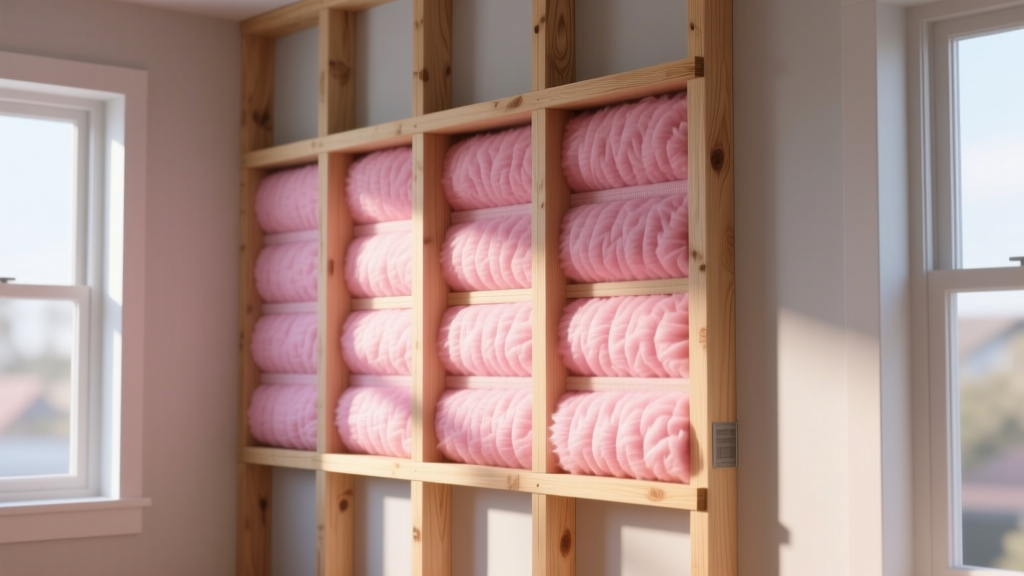
Fiberglass traps air within fine glass fibers to slow heat transfer. Products like Owens Corning PINK Next Gen have improved significantly in itch-factor and recovery time from compression. For a standard 2x6 wall cavity (R-19 to R-21), material costs hover around $0.85 per square foot.
The Hidden Cost: Fiberglass is entirely air-permeable. According to the U.S. Department of Energy, convective heat loss (air leakage) can render up to 40% of a fiberglass batt's rated R-value useless if the cavity is not perfectly sealed. To make fiberglass perform to its rated specification, you must pair it with a continuous air barrier, such as a fluid-applied membrane or meticulously taped housewrap, adding $0.30 to $0.50 per square foot in secondary material and labor costs.
Mineral Wool: The Fire, Sound, and Moisture Specialist
Mineral wool (stone wool) is manufactured by spinning molten basalt rock and slag into dense fibers. ROCKWOOL Comfortbatt is the industry standard here. It costs roughly 40% to 60% more than fiberglass, but it offers distinct physical properties that offset secondary construction costs.
- Fire Resistance: Mineral wool is non-combustible and can withstand temperatures exceeding 2,000°F (meeting ASTM E119 standards for firestopping). This can eliminate the need for specialized fire-blocking materials in multi-family or commercial party walls.
- Hydrophobic Nature: Unlike fiberglass, which loses all insulating value when wet, mineral wool repels water while remaining vapor-permeable, allowing wall assemblies to dry to the exterior.
- Acoustic Damping: The dense, chaotic fiber structure absorbs sound waves, providing an STC (Sound Transmission Class) rating boost of 3 to 5 points over standard fiberglass in partition walls.
Closed-Cell Spray Polyurethane Foam (SPF): The Premium Envelope
Closed-cell SPF, such as Huntsman Enertite or Demicore, is a two-part chemical mixture that expands and cures into a rigid, dense plastic. With an R-value of roughly 6.5 per inch, it provides the highest thermal resistance per unit of thickness.
At $4.50 to $6.00 per square foot for a standard 3-inch application (yielding R-19.5), the Cost per R-Value is exceptionally high ($0.25). However, a pure cost-per-R analysis fails to capture SPF's secondary structural benefits. Closed-cell foam adheres to the sheathing and studs, increasing the racking strength of the wall assembly by up to 300%. Furthermore, at 1.5 inches of thickness, it qualifies as a Class II vapor retarder, entirely eliminating the need for a separate polyethylene vapor barrier in cold climates. When factoring in the elimination of air-sealing labor and vapor barrier materials, the cost gap between SPF and premium batts narrows significantly.
Thermal Bridging and the 'Effective R-Value' Reality
One of the most critical concepts in modern cost analysis is the difference between nominal R-value (the rating on the package) and effective R-value (the actual performance in the wall). Wood framing studs act as thermal bridges. Wood has an R-value of roughly 1.25 per inch. In a standard 2x6 wall framed at 16 inches on-center, the wood makes up about 25% of the wall surface area.
This is where Rigid Polyisocyanurate (Polyiso) boards become financially viable. Installing a 1-inch layer of foil-faced polyiso (R-6) over the exterior sheathing costs about $0.65 per square foot for materials. This continuous layer blankets the studs, eliminating thermal bridging and pushing the whole-wall effective R-value well past R-20, yielding a much faster energy payback period.
Climate Zone Adjustments and Code Minimums
The financial viability of premium insulation is directly tied to your IECC (International Energy Conservation Code) Climate Zone. Upgrading from R-13 to R-21 in Climate Zone 2 (e.g., Miami, FL) might yield a simple payback period of 15 years due to the relatively low heating/cooling degree days. The same upgrade in Climate Zone 6 (e.g., Minneapolis, MN) will pay for itself in 3 to 5 years.
According to building envelope guidelines outlined by the Building Science Corporation, the ratio of exterior rigid insulation to interior cavity insulation must be carefully calibrated to prevent condensation within the wall cavity during winter months. In colder zones (5, 6, 7, and 8), the exterior rigid foam must account for at least 20% to 35% of the total wall R-value to keep the interior face of the sheathing above the dew point. Failing to calculate this ratio leads to interstitial condensation, mold growth, and catastrophic structural rot—costs that dwarf any initial savings from cheaping out on exterior foam.
Decision Framework: Allocating Your Insulation Budget
To determine exactly what material is an insulator best suited for your specific project, apply this decision framework based on your primary construction constraints:
- If Budget is the Absolute Primary Constraint: Use fiberglass batts (Owens Corning PINK Next Gen) for the cavities, but reallocate savings to hire a specialized air-sealing contractor to apply expanding foam and caulk at all top plates, bottom plates, and window penetrations. A perfectly air-sealed R-13 wall outperforms a leaky R-21 wall.
- If Space/Thickness is Constrained: Use closed-cell spray foam. In roof assemblies where rafter depth is limited to 2x8 or 2x10, closed-cell SPF is the only material that can achieve code-required R-values without requiring a drop-ceiling or furring out the rafters.
- If Soundproofing or Fire-Rating is Required: Default to mineral wool (ROCKWOOL). The cost premium is easily justified by the elimination of specialized acoustic caulking and the inherent fire-blocking capabilities required in multi-family partitions.
- If Preventing Thermal Bridging is the Goal: Utilize exterior rigid polyiso or mineral wool boards. This is non-negotiable for high-performance builds targeting Passive House or Net-Zero certifications, as cavity insulation alone cannot defeat the thermal bridging of the framing lumber.
The Bottom Line on Insulator ROI
Ultimately, answering the question of what material is an insulator worth buying requires viewing the building envelope as an integrated system. The cheapest material per square foot (fiberglass) becomes the most expensive if it fails to control air and moisture. Conversely, the most expensive material (closed-cell foam) can become cost-effective when its structural, air-sealing, and vapor-retarding properties eliminate the need for three other trades on your job site. Calculate your costs per effective R-value, account for your specific climate zone, and always prioritize air-sealing before stuffing the cavities.
Written by
James ThorntonJames Thornton is a construction industry veteran with 25 years of hands-on experience in wood framing, lumber grading, and residential building codes. He started as a framing carpenter in rural Oregon, earned his ICC Residential Building Inspector certification, and eventually became a senior plan reviewer for the City of Portland Bureau of Development Services. James holds a B.S. in Wood Science & Technology from Oregon State University and is a certified lumber grader through the West Coast Lumber Inspection Bureau (WCLIB). He has inspected over 3,000 residential construction sites and authored the city's internal guide on advanced framing techniques (2x6 at 24" O.C.). James lives in Bend, OR, where he builds custom timber-frame cabins and competes in lumberjack sports.
More from James Thornton
View all
Insulation
Best Home Insulation Materials: Complete 2026 Guide
Compare top home insulation materials for 2026. Find R-values, installed costs per square foot, and best uses for fiberglass, spray foam, and mineral wool.
Aug 4, 2026

Sustainable Building
Certify Your Green Building Material for LEED and WELL
Step-by-step guide to certifying a green building material for LEED v5 and WELL v2. Master EPDs, HPDs, and VOC limits for 2026 project specifications.
Aug 4, 2026

Stone & Masonry
Veneer Stacked Stone Panels: Interior Design & Style Showcase
Discover how veneer stacked stone panels transform interiors. Explore modern design profiles, material pairings, and technical installation specs.
Aug 4, 2026