What Is the Best Sound Insulation Material? An Acoustic Comparison
Discover what is the best sound insulation material for your project. Compare STC ratings, costs, and assemblies for mineral wool, MLV, and fiberglass.

The Physics of Soundproofing: STC vs. IIC vs. NRC
Answering the question of what is the best sound insulation material requires abandoning the idea of a single 'magic' product. Acoustic performance is dictated by assembly physics, not just the batt stuffed inside a wall cavity. Before selecting a material, you must define the acoustic metric you are trying to improve:
- STC (Sound Transmission Class): Measures a partition's ability to block airborne sound (voices, televisions, traffic). A standard interior wall is STC 33; a luxury hotel wall is STC 55+.
- IIC (Impact Insulation Class): Measures resistance to structure-borne impact noise (footsteps, dropped objects). Crucial for floor/ceiling assemblies.
- NRC (Noise Reduction Coefficient): Measures sound absorption within a room to reduce echo and reverberation, not sound blocking between rooms.
According to the U.S. Department of Housing and Urban Development (HUD), achieving meaningful noise isolation requires addressing mass, decoupling, damping, and absorption simultaneously. The materials below serve distinct roles within this framework.
Material Matrix: What Is the Best Sound Insulation Material by Application?
The following matrix compares the top acoustic materials based on their primary function, material costs, and maximum STC gain when integrated into a properly sealed assembly.
| Material Type | Brand/Model Example | Primary Acoustic Function | Cost per Sq Ft (Material) | Max STC Gain (in standard assembly) |
|---|---|---|---|---|
| Mineral Wool Batts | Rockwool Safe'n'Sound | Cavity Absorption / Low-Freq Damping | $1.15 - $1.45 | +8 to +10 STC |
| Rigid Fiberglass | Owens Corning 703 | Surface Absorption / High-Freq NRC | $2.60 - $3.10 | N/A (Used for treatment) |
| Mass Loaded Vinyl | Soundproof Cow 1lb MLV | Mass Addition / Flanking Block | $1.60 - $2.10 | +4 to +6 STC |
| Damping Compound | Green Glue Noiseproofing | Viscoelastic Shear Damping | $1.75 - $2.25 | +8 to +12 STC |
| Acoustic Sealant | OSI Pro Series SC-175 | Flanking Path Elimination | $0.15 - $0.25 (per linear ft) | Prevents STC collapse |
Deep Dive: Top Contenders for Airborne and Impact Noise
Mineral Wool (Rockwool Safe'n'Sound)
When contractors ask what is the best sound insulation material for interior partition walls, mineral wool is the default recommendation. Unlike standard thermal fiberglass (density ~0.5 lbs/cu ft), acoustic mineral wool has a density of 2.5 lbs/cu ft. This higher mass and non-directional fiber matrix excel at trapping low-frequency sound waves (bass, HVAC rumble) that easily pass through lighter materials.
Mass Loaded Vinyl (MLV)
MLV is a limp-mass material made from PVC loaded with barium sulfate. It does not absorb sound; it reflects it. Because it is limp (uncoupled), it does not transmit vibrational energy. A single layer of 1 lb/sq ft MLV has an STC of 27 on its own. It is the best material for wrapping HVAC ductwork, lining plumbing chases, and adding mass to floor assemblies where adding a second layer of 5/8-inch drywall is structurally or spatially unfeasible.
Viscoelastic Damping Compounds (Green Glue)
Damping compounds are not insulation; they are constrained-layer dampers. When sandwiched between two rigid panels (like two layers of 5/8-inch Type X drywall), the compound undergoes shear stress as sound waves vibrate the panels. This mechanical friction converts acoustic energy into trace amounts of heat. USG acoustical guidelines frequently highlight constrained-layer damping as the most space-efficient method to achieve STC 55+ without building a double-stud wall.
The Decoupling Multiplier: Why Material Alone Fails
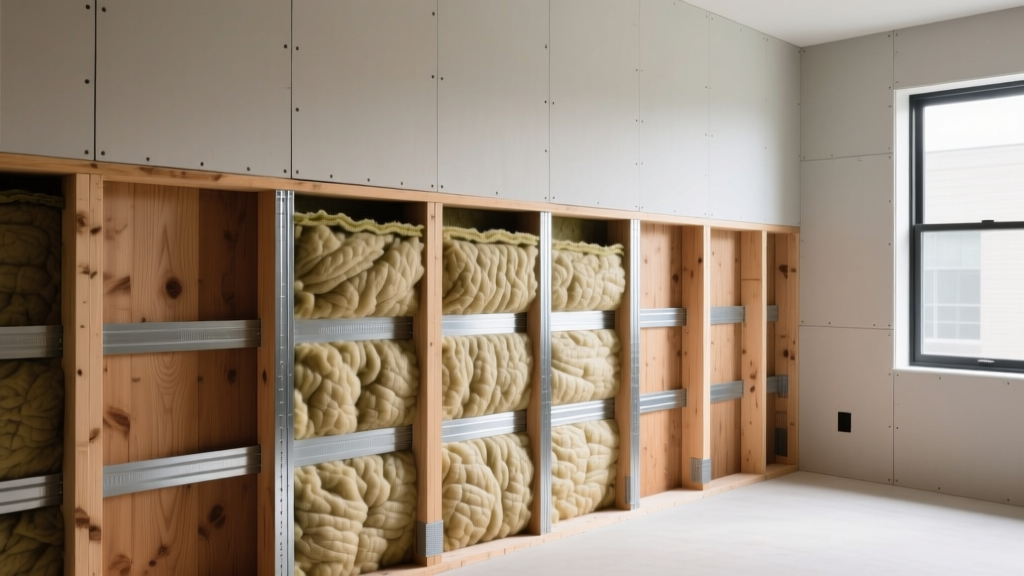
The most common mistake in residential soundproofing is relying entirely on cavity insulation. If you fill a standard 2x4 wood-framed wall with Rockwool and apply one layer of drywall to each side, you will achieve an STC of roughly 45. However, low-frequency sound will still travel through the rigid wood studs (structure-borne flanking).
To unlock the true potential of your insulation material, you must decouple the drywall from the framing. Here is how decoupling methods compare:
- Resilient Channels (RC-1): 25-gauge metal channels screwed horizontally to the studs. The drywall attaches only to the channel. Cost: $0.60/sq ft. STC boost: +5 to +7. High risk of short-circuiting if drywall screws penetrate the channel into the stud.
- Sound Isolation Clips & Hat Channel: Rubber-isolated clips (e.g., Kinetics RWS) snap onto the studs, holding a 25-gauge furring channel. Cost: $1.85/sq ft. STC boost: +12 to +15. The gold standard for decoupling, virtually eliminating low-frequency structural transfer.
- Double Stud Wall: Two separate 2x4 frames with a 1-inch air gap between them, each insulated and sheeted independently. Cost: High (lumber and lost square footage). STC boost: +20+. Best for recording studios and home theaters.
Common Installation Failures That Ruin STC Ratings
Acoustic testing by the Acoustical Society of America demonstrates that a 1% gap or unsealed penetration in a partition can reduce the overall STC rating by 50%. Avoid these critical failure modes:
- Back-to-Back Electrical Boxes: Never install electrical outlets on opposite sides of the same stud bay. Sound will bypass the insulation entirely. Stagger boxes by at least one stud bay and wrap them in MLV or acoustic putty pads.
- Hard-Coded Perimeters: If drywall touches the floor, ceiling, or adjacent walls, vibrations will transfer. Leave a 1/4-inch gap at all perimeters and fill it with OSI SC-175 acoustic sealant before installing baseboards.
- Recessed Lighting (Can Lights): Standard recessed lights punch massive holes in your acoustic envelope. Use surface-mounted fixtures, or build sealed, drywall-backed acoustic enclosures (backer boxes) around the fixtures inside the ceiling cavity.
- Uninsulated Flanking Paths: Sound will travel over the top plate of an interior wall into the attic and drop down into the next room. Insulation must extend over the top plate, or the ceiling drywall must be continuous above the partition.
Final Verdict: Matching Material to Your Acoustic Goal
There is no universal 'best' material, only the best material for your specific acoustic bottleneck. Use this decision framework to finalize your bill of materials:
For Home Theaters and Music Rooms (Target STC 55-60): Use sound isolation clips and hat channel, Rockwool cavity fill, and two layers of 5/8-inch drywall with Green Glue damping compound sandwiched between them.
For Impact Noise (Upstairs Footsteps): Cavity insulation will not help. Install a 1/2-inch acoustic underlayment (like Regupol E481) beneath the subfloor, or use a decoupled ceiling with sound isolation clips and dense mineral wool.
Ultimately, identifying what is the best sound insulation material requires looking past the insulation itself. A $2.00 tube of acoustic sealant applied correctly will yield a higher return on acoustic performance than upgrading from standard fiberglass to premium mineral wool. Design the assembly first, select the decoupling mechanism second, and choose the cavity filler third.
Written by
David NakamuraDavid Nakamura is a licensed architect (AIA) and construction technology writer focused on sustainable building methods, mass timber engineering, and high-performance building envelopes. He holds a Master of Architecture from the University of Washington and is a certified Passive House Consultant (CPHC). David spent eight years at the Seattle firm Mithun, where he led the design of three LEED Platinum projects, before founding his own practice specializing in net-zero residential design. He serves on the editorial advisory board of GreenBuilder Magazine and has authored peer-reviewed papers on cross-laminated timber (CLT) connections for the Journal of Structural Engineering. In his spare time, David teaches woodworking at Pratt Fine Arts Center and kayaks the Puget Sound.
More from David Nakamura
View all
Construction Cost
Labor Cost to Build a Deck Per Sq Ft: 2026 Installation Guide
Discover the exact labor cost to build a deck per sq ft in 2026. This installation guide breaks down contractor rates, complexity factors, and hidden fees.
Aug 4, 2026

Construction Cost
How Much Does It Cost to Build a 3 Bedroom House? Financing Guide
Learn exactly how much it costs to build a 3 bedroom house and explore 2026 financing options, construction loan types, and budget frameworks for your build.
Aug 4, 2026

Construction Cost
Cost to Build a Tennis Court: 2026 Guide
How much does it cost to build a tennis court in 2026? Breakdowns for asphalt, concrete, and synthetic surfaces plus fencing and lighting.
Jul 30, 2026