Best Insulating Material Compared: Spray Foam vs Mineral Wool
Compare top insulating material options. We break down closed-cell spray foam vs. mineral wool by R-value, cost, acoustics, and moisture.

The Insulating Material Dilemma: Air Sealing vs. Fire Resistance
Selecting the correct insulating material requires balancing thermal resistance, air impermeability, acoustic dampening, and moisture management. In modern high-performance building envelopes, the decision frequently narrows down to two heavyweights: closed-cell spray polyurethane foam (ccSPF) and mineral wool (stone wool) batts. While both dramatically outperform legacy materials like fiberglass, their chemical and physical properties dictate entirely different applications. This comparison breaks down the exact metrics, failure modes, and 2026 pricing realities to help you specify the right product for your project.
Head-to-Head Matrix: Closed-Cell Foam vs. Mineral Wool
| Property | 2lb Closed-Cell SPF | Mineral Wool Batts |
|---|---|---|
| R-Value per Inch | 6.5 – 7.0 | 4.2 – 5.0 |
| Air Permeability | Zero (Air Barrier at 1") | High (Requires separate WRB) |
| Vapor Permeability | Class II Retarder (at 1.5") | Vapor Open (~30-40 Perms) |
| Fire Rating (ASTM E84) | Class 1 (with intumescent coating) | Class A (Non-combustible to 2,150°F) |
| Acoustic STC Rating | Poor (Transmits low-frequency sound) | Excellent (STC 50+ in standard walls) |
| Embodied Carbon | High (Petroleum-based) | Moderate (Recycled slag/basalt) |
Deep Dive: Closed-Cell Spray Polyurethane Foam (ccSPF)
Thermal Dynamics and Modern Blowing Agents
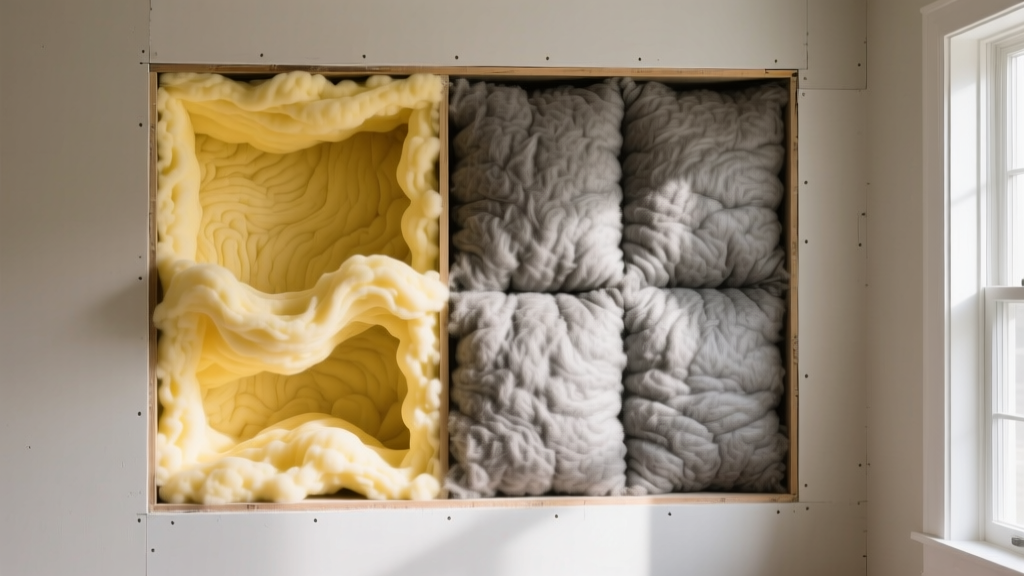
Closed-cell foam achieves its high R-value (typically R-6.5 to R-7.0 per inch) through the gas trapped within its cellular structure. Historically, this relied on HFC blowing agents with high Global Warming Potential (GWP). Under recent AIM Act regulations, the industry has transitioned to Hydrofluoroolefin (HFO) blowing agents, such as Honeywell Solstice. Products like Demilec Heatlok XT or Icynene ProSeal Eco now boast a GWP of less than 2, virtually eliminating the climate penalty of the blowing agent while maintaining structural rigidity and moisture resistance.
Application Limits and Failure Modes
ccSPF is applied as a liquid that expands to 30 times its volume. Because the chemical reaction is highly exothermic, installers must adhere to strict maximum pass thicknesses—usually 2 to 3 inches per lift. Applying a 6-inch layer in a single pass can cause the core temperature to exceed 400°F, leading to thermal degradation, charring, and severe off-gassing. Furthermore, if the ambient substrate temperature drops below 60°F during application, the foam can suffer from poor adhesion and cellular shrinkage, creating hidden gaps that compromise the air barrier.
Spray foam installation releases volatile organic compounds (VOCs) and airborne isocyanates. The EPA mandates strict respiratory protection for installers. Building occupants must vacate the premises during application and remain out for a minimum of 24 to 48 hours post-installation to allow for complete curing and off-gassing.
Deep Dive: Mineral Wool (Stone Wool) Batts
Fire, Moisture, and Acoustic Superiority
Mineral wool is manufactured by spinning molten basalt rock and recycled steel slag into dense fibers. This process yields an insulating material that is inherently non-combustible, withstanding temperatures up to 2,150°F without melting or releasing toxic smoke (passing ASTM E136). Unlike foam, mineral wool is hydrophobic; it repels liquid water but remains highly vapor-permeable. This allows walls to dry to the exterior, significantly reducing the risk of trapped moisture and mold growth in mixed-humid climates. Acoustically, the dense, randomized fiber matrix traps sound waves, making products like Rockwool Safe'n'Sound the gold standard for interior party walls, achieving STC ratings of 52 or higher in standard 2x4 framing.
Installation Realities and Friction Fit
Mineral wool batts are manufactured slightly wider than standard stud cavities to ensure a friction fit. When properly installed, they eliminate the convective loops that plague poorly fitted fiberglass. However, the material is dense and abrasive. Cutting it requires a specialized serrated insulation knife or a bread knife; standard utility blades will dull almost instantly and result in jagged, compressed edges that compromise the thermal envelope.
When routing mineral wool around electrical boxes, do not compress the batt behind the box. Instead, split the batt horizontally, slide the back half behind the box, and tuck the front half around it. Compressing the material reduces its R-value locally and puts stress on the drywall.
Cost Analysis: Achieving an R-20 Wall Assembly
When budgeting, contractors must look beyond the raw material cost and factor in labor, air sealing requirements, and drywall finishing. Below is a 2026 cost breakdown for achieving an R-20 cavity insulation in a standard 2x6 framed wall (per square foot of wall area):
- 3 inches of 2lb ccSPF: $4.50 – $6.00 per sq. ft. (Includes material, professional installation, and integrated air/vapor barrier. No additional housewrap tape or caulking required for the insulated zone).
- 5.5 inches of Mineral Wool (e.g., Rockwool Comfortbatt): $1.80 – $2.40 per sq. ft. (Includes material and standard labor. Requires an additional $0.40/sq. ft. for meticulous interior air sealing via the Airtight Drywall Approach or interior membrane, as mineral wool is air-permeable).
While ccSPF carries a 200% to 300% premium over mineral wool, it consolidates the insulation, air barrier, and vapor retarder into a single trade application, which can accelerate the critical path on complex commercial or custom residential builds.
Environmental and Lifecycle Considerations
The environmental impact of your chosen insulating material extends beyond operational energy savings. According to the U.S. Department of Energy, while spray foam offers superior operational efficiency due to its air-sealing properties, its upfront embodied carbon is significantly higher due to petroleum extraction and chemical processing. Mineral wool, as highlighted by the North American Insulation Manufacturers Association (NAIMA), utilizes up to 70% recycled post-industrial slag. However, the rock-melting process is highly energy-intensive. For projects targeting LEED v4.1 or Living Building Challenge certification, mineral wool generally yields a more favorable Environmental Product Declaration (EPD) regarding upfront carbon emissions.
Decision Framework: Which Insulating Material Fits Your Project?
Do not default to a single material for the entire structure. High-performance builders utilize a zone-specific approach:
- Unvented Cathedral Ceilings & Rooflines: Choose ccSPF. The high R-value per inch maximizes headroom, while the impermeable nature prevents warm, moist interior air from reaching the cold roof sheathing, eliminating condensation risks without requiring a ventilation channel.
- Basement Rim Joists: Choose ccSPF. Rim joists are notoriously difficult to air-seal with rigid cuts of batt insulation. A 2-inch flash of spray foam perfectly seals the irregular gaps between the foundation and the floor framing.
- Exterior Walls in Mixed-Humid Climates: Choose Mineral Wool. The vapor-open nature allows any incidental moisture that penetrates the exterior cladding to dry inward or outward, protecting the structural sheathing from rot.
- Interior Partition Walls & Home Theaters: Choose Mineral Wool. Spray foam is rigid and can actually transmit low-frequency vibrations (like bass from a subwoofer) through the framing. Mineral wool's dense, fibrous structure absorbs acoustic energy, drastically improving sound isolation.
Expert FAQs on Insulating Material Selection
Can I combine both materials in a single wall?
Yes, this is known as a "flash and batt" assembly. Installers apply a 1-inch to 1.5-inch "flash" layer of closed-cell foam against the exterior sheathing to act as an air and vapor control layer, then fill the remainder of the cavity with mineral wool. This hybrid approach lowers the overall cost compared to full-depth foam while providing the air-sealing benefits of spray foam and the acoustic and fire-resistant benefits of mineral wool.
How do building codes affect this choice?
The International Residential Code (IRC) requires spray foam to be separated from the living space by a 15-minute thermal barrier (typically 1/2-inch gypsum board). If you plan to leave spray foam exposed in an attic or crawlspace, you must specify a foam product that has been tested and approved with a specific intumescent paint coating to serve as an ignition barrier, which adds to the project cost. Mineral wool, being non-combustible, does not require these additional thermal or ignition barriers when left exposed in certain unconditioned spaces.
Written by
Sarah WhitfieldSarah Whitfield is a chartered quantity surveyor (MRICS) and construction cost analyst with 15 years of experience in material pricing, procurement strategy, and project budgeting. She earned her degree in Construction Management from the University of Reading (UK) and has worked on projects ranging from $2M custom homes to $180M mixed-use developments across North America and Europe. Sarah currently leads cost estimating for BuildMat Insight, maintaining a proprietary database of 4,000+ material price points updated quarterly. She is a frequent contributor to RSMeans cost data panels and has presented at the International Cost Engineering Council (ICEC) congress. Based in Denver, CO, Sarah is an avid trail runner and volunteer mentor for Women in Construction.
More from Sarah Whitfield
View all
Wood & Lumber
What Are the Different Types of Wood? A Builder's Guide
Compare structural softwoods, finish hardwoods, and engineered lumber. Analyze Janka ratings, MOE values, and 2026 pricing for construction.
Aug 4, 2026

Walls & Panels
Steel Framing vs Wood Framing: Corrosion and Moisture Defense
Compare steel framing vs wood framing for moisture resistance. Learn about galvanized coatings, condensation risks, and corrosion protection strategies.
Jul 21, 2026

Stone & Masonry
How to Cut Stone Veneer: Wet Saw vs Grinder Comparison
Compare the best tools for cutting stone veneer. We review wet saws, angle grinders, and chop saws to help you achieve clean, chip-free cuts.
Jul 21, 2026