Comparing Insulation Materials for Pipes: 2026 Guide
Compare top insulation materials for pipes in 2026. Analyze R-values, temp limits, and costs for fiberglass, elastomeric, and mineral wool.

Selecting the correct insulation materials for pipes dictates system efficiency, freeze protection, and condensation control. A mismatched material leads to Corrosion Under Insulation (CUI), melted jackets, or catastrophic heat loss. This guide provides a technical comparison of the primary pipe insulation categories available in 2026, detailing thermal resistance, temperature thresholds, material costs, and specific failure modes to inform your specification decisions.
Quick Comparison Matrix: Pipe Insulation Materials
| Material Type | Core Composition | Max Temp Limit | R-Value (per inch) | Avg Cost (per lin. ft.) | Vapor Barrier Required? |
|---|---|---|---|---|---|
| Elastomeric Rubber | Closed-cell NBR/EPDM | 220°F (104°C) | 4.2 | $2.50 - $4.00 | No (Inherent) |
| Fiberglass | Glass fibers + ASJ | 850°F (454°C) | 3.1 - 4.3 | $1.80 - $3.50 | Yes (ASJ Jacket) |
| Mineral Wool | Basalt/Slag rock fibers | 1200°F (649°C) | 3.8 - 4.0 | $3.50 - $6.00 | Yes (Metal Jacket) |
| Polyethylene Foam | Closed-cell PE foam | 200°F (93°C) | 3.6 | $0.60 - $1.20 | No (Inherent) |
Elastomeric Rubber: Best for Chilled Water & Condensation Control
Elastomeric rubber, dominated by products like Armacell’s ArmaFlex line, is the industry standard for below-ambient and cold-water piping. Its closed-cell structure inherently blocks moisture migration, eliminating the need for an external vapor barrier—a critical advantage in high-humidity environments where condensation drives corrosion.
Technical Specifications & Performance
- Thermal Conductivity: 0.24 BTU-in/hr·ft²·°F at 75°F.
- Water Vapor Permeability: ≤ 0.02 perm-in.
- Fire Rating: Typically ASTM E84 Class 1 (25/50 Flame/Smoke) for standard grades; zero-smoke halogen-free variants (like ArmaFlex Ultima) are required for mass transit and strict commercial codes.
Common Failure Modes
The primary vulnerability of elastomeric rubber is UV degradation. If installed outdoors without a protective coating (such as an acrylic elastomeric coating or metal cladding), the material will crack and chalk within 12 to 18 months. Additionally, applying this material to steam condensate lines that exceed 220°F will cause the cellular structure to melt and collapse, destroying its insulating value.
Fiberglass: The Standard for Hot Water & Low-Pressure Steam
Pre-formed fiberglass pipe insulation, such as Johns Manville Micro-Lok HP, remains the workhorse for commercial hot water heating and low-pressure steam systems. According to the North American Insulation Manufacturers Association (NAIMA), modern fiberglass formulations offer excellent dimensional stability and non-combustibility up to 850°F.
Technical Specifications & Performance
- Density Options: Standard (3.0 lbs/ft³) for hot water; High-Density (4.5+ lbs/ft³) for steam lines requiring higher compressive strength.
- Jacketing: Usually comes pre-wrapped in an All Service Jacket (ASJ), which is a kraft paper/scrim/foil laminate that acts as the vapor barrier.
Common Failure Modes
Fiberglass is highly susceptible to Corrosion Under Insulation (CUI) if the ASJ vapor barrier is compromised. When the foil jacket is punctured by foot traffic or mechanical impact, ambient moisture enters the open-cell fiberglass matrix. Because fiberglass holds water against the pipe surface, CUI initiates rapidly. Furthermore, longitudinal moisture migration can occur if the insulation is not properly sealed at valves and flanges.
Mineral Wool: High-Temperature Steam & Industrial Processes
For high-pressure steam, thermal fluid lines, and exhaust systems, mineral wool (rock wool) is mandatory. Products like Rockwool ProRox pipe sections are engineered from basalt rock, providing structural integrity and fire resistance at temperatures up to 1200°F. Unlike fiberglass, mineral wool does not use organic binders that can burn off at high temperatures, which prevents the material from slumping or losing thickness over time.
Technical Specifications & Performance
- Compressive Strength: High resistance to deformation under metal jacketing.
- Hydrophobic Treatment: Modern mineral wool is manufactured with water-repellent oils, meaning it will shed liquid water if the outer jacket is breached, though it still requires a vapor barrier for below-ambient applications.
Common Failure Modes
The main installation error with mineral wool is improper jacketing. Because mineral wool is rigid and brittle, it requires an outer metal jacket (aluminum or stainless steel) for mechanical protection. If the metal jacket seams are not properly lapped and sealed with weatherproof mastic, wind-driven rain will wash out the hydrophobic oils, leading to waterlogged insulation and severe pipe corrosion.
Polyethylene Foam: The Budget DIY Option
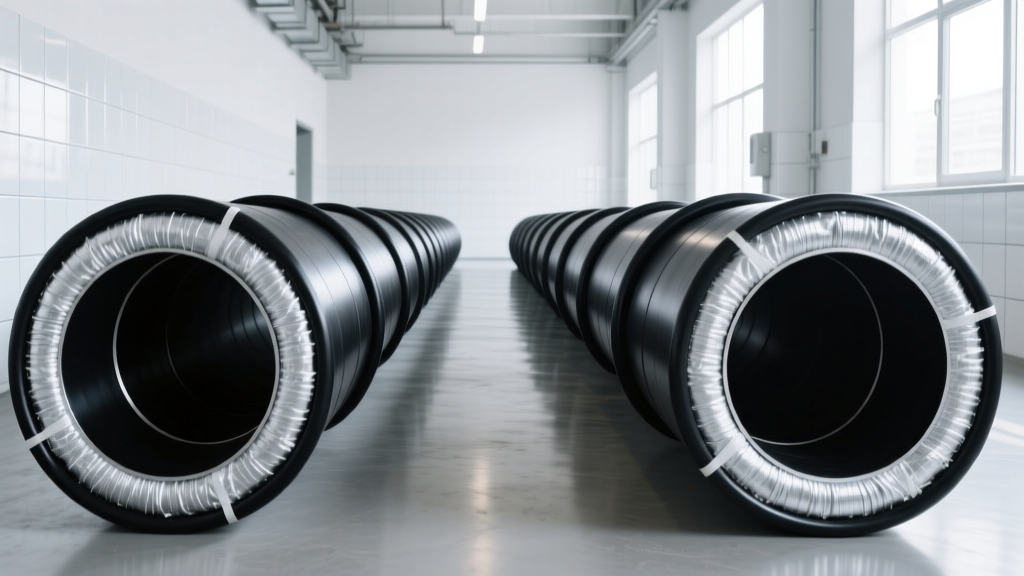
Polyethylene (PE) foam, recognizable by its rigid, snap-together slit tubes (often branded as Tubolit or similar generic equivalents), is widely available at retail hardware stores. While it offers a decent R-3.6 per inch and is completely waterproof, its structural limitations restrict its use in professional commercial applications.
Limitations & Edge Cases
PE foam softens and deforms at temperatures above 180°F to 200°F, making it entirely unsuitable for commercial boiler loops or steam lines. Additionally, PE foam exhibits thermal shrinkage. Over a 3-to-5-year period, the tubes can shrink longitudinally by up to an inch, exposing the bare pipe at the joints and creating localized condensation points. It is strictly recommended for domestic cold water, residential hot water (under 140°F), and temporary freeze protection.
Practical Decision Framework: Which Material to Specify?
Specification Flowchart
- IF piping carries chilled water or refrigerant (Below Ambient) → Specify Elastomeric Rubber. Ensure all longitudinal seams are glued with cyanoacrylate-based contact adhesive, not just taped.
- IF piping carries domestic hot water or hydronic heating (140°F - 250°F) → Specify Fiberglass with ASJ. Use 1.5-inch to 2-inch thickness to meet ASHRAE 90.1 energy compliance.
- IF piping carries low/high-pressure steam (250°F - 850°F) → Specify High-Density Fiberglass or Calcium Silicate with metal jacketing.
- IF piping carries superheated steam or thermal fluids (850°F+) → Specify Mineral Wool with stainless steel cladding.
- IF piping is exposed to direct sunlight outdoors → Never leave elastomeric or PE foam bare. Apply an acrylic UV coating, PVC jacket, or aluminum cladding.
Critical Installation Protocols & Failure Prevention
Even the highest-grade insulation materials for pipes will fail if installation protocols are ignored. The U.S. Department of Energy notes that improper sealing and vapor damming account for the vast majority of insulation-related energy losses and pipe degradation.
1. The Necessity of Vapor Dams
When using fibrous insulation (fiberglass or mineral wool) on cold or chilled water lines, you must install vapor dams at every valve, flange, and termination point. A vapor dam is a plug of closed-cell elastomeric foam or a thick application of vapor-barrier mastic applied between the pipe and the insulation. This prevents moisture from traveling longitudinally through the fibrous core. Without vapor dams, a single puncture in the outer jacket will allow moisture to migrate dozens of feet down the pipe run, causing widespread CUI.
2. Adhesive vs. Tape for Elastomeric Seams
For elastomeric rubber, rely on chemical bonding, not mechanical tape. While self-seal lap tapes are convenient for quick fixes, the permanent specification requires applying a thin layer of specialized contact adhesive (e.g., ArmaFlex 520) to both mating surfaces, allowing it to become tacky, and pressing them together. This creates a monolithic, welded seam that will not peel under thermal expansion and contraction cycles.
3. Managing Thermal Expansion
Pipes expand and contract significantly with temperature fluctuations. If insulation is installed tightly against rigid structural hangers or penetrations, the pipe's movement will tear the insulation jacket. Always specify and install insulated pipe hangers (which feature an integral high-density foam insert and metal shield) rather than resting the insulated pipe directly on a bare metal strut. For long runs, leave a 1-inch expansion gap at the insulation joints and seal it with a flexible elastomeric sealant to accommodate pipe movement without breaking the vapor barrier.
Written by
James ThorntonJames Thornton is a construction industry veteran with 25 years of hands-on experience in wood framing, lumber grading, and residential building codes. He started as a framing carpenter in rural Oregon, earned his ICC Residential Building Inspector certification, and eventually became a senior plan reviewer for the City of Portland Bureau of Development Services. James holds a B.S. in Wood Science & Technology from Oregon State University and is a certified lumber grader through the West Coast Lumber Inspection Bureau (WCLIB). He has inspected over 3,000 residential construction sites and authored the city's internal guide on advanced framing techniques (2x6 at 24" O.C.). James lives in Bend, OR, where he builds custom timber-frame cabins and competes in lumberjack sports.
More from James Thornton
View all
Insulation
Best Home Insulation Materials: Complete 2026 Guide
Compare top home insulation materials for 2026. Find R-values, installed costs per square foot, and best uses for fiberglass, spray foam, and mineral wool.
Aug 4, 2026

Sustainable Building
Certify Your Green Building Material for LEED and WELL
Step-by-step guide to certifying a green building material for LEED v5 and WELL v2. Master EPDs, HPDs, and VOC limits for 2026 project specifications.
Aug 4, 2026

Stone & Masonry
Veneer Stacked Stone Panels: Interior Design & Style Showcase
Discover how veneer stacked stone panels transform interiors. Explore modern design profiles, material pairings, and technical installation specs.
Aug 4, 2026