Choosing the Right Pipe Insulation Materials for Plumbing and HVAC
Compare pipe insulation materials like elastomeric rubber, fiberglass, and polyethylene. Expert guide on R-values, condensation control, and HVAC codes.

The Physics of Pipe Thermal Management
Uninsulated mechanical pipes lose up to 70% of their thermal energy to ambient air, while uninsulated chilled water lines accumulate condensation that destroys building interiors. Selecting the correct pipe insulation materials requires matching the thermal profile of the fluid, the ambient environmental conditions, and the strict fire code requirements of the plenum or mechanical room. A mismatch in material selection doesn't just waste energy; it leads to Corrosion Under Insulation (CUI), mold proliferation, and catastrophic system failures.
A common and costly error in commercial construction is specifying hot-water insulation (like standard unfaced fiberglass) for chilled water or refrigerant lines. Open-cell materials allow ambient moisture to migrate through the insulation, condense on the cold pipe surface, and saturate the matrix, completely destroying the R-value and accelerating pipe corrosion.
Core Pipe Insulation Materials Breakdown
The market is dominated by four primary material categories, each engineered for specific temperature bands and moisture environments. Understanding their cellular structure is the first step in proper specification.
1. Elastomeric Rubber (Closed-Cell)
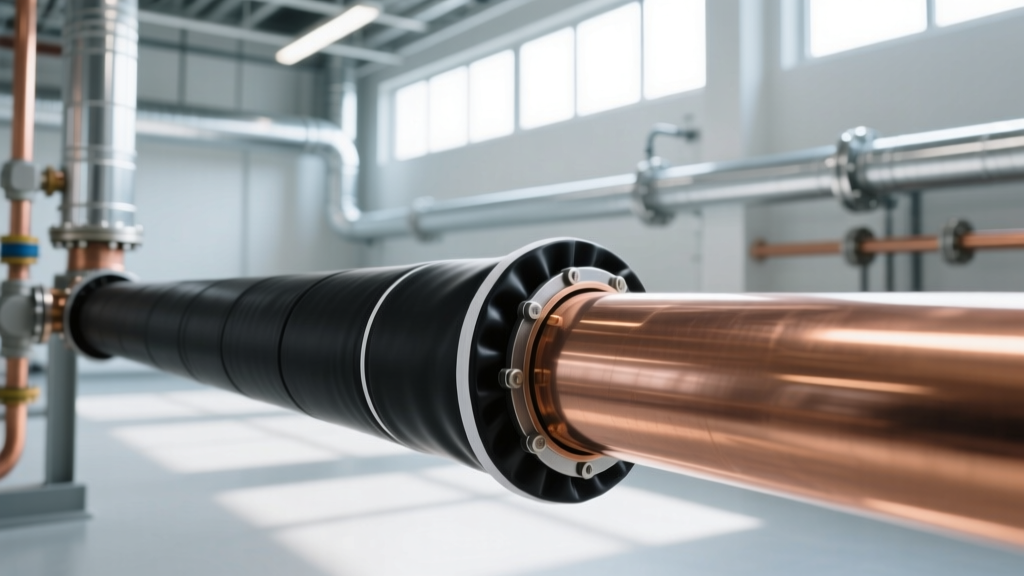
Products like Armacell ArmaFlex and Rubatex represent the industry standard for below-ambient applications. The closed-cell structure acts as a built-in vapor retarder, preventing moisture migration without the need for an external jacket. It is highly flexible, making it ideal for complex valve assemblies and tight mechanical room chases.
- Maximum Temperature: 220°F (104°C)
- Thermal Resistance: R-4.4 per inch at 75°F mean temperature
- Best Application: Chilled water, VRF refrigerant lines, cold domestic water
2. Polyethylene Foam (Closed-Cell)
Often recognized by brand names like Tubolit or Aerocell, polyethylene is a cost-effective, closed-cell alternative to elastomeric rubber. While it provides excellent moisture resistance, it has a lower maximum temperature threshold and is highly susceptible to UV degradation if exposed to direct sunlight outdoors without a protective mastic or PVC jacket.
- Maximum Temperature: 200°F (93°C)
- Thermal Resistance: R-3.8 per inch
- Best Application: Residential hot/cold plumbing, light commercial HVAC
3. Fiberglass Pre-Formed (Open-Cell)
Pre-formed fiberglass, such as Johns Manville Micro-Lok HP, is the workhorse for high-temperature commercial heating systems. Because it is an open-cell, fibrous material, it must be paired with an All Service Jacket (ASJ)—a multi-layer laminate of kraft paper, fiberglass scrim, and aluminum foil—when used on cold pipes to serve as a vapor barrier.
- Maximum Temperature: 850°F (454°C)
- Thermal Resistance: R-4.0 per inch
- Best Application: Hot water heating, low-pressure steam, heat tracing
4. Mineral Wool (Fibrous/High-Density)
For extreme heat and firestopping, mineral wool (e.g., Rockwool ProRox) is unmatched. It is non-combustible, maintains its structural integrity at extreme temperatures, and provides superior acoustic dampening for high-velocity steam lines. It requires an external metal or PVC jacket for mechanical protection and moisture management.
- Maximum Temperature: 1200°F (650°C)
- Thermal Resistance: R-3.9 per inch
- Best Application: High-pressure steam, industrial process piping, fire-rated penetrations
Material Selection Matrix & Cost Data
The following matrix provides a direct comparison of 2026 market averages for standard 1-inch thick pre-formed pipe insulation on 1.5-inch nominal copper or steel pipe.
| Material | Cell Structure | Max Temp | Vapor Retarder | Cost / Lin. Ft. |
|---|---|---|---|---|
| Elastomeric Rubber | Closed-Cell | 220°F | Built-in | $2.10 - $3.50 |
| Polyethylene Foam | Closed-Cell | 200°F | Built-in | $0.60 - $1.20 |
| Fiberglass (ASJ) | Open-Cell | 850°F | ASJ Jacket | $1.50 - $2.80 |
| Mineral Wool | Fibrous | 1200°F | Metal Jacket | $3.20 - $5.50 |
Sizing, Thickness, and Condensation Control
Thickness selection is not arbitrary; it is governed by dew point calculations. If a chilled water pipe operates at 45°F in a mechanical room maintained at 75°F and 50% relative humidity, the dew point is approximately 55°F. The outer surface of the insulation must remain above 55°F to prevent sweating.
According to guidelines published by the U.S. Department of Energy, minimum thickness requirements scale with pipe diameter and temperature differential. For below-ambient lines, relying on a single half-inch layer of elastomeric rubber is a frequent cause of condensation drip. Mechanical engineers typically specify:
- 1/2-inch thickness: Hot water heating lines (up to 250°F) to prevent heat loss and burns.
- 1-inch thickness: Cold domestic water and standard chilled water (45°F - 55°F) in low-humidity environments.
- 1.5-inch to 2-inch thickness: Low-temperature refrigerant lines or chilled water in high-humidity environments (e.g., coastal regions or indoor pools).
Installation Edge Cases & Failure Modes
Even premium pipe insulation materials will fail if installation ignores physical compression and environmental exposure. Address these three critical edge cases during the submittal and installation phases:
1. Compression at Pipe Hangers
When a standard pipe hanger rests directly on fiberglass or elastomeric insulation, the weight of the water-filled pipe compresses the material. A 1-inch layer of insulation compressed to 1/4-inch loses over 60% of its R-value and creates a thermal bridge that will sweat profusely. Solution: Specify high-density rigid insulation inserts (such as Foamglas or rigid phenolic blocks) at all hanger locations, sized to match the outer diameter of the insulated pipe, allowing the hanger to support the load without crushing the primary insulation.
2. Open Seams on Chilled Water Lines
Elastomeric rubber must be glued at every longitudinal seam and butt joint using specialized contact adhesives (e.g., Armacell 520 adhesive). Relying solely on self-seal tape or leaving micro-gaps at valve fittings allows ambient moisture to bypass the vapor barrier. Once inside, the moisture becomes trapped, leading to CUI on carbon steel pipes and mold growth on the exterior jacket.
3. UV and Physical Degradation Outdoors
Neither polyethylene nor elastomeric rubber is UV-stable. If routed on a rooftop or exterior wall, the material will chalk, crack, and disintegrate within 18 months of direct sun exposure. Outdoor runs must be coated with a UV-resistant elastomeric mastic (like WB-40) or wrapped in a 20-mil PVC jacketing with overlapping seams sealed with aluminum foil tape.
Code Compliance & Fire Ratings
In commercial construction, pipe insulation materials routed through return air plenums or occupied spaces must meet strict surface burning characteristics. The North American Insulation Manufacturers Association (NAIMA) emphasizes that all insulation specified for plenums must be tested to ASTM E84 (Standard Test Method for Surface Burning Characteristics of Building Materials).
To be code-compliant in most jurisdictions under the International Mechanical Code (IMC), the material must achieve a 25/50 rating (Flame Spread Index of 25 or less, and Smoke Developed Index of 50 or less). Standard elastomeric rubber and ASJ-faced fiberglass typically meet this requirement natively. However, if you are applying aftermarket mastics, sealants, or PVC jacketing, you must verify that the entire composite assembly maintains the 25/50 rating, as some solvent-based adhesives can drastically increase the smoke developed index during a fire event.
- Verify fluid operating temperature against material maximums (add a 20°F safety factor).
- Calculate dew point to determine minimum thickness for below-ambient lines.
- Mandate rigid inserts at all pipe hangers to prevent compression.
- Confirm ASTM E84 25/50 ratings for any materials installed in air plenums.
Written by
Elena RodriguezElena Rodriguez is a civil engineer and technical writer specializing in concrete technology, masonry systems, and ASTM/ACI compliance. She earned her B.S. in Civil Engineering from Texas A&M University and spent a decade at a materials testing laboratory, performing over 2,000 concrete compressive strength tests and masonry prism evaluations. Elena is an ACI-certified Field Testing Technician (Grade I) and a member of ASTM Committee C12 on Natural Building Stone. She currently consults on forensic engineering cases involving concrete failures and moisture intrusion. Based in San Antonio, TX, Elena is a proud member of the Society of Women Engineers (SWE) and coaches her daughter's FIRST Robotics team.
More from Elena Rodriguez
View all
Walls & Panels
Cost Analysis: Light Gauge Steel Framing Advantages and Disadvantages
Evaluate light gauge steel framing advantages and disadvantages through a strict cost analysis lens, comparing material, labor, and lifecycle expenses.
Aug 4, 2026

Walls & Panels
Gypsum Board Types: Exact Specifications, Thickness & Dimensions
Compare standard, Type X, and moisture-resistant gypsum board types. Get exact specifications, thicknesses, dimensions, and ASTM standards for your project.
Aug 4, 2026

Fire Resistance
Best Fire-Resistant Outdoor Decking Materials: 2026 Buyer Guide
Discover the best fire-resistant outdoor decking materials for 2026. Compare Class A PVC, aluminum, and hardwood options for WUI compliance and safety.
Aug 4, 2026