Wall Acoustic Insulation Materials That Maximize Energy Efficiency
Discover the best wall acoustic insulation materials that deliver high STC ratings and superior R-values. Compare mineral wool, cellulose, and hybrid systems.

The Dual-Performance Dilemma: STC vs. R-Value
When designing a high-performance building envelope or upgrading an interior partition, architects and homeowners often face a conflicting set of physics. Thermal resistance (R-value) relies on trapping pockets of still air to slow conductive heat flow. Acoustic attenuation, measured by Sound Transmission Class (STC), requires mass, density, and mechanical decoupling to block airborne and impact noise. Standard fiberglass batts excel at the former but fail at the latter, while heavy acoustic barriers like Mass Loaded Vinyl (MLV) offer zero thermal resistance.
To achieve both an energy-efficient envelope and a quiet interior, you must select wall acoustic insulation materials that bridge this gap. This guide breaks down the exact material specifications, densities, and hybrid assembly techniques required to hit STC 50+ and R-20+ targets simultaneously in 2026 construction standards.
Top Wall Acoustic Insulation Materials for Thermal Efficiency
1. Mineral Wool Batts: The Density Sweet Spot
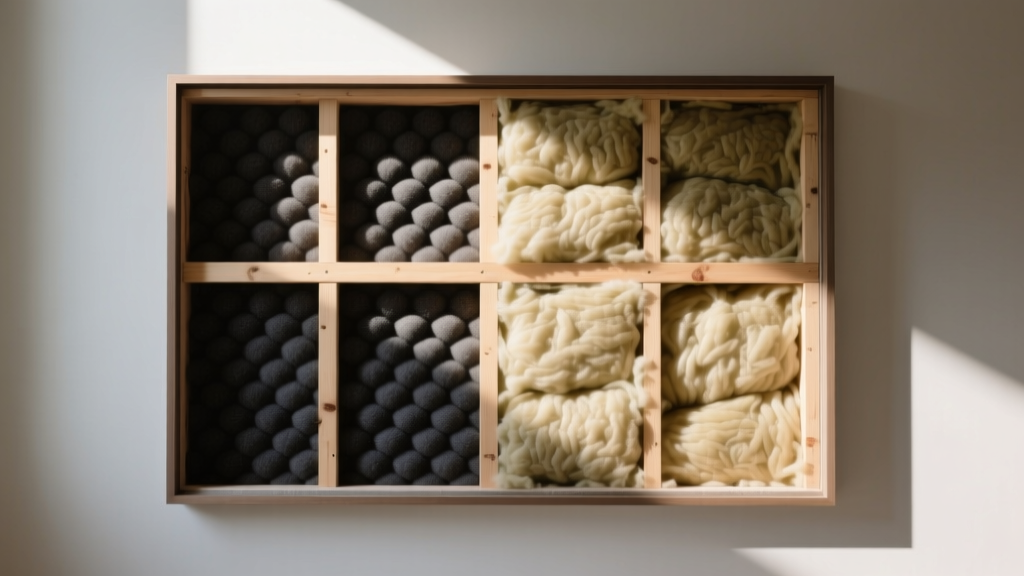
Mineral wool (specifically rock wool) is the undisputed leader in dual-purpose insulation. Unlike standard fiberglass, which has a density of roughly 0.5 to 1.0 lbs/cu ft, high-performance mineral wool batts range from 2.5 to 8.0 lbs/cu ft. This added mass significantly dampens mid-to-high frequency airborne noise while maintaining excellent thermal resistance.
Product Specifics: For exterior walls requiring both thermal and acoustic performance, use Rockwool Comfortbatt 80 (R-4.2 per inch, density ~8.0 lbs/cu ft). Avoid Rockwool Safe'n'Sound for exterior perimeter walls; while Safe'n'Sound is acoustically superior for interior partitions due to its specific fiber matrix, it lacks the formal R-value testing and moisture-facing options required by building codes for exterior thermal envelopes. According to the U.S. Department of Energy, mineral wool also provides inherent fire resistance, withstanding temperatures up to 1,800°F, which adds a critical safety layer to energy-efficient assemblies.
2. Dense-Pack Cellulose: The Cavity Filler
Blown-in cellulose is highly effective for acoustic damping because it completely eliminates the air gaps and voids that allow sound to flanking through wall cavities. To achieve acoustic performance, cellulose must be installed at a minimum density of 3.5 lbs/cu ft (dense-pack method). At this density, it achieves an R-value of approximately R-3.8 per inch and increases the STC of a standard 2x4 wall from 34 to over 44.
Edge Case Warning: Dense-pack cellulose is hygroscopic. In high-humidity climates or exterior walls without a properly calibrated vapor retarder, it can absorb moisture, leading to settling (which destroys both acoustic and thermal performance) and mold growth. Always pair dense-pack cellulose with a smart vapor retarder like CertainTeed MemBrain.
3. The Spray Foam Paradox: Open-Cell vs. Closed-Cell
Spray polyurethane foam (SPF) presents a paradox for acoustic insulation. Closed-cell foam (ccSPF) offers a massive R-6.5 per inch and exceptional air sealing, but its rigid, high-density structure (2.0 lbs/cu ft) actually transmits low-frequency structural vibrations, making it a poor acoustic isolator. Open-cell foam (ocSPF), with a density of 0.5 lbs/cu ft and R-3.6 per inch, is highly flexible and excellent at absorbing mid-frequency sound waves. However, its low R-value makes it inefficient as a standalone thermal barrier in space-constrained 2x4 walls.
Material Comparison Matrix: Dual-Purpose Performance
| Material | R-Value / Inch | Density (lbs/cu ft) | STC Boost (Standard 2x4) | Cost / Sq Ft (Installed) |
|---|---|---|---|---|
| Mineral Wool (Comfortbatt 80) | R-4.2 | 8.0 | +8 to +10 | $1.40 - $1.85 |
| Dense-Pack Cellulose | R-3.8 | 3.5 | +9 to +11 | $1.10 - $1.50 |
| Open-Cell Spray Foam | R-3.6 | 0.5 | +4 to +6 | $1.60 - $2.10 |
| Standard Fiberglass Batt | R-3.2 | 0.7 | +1 to +2 | $0.60 - $0.90 |
*STC boost represents the increase over an empty, uninsulated drywall-stud-drywall assembly (Base STC ~34). Data compiled from Insulation Institute manufacturer specifications.
Hybrid Wall Assemblies: Achieving STC 50+ and R-20+
Relying solely on the insulation material inside the cavity will rarely achieve luxury-grade acoustic isolation (STC 50+) while meeting modern energy codes. You must combine high-density insulation with structural decoupling. The most cost-effective hybrid assembly for 2026 involves the following layering technique:
- Air Sealing Base: Apply 1 inch of closed-cell spray foam directly against the exterior sheathing. This provides an R-6.5 thermal break, acts as a Class II vapor retarder, and locks out exterior wind washing.
- Acoustic Cavity Fill: Fill the remaining 4.5 inches of a 2x6 stud cavity with Rockwool Comfortbatt 80 (R-18.9). The mineral wool absorbs the internal acoustic reverberation that the rigid foam would otherwise reflect.
- Decoupling Mechanism: Install resilient channels (e.g., ClarkDietrich RC-1) horizontally across the studs before hanging the interior drywall. This breaks the mechanical path for structural vibration.
- Mass Layer: Finish with 5/8-inch Type X gypsum board attached to the resilient channels using acoustic sealant at all perimeter joints.
This hybrid assembly yields a total cavity R-value of R-25.4 and pushes the wall STC well past 52, effectively blocking loud speech and most exterior traffic noise while drastically reducing HVAC loads.
Many DIY soundproofing guides recommend stapling Mass Loaded Vinyl (1 lb/sq ft) directly to wall studs beneath drywall. From an energy efficiency perspective, this is a critical error. MLV is highly conductive and creates a massive thermal bridge through the wall cavity, effectively short-circuiting the R-value of your batt insulation. If MLV is required for extreme low-frequency blocking, it must be installed on the interior side of the drywall or decoupled via an independent stud wall, never embedded within the thermal cavity.
Installation Edge Cases and Failure Modes
Even the most expensive wall acoustic insulation materials will fail if installation ignores flanking paths and acoustic leaks. Sound behaves like water; it will exploit the smallest gap in your assembly. Address these specific failure modes during construction:
Electrical Box Sealing
Standard plastic electrical boxes cut into drywall destroy the acoustic integrity of a wall, dropping the STC by up to 10 points. Do not place electrical boxes back-to-back on opposite sides of a partition wall. Use acoustic putty pads (like Trademark Soundproofing Acoustic Putty Pads) wrapped around the exterior of every electrical box. For exterior walls, use foam-sealed, airtight electrical boxes to maintain the thermal envelope and prevent convective heat loss.
Top and Bottom Plate Flanking
The gap between the drywall and the subfloor, or the drywall and the top plate, allows noise to bypass the insulation entirely. Before installing baseboards or crown molding, inject a continuous bead of non-hardening acoustic sealant (such as OSI Pro-Series SC-175) into the joint between the drywall and the framing. This maintains flexibility, preventing the sealant from cracking as the building settles and expanding/contracting with seasonal temperature shifts.
Pipe and Duct Penetrations
Plumbing drains and HVAC trunks penetrating insulated walls transmit severe low-frequency impact noise. Wrap all PVC and cast-iron drain lines in 1-inch thick elastomeric pipe insulation (e.g., Armaflex) before closing the wall cavity. Where ductwork passes through a wall plate, use a 2-inch collar of mineral wool packed tightly around the duct, sealed with fire-rated acoustic mastic, to prevent both sound transmission and thermal leakage.
Cost Analysis and Energy Payback
Upgrading from standard R-13 fiberglass batts to a dual-purpose mineral wool or dense-pack cellulose system typically adds $0.60 to $1.10 per square foot of wall area to material costs. For a 2,500 sq ft home with approximately 2,800 sq ft of exterior wall area, the premium upgrade costs between $1,680 and $3,080.
However, the energy payback justifies the acoustic upgrade. The superior air-sealing properties of dense-pack cellulose and the higher R-value of mineral wool reduce annual heating and cooling loads by an estimated 12% to 18% compared to poorly installed fiberglass. In mixed-humid and cold climate zones, the thermal energy savings alone typically yield a return on investment within 4 to 6 years, meaning the acoustic benefits effectively become a free upgrade for the remaining lifespan of the structure.
Written by
James ThorntonJames Thornton is a construction industry veteran with 25 years of hands-on experience in wood framing, lumber grading, and residential building codes. He started as a framing carpenter in rural Oregon, earned his ICC Residential Building Inspector certification, and eventually became a senior plan reviewer for the City of Portland Bureau of Development Services. James holds a B.S. in Wood Science & Technology from Oregon State University and is a certified lumber grader through the West Coast Lumber Inspection Bureau (WCLIB). He has inspected over 3,000 residential construction sites and authored the city's internal guide on advanced framing techniques (2x6 at 24" O.C.). James lives in Bend, OR, where he builds custom timber-frame cabins and competes in lumberjack sports.
More from James Thornton
View all
Insulation
Best Home Insulation Materials: Complete 2026 Guide
Compare top home insulation materials for 2026. Find R-values, installed costs per square foot, and best uses for fiberglass, spray foam, and mineral wool.
Aug 4, 2026

Sustainable Building
Certify Your Green Building Material for LEED and WELL
Step-by-step guide to certifying a green building material for LEED v5 and WELL v2. Master EPDs, HPDs, and VOC limits for 2026 project specifications.
Aug 4, 2026

Stone & Masonry
Veneer Stacked Stone Panels: Interior Design & Style Showcase
Discover how veneer stacked stone panels transform interiors. Explore modern design profiles, material pairings, and technical installation specs.
Aug 4, 2026