Heat Insulating Material Compared: R-Value, Cost & Best Uses
Compare the best heat insulating material options. Analyze R-values, costs, and failure modes of fiberglass, spray foam, mineral wool, and polyiso.

The Physics of Heat Transfer and Insulation Performance
Selecting the right heat insulating material requires looking beyond the basic R-value printed on the packaging. While R-value measures resistance to conductive heat flow, real-world thermal performance is heavily dictated by air leakage, moisture accumulation, and thermal bridging. A material with a high laboratory R-value can underperform significantly in the field if it allows convective looping or if it is installed in a way that creates thermal bridges through wall studs.
According to the U.S. Department of Energy, the effective R-value of an insulation system is often 20% to 30% lower than its nominal rating due to framing factors and installation defects. Therefore, evaluating a heat insulating material means analyzing its density, vapor permeability, air-sealing capabilities, and long-term thermal drift.
Head-to-Head Matrix: Top Heat Insulating Material Options
The following comparison matrix breaks down the four primary categories of thermal insulation used in modern residential and commercial construction. Data reflects standard 2x4 and 2x6 framing applications and continuous exterior installations.
| Material Type | Nominal R-Value / Inch | Air Sealing | Vapor Permeability | Fire Rating | Approx. Material Cost (per sq ft) |
|---|---|---|---|---|---|
| Fiberglass Batts | R-3.1 to R-4.3 | Poor (Requires separate air barrier) | High (Vapor open) | Non-combustible | $0.45 - $0.85 |
| Closed-Cell Spray Foam (ccSPF) | R-6.0 to R-7.0 | Excellent (Monolithic seal) | Low (Class II vapor retarder) | Self-extinguishing | $1.60 - $2.80 (per board ft) |
| Mineral Wool Batts | R-4.2 to R-4.3 | Good (Dense friction fit) | High (Vapor open) | Fireproof (up to 2150°F) | $0.95 - $1.45 |
| Polyisocyanurate (Polyiso) | R-5.6 to R-6.5 (at 75°F) | Excellent (Taped seams) | Very Low (Foil-faced) | Thermoset (Charring) | $0.75 - $1.25 (per board ft) |
Deep-Dive Analysis: Strengths, Weaknesses, and Failure Modes
Fiberglass Batts (The Budget Baseline)
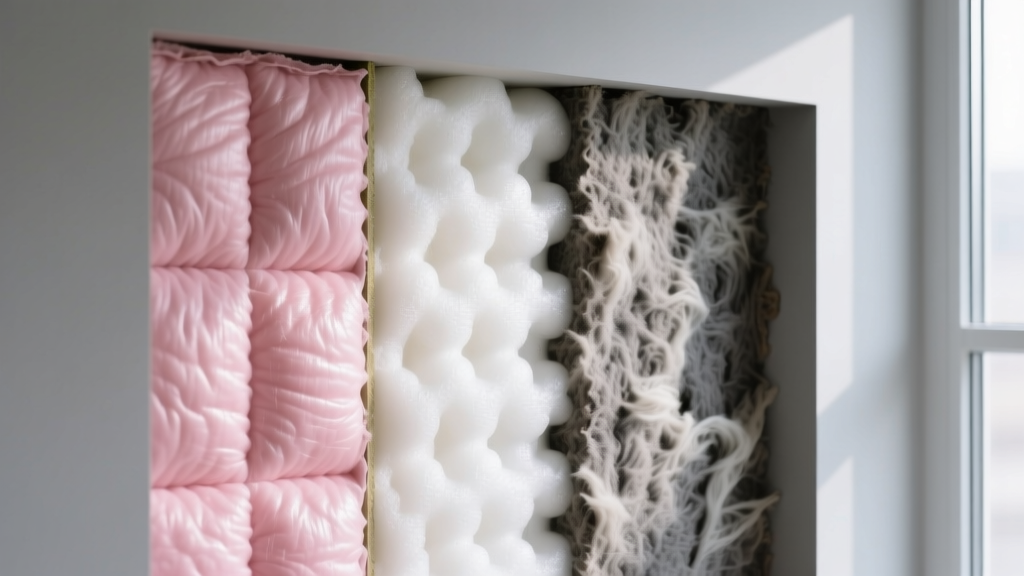
Fiberglass remains the most widely installed heat insulating material in North America. Modern products, such as Owens Corning EcoTouch, utilize acrylic binders that eliminate the formaldehyde off-gassing associated with older iterations. However, fiberglass is fundamentally a filter, not an air barrier.
- Pros: Lowest upfront material cost, non-combustible, highly accessible, DIY-friendly.
- Cons: Susceptible to convective heat loss if not paired with a meticulous air barrier, loses R-value when compressed.
- Common Failure Mode: 'Stuffing' batts into narrow cavities. Compressing an R-19 batt into a 2x4 wall cavity does not yield R-19; it drops the effective R-value to roughly R-14 while increasing material density, which paradoxically increases conductive heat transfer through the glass fibers themselves.
Closed-Cell Spray Foam (The Air & Vapor Sealer)
Closed-cell spray polyurethane foam (ccSPF) is a premium heat insulating material that simultaneously acts as a structural adhesive, air barrier, and vapor retarder. Modern formulations like Demilec Heatlok XT 2.0 use HFO (hydrofluoroolefin) blowing agents, which have a near-zero Global Warming Potential (GWP) compared to older HFC-based foams.
- Pros: Highest R-value per inch, eliminates convective looping, adds racking strength to wall assemblies, rejects bulk water.
- Cons: High cost, requires certified professional installation, makes future wiring or plumbing retrofits difficult.
- Common Failure Mode: Off-ratio mixing during application. If the ambient temperature or equipment calibration is off, the foam can remain tacky, shrink away from the studs, or emit persistent volatile organic compounds (VOCs). Furthermore, ccSPF can mask roof leaks, allowing wood sheathing to rot unnoticed behind the foam.
Mineral Wool (The Fire & Sound Resistor)
Mineral wool (often referred to as rock wool or slag wool) is engineered from spun basalt rock and steel slag. Products like ROCKWOOL Comfortbatt offer a dense, rigid batt that excels in both thermal and acoustic applications. The North American Insulation Manufacturers Association (NAIMA) highlights its superior dimensional stability compared to fiberglass.
- Pros: Hydrophobic (drains water while maintaining R-value), fireproof up to 2,150°F, excellent sound attenuation (STC ratings), friction-fits tightly into cavities.
- Cons: Heavier and harder to cut than fiberglass, higher material cost, requires a utility knife or specialized serrated blade.
- Common Failure Mode: Moisture trapping in cold climates. Because mineral wool is highly vapor-permeable, if it is installed on the exterior side of a foam sheathing without proper drying potential, or if an interior vapor barrier is incorrectly placed, moisture can condense within the batt and freeze against the cold exterior sheathing.
Polyisocyanurate Rigid Foam (The Continuous Exterior Shield)
Polyiso is a closed-cell, rigid foam board typically faced with aluminum foil. It is the premier choice for continuous exterior insulation (ci) to break thermal bridging through wood or steel studs. Rmax Thermasheath 3 is a common industry standard for roof and wall applications.
- Pros: High R-value per inch, foil facing acts as a radiant barrier and exterior vapor retarder, lightweight and easy to score.
- Cons: Subject to thermal drift, joints must be meticulously taped to prevent air infiltration.
- Common Failure Mode: Thermal drift in extreme cold. Polyiso relies on low-conductivity blowing gases trapped in its cells. As Building Science Corporation notes, the R-value of polyiso actually decreases as the outdoor temperature drops below 50°F, meaning a board rated at R-6.5 per inch at 75°F may perform closer to R-5.0 per inch during a freezing winter night.
Scenario-Based Decision Framework
Rather than searching for a single 'best' heat insulating material, match the material to the specific architectural and climatic demands of your project.
Scenario 1: Unvented Cathedral Ceiling in a Hot-Humid Climate
Recommendation: Closed-Cell Spray Foam (ccSPF).
Why: In hot-humid zones (like Florida or Texas), interior moisture-laden air will condense on the back of cold roof sheathing if it reaches the dew point. ccSPF applied directly to the underside of the roof deck raises the temperature of the interior surface above the dew point while acting as a Class II vapor retarder, preventing condensation and subsequent mold growth.
Scenario 2: Retrofitting an Uninsulated 1920s Plaster-and-Lath Home
Recommendation: Dense-Pack Cellulose or Mineral Wool.
Why: Older homes lack modern weather-resistive barriers and rely on 'breathability' to dry out. Closed-cell foam will trap moisture against the old wooden lath, causing rot. Dense-pack cellulose or blown-in mineral wool fills irregular cavities, blocks convective drafts, and remains vapor-open, allowing the historic wall assembly to dry to the interior or exterior as seasons change.
Scenario 3: New Construction 2x6 Walls in Climate Zone 6 (Cold)
Recommendation: Mineral Wool Batts (Cavity) + Polyiso (Exterior Continuous).
Why: This 'flash-and-batt' or hybrid approach utilizes mineral wool for its fire resistance, soundproofing, and high R-value in the cavity, while a 1.5-inch layer of exterior Polyiso (R-9) breaks the thermal bridge of the wood studs and keeps the interior sheathing warm enough to prevent interstitial condensation.
2026 Cost Realities and Installation Variables
When budgeting for a heat insulating material, material costs only tell half the story. Labor, specialized equipment, and finishing requirements drastically alter the final price per square foot of insulated surface area.
- Fiberglass: Material is cheap ($0.45-$0.85/sq ft), but achieving code-mandated airtightness requires additional costs for membranes, acoustic sealant, and meticulous drywall sealing. Total installed cost: $1.50 - $2.50 per sq ft.
- Mineral Wool: Material is moderate ($0.95-$1.45/sq ft). It cuts slower than fiberglass, slightly increasing labor time for large crews. Total installed cost: $2.20 - $3.50 per sq ft.
- Polyiso Rigid Board: Material costs $0.75-$1.25 per board foot. Installation requires cap nails, specialized tape (e.g., Zip System or 3M All Weather), and furring strips if used as exterior continuous insulation to provide a nailing base for siding. Total installed cost: $3.00 - $5.00 per sq ft (factoring in furring and fasteners).
- Closed-Cell Spray Foam: Priced by the board foot (volume, not area). A 3-inch application (R-18 to R-21) costs between $4.80 and $8.40 per sq ft installed. However, this price includes the air barrier and vapor retarder, eliminating the need to purchase and install separate housewraps or interior poly sheeting.
Ultimately, the most effective heat insulating material is the one that aligns with your specific climate zone, framing geometry, and moisture-control strategy. Prioritize air-sealing and continuous thermal barriers over simply chasing the highest nominal R-value in the cavity.
Written by
David NakamuraDavid Nakamura is a licensed architect (AIA) and construction technology writer focused on sustainable building methods, mass timber engineering, and high-performance building envelopes. He holds a Master of Architecture from the University of Washington and is a certified Passive House Consultant (CPHC). David spent eight years at the Seattle firm Mithun, where he led the design of three LEED Platinum projects, before founding his own practice specializing in net-zero residential design. He serves on the editorial advisory board of GreenBuilder Magazine and has authored peer-reviewed papers on cross-laminated timber (CLT) connections for the Journal of Structural Engineering. In his spare time, David teaches woodworking at Pratt Fine Arts Center and kayaks the Puget Sound.
More from David Nakamura
View all
Construction Cost
Labor Cost to Build a Deck Per Sq Ft: 2026 Installation Guide
Discover the exact labor cost to build a deck per sq ft in 2026. This installation guide breaks down contractor rates, complexity factors, and hidden fees.
Aug 4, 2026

Construction Cost
How Much Does It Cost to Build a 3 Bedroom House? Financing Guide
Learn exactly how much it costs to build a 3 bedroom house and explore 2026 financing options, construction loan types, and budget frameworks for your build.
Aug 4, 2026

Construction Cost
Cost to Build a Tennis Court: 2026 Guide
How much does it cost to build a tennis court in 2026? Breakdowns for asphalt, concrete, and synthetic surfaces plus fencing and lighting.
Jul 30, 2026