R-Value Performance Guide: Comparing Types of Insulation Material
Compare R-value performance across common types of insulation material. Expert data on spray foam, mineral wool, and rigid boards for real-world building.
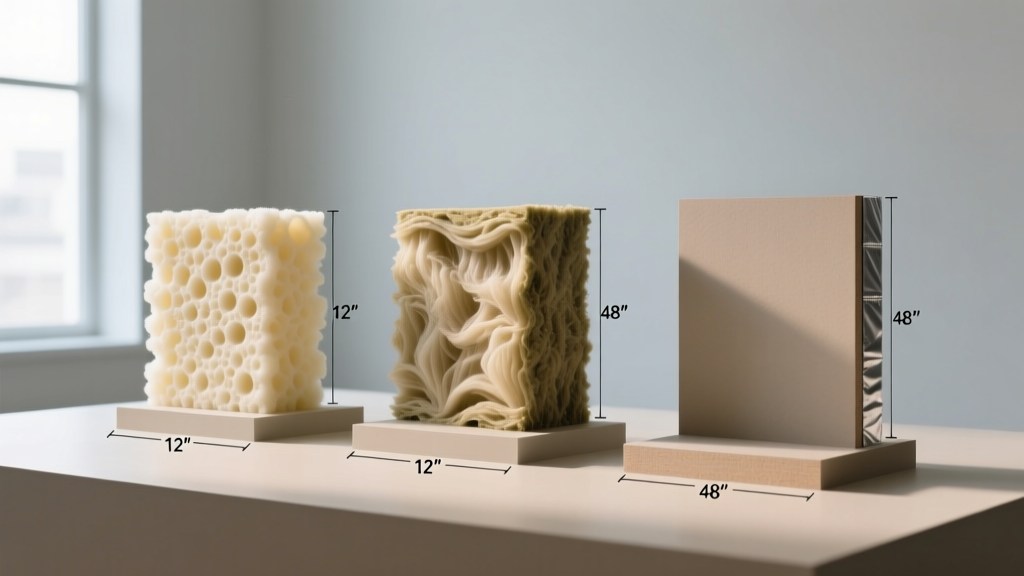
The Physics of Thermal Resistance: Why Lab R-Value Isn't Everything
When evaluating different types of insulation material, building professionals often default to the manufacturer's stated R-value. However, the Federal Trade Commission's R-Value Rule (16 CFR Part 460) mandates that R-values be tested at a mean temperature of 75°F (24°C). In real-world applications, wall cavities and roof assemblies experience extreme temperature differentials that drastically alter thermal performance.
Thermal resistance is not a static property. It is influenced by thermal bridging through framing members, air infiltration, moisture accumulation, and thermal drift. According to the U.S. Department of Energy, a wall assembly's effective R-value can be 15% to 20% lower than the cavity insulation's nominal R-value due to the conductive nature of wood or steel studs. Therefore, selecting the right material requires analyzing its performance under dynamic environmental stressors, not just its baseline laboratory rating.
Comprehensive R-Value Matrix: Insulation Types Compared
The following matrix breaks down the nominal R-value, installed cost expectations for 2026, and critical performance characteristics for the primary insulation categories used in residential and commercial construction.
| Material Type | R-Value per Inch | Avg. Installed Cost (per sq. ft.) | Air Sealing Capability | Moisture & Vapor Profile |
|---|---|---|---|---|
| Closed-Cell SPF | R-6.5 to R-7.0 | $1.80 - $3.20 | Excellent (Monolithic) | Class II Vapor Retarder |
| Open-Cell SPF | R-3.5 to R-3.8 | $0.90 - $1.50 | Excellent (Monolithic) | Vapor Permeable |
| Polyiso (Foil-Faced) | R-6.0 to R-6.5 (Aged) | $0.80 - $1.20 | Poor (Requires Taping) | Class I Vapor Retarder |
| XPS (Next-Gen HFO) | R-4.8 to R-5.0 | $0.70 - $1.10 | Poor (Requires Taping) | Class II Vapor Retarder |
| Mineral Wool Batts | R-4.2 to R-4.3 | $1.20 - $1.60 | Moderate (Friction Fit) | Vapor Permeable, Hydrophobic |
| Fiberglass Batts | R-3.1 to R-3.4 | $0.50 - $0.85 | Poor (Highly Air Permeable) | Vapor Permeable |
Deep Dive: Real-World Performance by Material Category
Spray Polyurethane Foam (SPF): The Air-Sealing Advantage
Closed-cell spray foam, such as Demilec Heatlok XT 2.0 or Gaco Western Roof Coating systems, provides the highest R-value per inch (R-7.0) while simultaneously acting as an air barrier and structural adhesive. The critical advantage of SPF is its elimination of convective heat loss. In a windy climate, a fiberglass-insulated wall can lose up to 40% of its thermal efficiency due to wind washing; SPF eliminates this entirely.
However, open-cell foam (R-3.7/inch) requires careful moisture management. Because it is vapor-permeable, open-cell foam used in unvented roof assemblies in cold climates (IECC Zones 5 and higher) requires an interior vapor retarder coating, such as Demilec Sealection 500 paired with a specialized intumescent paint, to prevent interstitial condensation.
Mineral Wool vs. Fiberglass: Density and Fire Performance
While fiberglass batts (like Owens Corning EcoTouch) remain the budget default, mineral wool (such as ROCKWOOL Comfortbatt) offers superior real-world performance. Mineral wool's high density (2.5 to 8.0 lbs/ft³ compared to fiberglass's 0.5 to 1.2 lbs/ft³) significantly reduces convective looping within the cavity.
Furthermore, mineral wool is inherently hydrophobic. If a roof leak or window flashing failure introduces water into the cavity, mineral wool will drain and dry without losing its R-value or harboring mold. Fiberglass, conversely, acts like a sponge, matting down and losing up to 50% of its R-value when wet, often requiring full replacement.
Rigid Foam Boards: The Polyiso Cold-Weather Anomaly
Polyisocyanurate (Polyiso) boasts the highest initial R-value of rigid boards (up to R-6.5/inch). However, building scientists have documented a critical flaw: thermal drift and cold-weather degradation. Polyiso uses hydrocarbon blowing gases trapped in the foam cells. At temperatures below 40°F (4°C), these gases begin to condense, causing the R-value to drop significantly—sometimes performing worse than XPS in deep winter conditions.
For exterior continuous insulation in cold climates, experts at Building Science Corporation recommend using a hybrid approach: a layer of XPS or EPS against the sheathing to keep the Polyiso warm, or utilizing graphite-infused EPS (Neopor) which maintains a stable R-5 per inch regardless of temperature drops.
Never compress batt insulation to fit a shallower cavity. Compressing an R-19 fiberglass batt (designed for a 6.25-inch 2x6 wall) into a 3.5-inch 2x4 wall does not yield R-19. The compression increases thermal conductivity, dropping the effective R-value to approximately R-13. Always use high-density R-15 batts specifically manufactured for 2x4 framing.
Decision Framework: Matching Insulation to Climate Zones
Selecting the correct material requires aligning the insulation's vapor profile and R-value with the specific hygrothermal demands of your climate zone.
- Zones 1-3 (Hot/Humid & Mixed-Humid): Prioritize open-cell SPF or unfaced fiberglass/mineral wool. The assembly must be able to dry to the interior. Avoid interior polyethylene vapor barriers, which trap moisture from the exterior humid air.
- Zones 4-5 (Mixed & Cold): Utilize closed-cell SPF or exterior continuous Polyiso (minimum R-5 to R-7.5) to raise the temperature of the interior sheathing above the dew point. Interior vapor-retarding paints (Class III) are generally sufficient.
- Zones 6-8 (Cold & Subarctic): High-R exterior continuous insulation is mandatory to prevent thermal bridging and ice damming. Use exterior mineral wool boards (e.g., ROCKWOOL Comfortboard 80) or XPS. Ensure the ratio of exterior R-value to cavity R-value meets code requirements to prevent condensation on the inner face of the sheathing.

Expert FAQs on Insulation Performance
Does adding a radiant barrier increase the R-value of my wall?
No. Radiant barriers (like foil-faced kraft paper or standalone reflective foils) do not possess inherent conductive R-value. They reduce radiant heat transfer across an air space. A radiant barrier must face a minimum 3/4-inch dead air space to function. If it is pressed directly against sheathing or drywall, its reflective properties are neutralized, and it contributes virtually zero thermal resistance.
Why is my new XPS foam board labeled with a lower R-value than older stock?
The XPS industry has transitioned away from HFC blowing agents (which had high Global Warming Potential) to next-generation HFO (hydrofluoroolefin) blowing agents, seen in products like Owens Corning FOAMULAR NGX. While HFOs are vastly better for the environment, they yield a slightly lower nominal R-value (dropping from R-5.0 to roughly R-4.8 per inch). This is a deliberate environmental trade-off, not a manufacturing defect.
How do I verify the R-value of insulation already installed in my home?
You cannot accurately determine R-value via visual inspection alone. The FTC's R-Value Rule requires manufacturers to provide factual data based on standardized ASTM testing. For existing homes, hire a BPI-certified energy auditor to perform an infrared thermography scan combined with a blower door test. This will identify missing insulation, compression, and thermal bypasses that compromise the assembly's effective R-value.
Written by
Sarah WhitfieldSarah Whitfield is a chartered quantity surveyor (MRICS) and construction cost analyst with 15 years of experience in material pricing, procurement strategy, and project budgeting. She earned her degree in Construction Management from the University of Reading (UK) and has worked on projects ranging from $2M custom homes to $180M mixed-use developments across North America and Europe. Sarah currently leads cost estimating for BuildMat Insight, maintaining a proprietary database of 4,000+ material price points updated quarterly. She is a frequent contributor to RSMeans cost data panels and has presented at the International Cost Engineering Council (ICEC) congress. Based in Denver, CO, Sarah is an avid trail runner and volunteer mentor for Women in Construction.
More from Sarah Whitfield
View all
Wood & Lumber
What Are the Different Types of Wood? A Builder's Guide
Compare structural softwoods, finish hardwoods, and engineered lumber. Analyze Janka ratings, MOE values, and 2026 pricing for construction.
Aug 4, 2026

Walls & Panels
Steel Framing vs Wood Framing: Corrosion and Moisture Defense
Compare steel framing vs wood framing for moisture resistance. Learn about galvanized coatings, condensation risks, and corrosion protection strategies.
Jul 21, 2026

Stone & Masonry
How to Cut Stone Veneer: Wet Saw vs Grinder Comparison
Compare the best tools for cutting stone veneer. We review wet saws, angle grinders, and chop saws to help you achieve clean, chip-free cuts.
Jul 21, 2026