An Insulator Is Any Material That Resists Heat Flow: Energy Guide
Discover why an insulator is any material that resists heat flow. Compare R-values, costs, and top 2026 building materials for maximum energy efficiency.

The Thermodynamics of Building Envelopes
In building science, an insulator is any material that significantly impedes the transfer of thermal energy. While the phrase is often used broadly in physics to describe electrical or acoustic resistance, in the context of construction and energy efficiency, it strictly refers to thermal resistance. Heat naturally moves from warmer areas to cooler ones, driven by the second law of thermodynamics. In a residential or commercial structure, this means heat escapes through the envelope in winter and infiltrates in summer.
According to the U.S. Department of Energy, proper insulation reduces the need for heating and cooling, which accounts for nearly 48% of a typical home's energy consumption. To quantify this resistance, the industry uses the R-value metric, which measures a material's thermal resistance per inch of thickness. However, simply stuffing a cavity with high-R-value material is insufficient if the assembly fails to address the three modes of heat transfer: conduction, convection, and radiation.
The Three Modes of Heat Transfer
- Conduction: Direct heat flow through solid materials. Wood studs, steel framing, and concrete act as thermal bridges, conducting heat much faster than the insulation between them.
- Convection: Heat transfer via air movement. Unsealed gaps allow warm air to rise and escape (stack effect), bypassing the insulation entirely.
- Radiation: Electromagnetic heat transfer. Reflective foil facers on rigid foam boards are specifically designed to bounce radiant heat away from the building envelope.
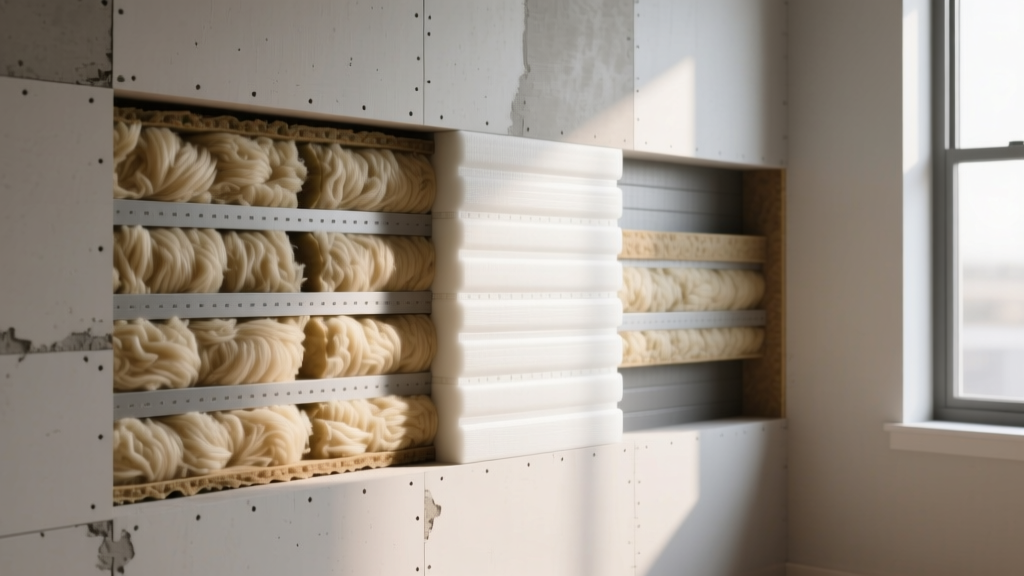
Comparative Matrix: R-Value, Density, and Cost
Not all insulators are created equal. The physical structure of the material—whether it relies on trapped gas, solid matrix resistance, or reflective barriers—dictates its performance. Below is a technical comparison of the primary insulation materials used in modern construction, reflecting 2026 market pricing and manufacturing standards.
| Material Type | R-Value per Inch | Density (lb/ft³) | Perm Rating | Installed Cost (per sq ft) |
|---|---|---|---|---|
| Closed-Cell Spray Foam (ccSPF) | R-6.5 to R-7.0 | 1.7 - 2.0 | < 1.0 (Vapor Retarder) | $1.80 - $2.60 |
| Polyisocyanurate (Foil-Faced) | R-6.0 to R-6.5* | 2.0 | < 0.1 (Vapor Barrier) | $1.10 - $1.50 |
| Mineral Wool (Rockwool) | R-4.2 to R-5.0 | 4.0 - 8.0 | Highly Permeable | $0.95 - $1.35 |
| Extruded Polystyrene (XPS) | R-4.7 to R-5.0 | 1.3 - 1.5 | 0.5 - 1.5 | $0.80 - $1.20 |
| High-Density Fiberglass | R-3.8 to R-4.3 | 2.5 - 3.5 | Highly Permeable | $0.55 - $0.85 |
| Open-Cell Spray Foam (ocSPF) | R-3.5 to R-3.8 | 0.4 - 0.5 | Highly Permeable | $1.10 - $1.60 |
*Note: Polyisocyanurate experiences thermal drift; its R-value decreases in temperatures below 40°F (4°C) due to the condensation of blowing agents within the foam matrix.
The 'Trapped Gas' Mechanism
To understand why an insulator is any material that resists heat flow, you must look at the microscopic level. Solid materials are generally poor insulators; glass fibers conduct heat relatively well. The true insulating power of materials like fiberglass, mineral wool, and spray foam comes from trapped gas (usually air or specialized blowing agents) held within a solid matrix.
In standard fiberglass batts, the glass fibers merely serve to stop the trapped air from convecting. If the air is allowed to move through the batt, the R-value plummets. This is why air sealing (using spray foam, caulk, or fluid-applied membranes) is a mandatory prerequisite for maximizing the performance of air-permeable insulators like fiberglass and mineral wool.
Real-World Failure Modes and Edge Cases
Specifying the correct R-value on paper does not guarantee real-world energy efficiency. Installers and architects must account for physical and environmental failure modes that degrade thermal performance.
1. Compression and Solid Conduction
A common field error is forcing a thicker batt into a shallower cavity. For example, compressing an R-21 fiberglass batt (designed for a 5.5-inch 2x6 cavity) into a 3.5-inch 2x4 cavity does not yield R-21. The compression increases the density of the glass fibers, creating more solid contact points for heat to conduct through. The effective R-value drops to approximately R-15, while simultaneously increasing material costs.
2. Moisture Intrusion and Wicking
Water is a highly effective thermal conductor—roughly 24 times more conductive than still air. If a vapor-permeable insulation like mineral wool or fiberglass gets wet, its R-value approaches zero. The Pacific Northwest National Laboratory emphasizes that managing bulk water and vapor diffusion is just as critical as the insulation material itself. In cold climates, interior vapor retarders prevent warm, moist indoor air from condensing inside the cold wall cavity.
3. Thermal Bridging
Wood framing has an R-value of about 1.25 per inch. Steel studs are highly conductive and can reduce the effective R-value of a cavity by up to 50% due to thermal bridging. Modern energy codes require Continuous Insulation (ci)—rigid foam or mineral wool applied over the exterior sheathing—to break this thermal bridge.
Optimizing Assemblies: The 'Flash and Batt' Method
For high-performance residential builds, the 'flash and batt' technique offers an optimal balance of cost, air sealing, and thermal resistance. This method involves spraying a 1.5-inch layer of closed-cell spray foam (ccSPF) directly against the exterior sheathing, followed by filling the remainder of the cavity with a high-density fiberglass or mineral wool batt.
- The Flash (ccSPF): The 1.5 inches of closed-cell foam provides roughly R-10, acts as a Class II vapor retarder, and perfectly seals all rim joists, wiring penetrations, and top plates against convective air leakage.
- The Batt (Mineral Wool): The remaining 3.5 inches of the 2x4 cavity (or 4 inches of a 2x6 cavity) is filled with mineral wool, adding R-15 to R-18 while providing superior acoustic dampening and non-combustible fire resistance.
This hybrid approach leverages the air-sealing and vapor-controlling properties of spray foam while utilizing the cost-effectiveness and fire-resistance of mineral wool, resulting in an assembly that performs exactly as modeled in energy simulation software.
Decision Framework for Material Selection
Choosing the right insulator requires matching the material's physical properties to the specific demands of the building assembly and local climate.
- Below-Grade Foundations: Use XPS or EPS. Closed-cell spray foam is also viable but requires careful waterproofing. Never use fiberglass or mineral wool below grade due to moisture wicking.
- Exterior Continuous Insulation (ci): Use foil-faced Polyiso for maximum R-value per inch and built-in radiant reflection, or semi-rigid Mineral Wool for vapor permeability and fire resistance.
- Attic Roof Decks (Unvented): Use closed-cell spray foam to adhere directly to the decking, preventing condensation on the underside of the roof sheathing in humid climates.
- Interior Soundproofing: Use high-density Mineral Wool. Its high mass and fibrous structure excel at dampening acoustic frequencies, a secondary benefit of its thermal resistance.
Ultimately, recognizing that an insulator is any material that effectively manages the thermodynamics of a structure allows builders to move beyond basic R-value charts. By addressing convection, radiation, and thermal bridging through proper detailing and material pairing, you ensure the building envelope performs efficiently for decades.
Written by
James ThorntonJames Thornton is a construction industry veteran with 25 years of hands-on experience in wood framing, lumber grading, and residential building codes. He started as a framing carpenter in rural Oregon, earned his ICC Residential Building Inspector certification, and eventually became a senior plan reviewer for the City of Portland Bureau of Development Services. James holds a B.S. in Wood Science & Technology from Oregon State University and is a certified lumber grader through the West Coast Lumber Inspection Bureau (WCLIB). He has inspected over 3,000 residential construction sites and authored the city's internal guide on advanced framing techniques (2x6 at 24" O.C.). James lives in Bend, OR, where he builds custom timber-frame cabins and competes in lumberjack sports.
More from James Thornton
View all
Insulation
Best Home Insulation Materials: Complete 2026 Guide
Compare top home insulation materials for 2026. Find R-values, installed costs per square foot, and best uses for fiberglass, spray foam, and mineral wool.
Aug 4, 2026

Sustainable Building
Certify Your Green Building Material for LEED and WELL
Step-by-step guide to certifying a green building material for LEED v5 and WELL v2. Master EPDs, HPDs, and VOC limits for 2026 project specifications.
Aug 4, 2026

Stone & Masonry
Veneer Stacked Stone Panels: Interior Design & Style Showcase
Discover how veneer stacked stone panels transform interiors. Explore modern design profiles, material pairings, and technical installation specs.
Aug 4, 2026