Maximizing R-Value: Insulation Tools and Materials St Charles MO
Discover the best insulation tools and materials St Charles MO contractors use to maximize R-value and thermal performance in Climate Zone 4 homes.

St. Charles Climate Zone 4A: The R-Value Baseline
St. Charles County sits squarely in the International Energy Conservation Code (IECC) Climate Zone 4A, classified as a mixed-humid environment. This designation dictates severe thermal swings: summer heat indexes frequently exceed 100°F with high ambient humidity, while winter wind chills off the Missouri River can drop below zero. Achieving the rated R-value in this environment requires more than simply stuffing cavities with fiberglass; it demands a precise combination of continuous insulation (ci), advanced air-sealing, and specialized diagnostic equipment.
Under current 2021 and 2024 IECC frameworks adopted across the greater St. Louis metro area, wood-frame walls require a minimum of R-20, or R-13 cavity insulation combined with R-5 continuous exterior insulation. Attic assemblies demand R-49 to R-60. However, the nominal R-value printed on a product label rarely translates to effective R-value in the field without the correct installation methodology. For professionals evaluating insulation tools and materials St Charles MO supply chains offer, prioritizing thermal resistance and moisture management is non-negotiable.
High-Performance Insulation Materials for Zone 4
The mixed-humid climate of St. Charles requires materials that resist thermal transfer while managing vapor drive, which reverses direction between summer (outdoor-to-indoor) and winter (indoor-to-outdoor). Selecting the wrong vapor retarder class can lead to interstitial condensation within the wall cavity, degrading the R-value and promoting mold growth.
| Material Type | Specific Product Example | R-Value / Inch | Vapor Retarder Class | Best Application in Zone 4A |
|---|---|---|---|---|
| Closed-Cell Spray Foam (ccSPF) | Demetile Sealection 500 / Huntsman Heatlok | R-6.5 to R-7.0 | Class II (at 3+ inches) | Rim joists, cathedral ceilings, unvented attics |
| Mineral Wool Batts | ROCKWOOL Comfortbatt | R-4.22 | Vapor Permeable | Exterior wall cavities (behind vented rain screens) |
| Polyiso Rigid Foam (ci) | Owens Corning FOAMULAR NGX / Carlisle Securock | R-6.5 (aged) | Class I or II (foil-faced) | Exterior continuous insulation over OSB sheathing |
| Dense-Pack Cellulose | Applegate Stabilized Cellulose | R-3.2 to R-3.8 | Vapor Permeable | Existing wall retrofits (drill-and-fill) |
According to building envelope experts at Building Science Corporation, the most resilient wall assembly for Zone 4A places the control layers (water, air, thermal, vapor) on the exterior of the structural sheathing. Utilizing foil-faced polyiso as continuous exterior insulation not only provides the required R-5+ thermal break to prevent thermal bridging through the wood studs but also acts as a Class I or II vapor retarder, keeping the sheathing warm and dry during the winter months.
Essential Installation Tools for Maximum Thermal Resistance
The effective R-value of an assembly is entirely dependent on installation quality. A gap of just one inch at the top of a fiberglass batt can reduce the overall wall R-value by 25% due to convective looping. Professionals sourcing insulation tools and materials St Charles MO distributors stock must invest in precision application and diagnostic equipment.
Diagnostic and Measuring Tools
- Calibrated Blower Door (e.g., Retrotec 5000 or The Energy Conservatory DG-1000): Essential for measuring the Air Changes per Hour at 50 Pascals (ACH50). St. Charles building codes increasingly mandate a maximum of 3.0 ACH50 for new residential construction. A blower door depressurizes the home, allowing installers to locate and seal bypasses before insulation is applied.
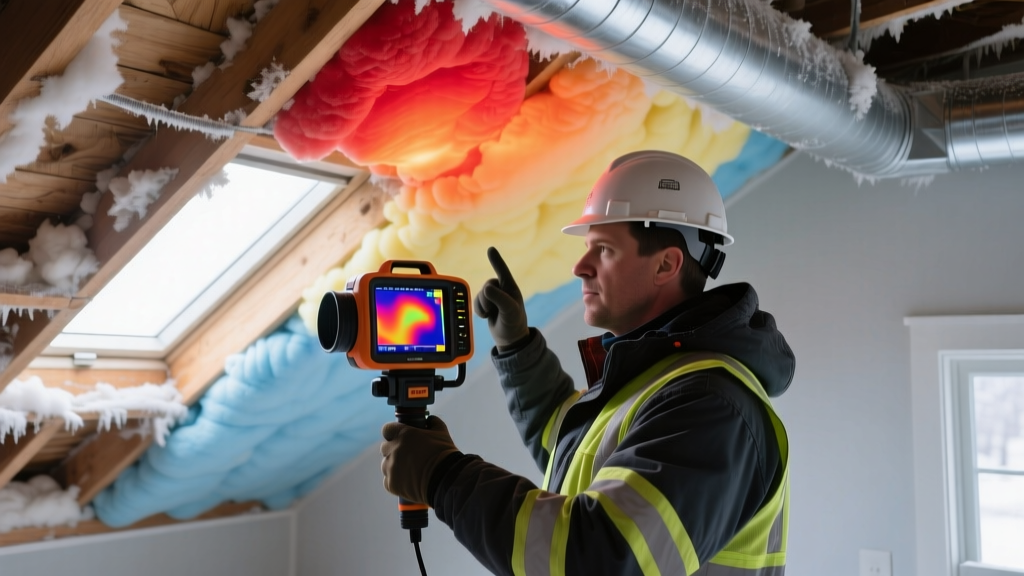
- Thermal Imaging Camera (e.g., FLIR E8-XT): With a 320 x 240 infrared resolution, this tool is critical for post-installation verification. It instantly identifies voids in dense-pack cellulose, settled fiberglass, or missed spray foam cavities that would otherwise compromise the thermal envelope.
- Digital Hygrometers and Surface Thermometers: Used to calculate the dew point on interior sheathing before applying closed-cell spray foam, ensuring the substrate temperature meets the manufacturer's strict 5°F above dew point requirement to prevent off-ratio curing.
Application and Fastening Tools
- Pneumatic Insulation Staplers (e.g., Pneu-Tools STCN-22): Used for securing housewraps and batt flanges. Proper staple depth is critical; over-driven staples tear the facing, while under-driven staples leave gaps that allow air infiltration.
- Proportioning Rigs (e.g., Graco Reactor E-20): For professional spray foam contractors, maintaining exact 1:1 mixing ratios of isocyanate and polyol resin at precise temperatures (typically 110°F-130°F) is required to achieve the advertised R-6.5 per inch. Off-ratio mixing results in friable, low-R-value foam that shrinks and off-gasses.
- Insulation Blowers (e.g., Meyer Accu1): For dense-pack cellulose, the machine must be calibrated to deliver material at 3.0 to 3.5 lbs per cubic foot. Under-dense packing leads to settling over time, leaving the top of the wall cavity uninsulated.
Never compress a batt to fit a smaller cavity. An R-19 fiberglass batt designed for a 2x6 wall (5.5 inches thick) will drop to an effective R-13 or lower if compressed into a 2x4 wall (3.5 inches thick). Fiberglass relies on trapped, still air for its thermal resistance. Compressing the material reduces the air pockets, increasing thermal conductivity and destroying the R-value. Always use materials specifically manufactured for the cavity depth.
Preventing R-Value Degradation in Humid Continental Climates
In St. Charles, the primary enemy of long-term R-value is moisture accumulation. When porous insulation materials like fiberglass or open-cell spray foam absorb moisture from humid summer air or winter condensation, their R-value plummets. Water conducts heat roughly 25 times faster than still air.
Managing Air Leakage and Thermal Bridging
The U.S. Department of Energy emphasizes that air leakage accounts for up to 40% of a home's heat loss. Air movement through insulation strips away the thermal boundary layer, rendering the material's rated R-value useless. This is why air-sealing with two-part closed-cell spray foam or fluid-applied membranes must precede cavity insulation.
Furthermore, thermal bridging through wood studs (which have an R-value of roughly R-1.25 per inch) bypasses the cavity insulation entirely. In a standard 2x6 wall with R-20 cavity insulation, the whole-wall R-value drops to approximately R-14 due to the framing factor. Applying R-5 continuous rigid foam over the exterior sheathing breaks this thermal bridge, restoring the assembly's effective performance and aligning with ENERGY STAR guidelines for high-performance envelopes.
Sourcing Supply: Navigating the St. Louis Metro Market
Contractors operating in St. Charles typically bypass big-box retail for high-performance materials, relying instead on specialized commercial distributors located along the I-70 and Hwy 94 corridors in the broader St. Louis metro area. Sourcing commercial-grade polyiso, mineral wool, and spray foam rigs requires established accounts with regional suppliers like ABC Supply Co., Carter-Waters, or specialized foam distributors.
When procuring materials, always verify the manufacturing date on rigid foam boards. Polyiso and XPS boards stored in unconditioned, un-shaded lumber yards for extended periods can experience thermal drift and UV degradation on the facers. For spray foam, ensure the chemical drums (ISO and Resin) have been climate-controlled during transport and storage; drums exposed to freezing winter temperatures in unheated St. Charles warehouses will crystallize, requiring extensive heating and agitation before they can be safely proportioned.
"Achieving the nominal R-value in Climate Zone 4 requires treating the building envelope as an interconnected system. The insulation material is only as effective as the air barrier protecting it and the tools used to verify its installation."
— Building Envelope Commissioning Guidelines
Ultimately, maximizing thermal performance in St. Charles requires moving beyond basic code minimums. By pairing high-R-value continuous materials with rigorous diagnostic testing and precision application tools, builders can deliver homes that remain thermally stable, energy-efficient, and structurally protected against the region's demanding seasonal extremes.
Written by
Elena RodriguezElena Rodriguez is a civil engineer and technical writer specializing in concrete technology, masonry systems, and ASTM/ACI compliance. She earned her B.S. in Civil Engineering from Texas A&M University and spent a decade at a materials testing laboratory, performing over 2,000 concrete compressive strength tests and masonry prism evaluations. Elena is an ACI-certified Field Testing Technician (Grade I) and a member of ASTM Committee C12 on Natural Building Stone. She currently consults on forensic engineering cases involving concrete failures and moisture intrusion. Based in San Antonio, TX, Elena is a proud member of the Society of Women Engineers (SWE) and coaches her daughter's FIRST Robotics team.
More from Elena Rodriguez
View all
Walls & Panels
Cost Analysis: Light Gauge Steel Framing Advantages and Disadvantages
Evaluate light gauge steel framing advantages and disadvantages through a strict cost analysis lens, comparing material, labor, and lifecycle expenses.
Aug 4, 2026

Walls & Panels
Gypsum Board Types: Exact Specifications, Thickness & Dimensions
Compare standard, Type X, and moisture-resistant gypsum board types. Get exact specifications, thicknesses, dimensions, and ASTM standards for your project.
Aug 4, 2026

Fire Resistance
Best Fire-Resistant Outdoor Decking Materials: 2026 Buyer Guide
Discover the best fire-resistant outdoor decking materials for 2026. Compare Class A PVC, aluminum, and hardwood options for WUI compliance and safety.
Aug 4, 2026