What Materials Are Insulators for Building Sound Control?
Discover what materials are insulators for sound control. Compare mineral wool, MLV, and fiberglass with STC ratings, costs, and assembly guides.

Redefining Insulation: Thermal vs. Acoustic Performance
When evaluating building envelopes, the question of what materials are insulators for acoustic control requires a fundamental shift in how we view building physics. While thermal insulation aims to slow conductive heat transfer, acoustic insulation must disrupt mechanical sound waves. A material that excels at trapping heat—like closed-cell spray foam or rigid extruded polystyrene (XPS)—often performs poorly at blocking noise, and can sometimes even amplify it.
Effective sound control relies on four mechanical principles: Mass (to reflect sound), Damping (to dissipate vibrational energy), Decoupling (to break structural pathways), and Absorption (to reduce cavity resonance). Understanding these principles is the first step in selecting the correct materials for your assembly.
STC (Sound Transmission Class): Measures a partition's ability to block airborne sound (e.g., voices, TV). Higher is better. A standard interior wall is STC 33; a luxury hotel wall is STC 55+.
NRC (Noise Reduction Coefficient): Measures a material's ability to absorb sound within a room, reducing echo and reverberation. Scaled from 0.0 (perfect reflection) to 1.0 (perfect absorption).
Core Acoustic Insulating Materials
To answer what materials are insulators for soundproofing, we must look at high-density, porous, and viscoelastic compounds engineered specifically for mechanical wave disruption.
1. High-Density Mineral Wool Batts
Mineral wool (specifically rock wool) is the industry standard for cavity sound absorption. Unlike standard thermal fiberglass, which has a density of roughly 0.5 to 0.7 pounds per cubic foot (pcf), acoustic mineral wool products like ROCKWOOL Safe'n'Sound are manufactured at approximately 2.5 pcf. This higher density increases internal friction, converting acoustic energy into negligible amounts of heat as sound waves pass through the fibers. Mineral wool also provides superior fire resistance, maintaining integrity at temperatures exceeding 1,800°F, which is critical for fire-rated acoustic partitions.
2. Rigid High-Density Fiberglass Boards
For applications requiring both sound absorption and structural rigidity—such as acoustic wall panels, bass traps, or ceiling clouds—rigid fiberglass boards like Owens Corning 703 (3.0 pcf) or 705 (4.8 pcf) are the benchmark. These are not cavity fillers; they are surface treatments designed to absorb mid-to-high frequency reverberations, drastically lowering the NRC of a room and preventing flutter echoes that degrade audio clarity.
3. Mass Loaded Vinyl (MLV)
When adding physical mass to a wall without increasing its thickness significantly, MLV is the premier solution. MLV is a limp, high-density viscoelastic sheet loaded with barium sulfate or calcium silicate. A standard 1 lb/sq ft MLV adds roughly 27 STC points when used in a perfectly decoupled assembly, though in real-world standard stud walls, it typically yields a 4 to 6 STC point gain by shifting the wall's resonance frequency. It is highly effective at blocking low-frequency mechanical noise, such as HVAC rumble or bass from home theaters.
4. Viscoelastic Damping Compounds
Damping compounds, most notably Green Glue Noiseproofing Compound, represent a leap in constrained-layer damping technology. Applied between two rigid layers of drywall, the compound remains in a semi-liquid viscoelastic state. As sound waves vibrate the drywall, the shearing action within the compound converts mechanical kinetic energy into heat. Two standard tubes (covering one 4x8 sheet) can increase a wall's STC by 8 to 10 points, specifically targeting the low-frequency 'coincidence dip' where drywall naturally becomes transparent to sound.
Material Comparison Matrix
| Material | Primary Function | Est. STC Gain* | NRC Rating | Approx. Cost (2026) |
|---|---|---|---|---|
| Mineral Wool Batts (2.5 pcf) | Cavity Absorption | +4 to +6 | 0.95 - 1.05 | $1.10 / sq ft |
| Rigid Fiberglass (OC 703) | Surface Absorption | N/A (Surface) | 0.85 - 1.10 | $2.40 / sq ft |
| Mass Loaded Vinyl (1 lb) | Mass / Low-Freq Block | +4 to +6 | 0.10 | $1.65 / sq ft |
| Viscoelastic Compound | Constrained-Layer Damping | +8 to +10 | N/A (Hidden) | $1.25 / sq ft |
*STC Gain estimates assume application within a standard 2x4 wood-framed wall with single-layer 5/8" drywall on both sides. Gains are not strictly additive.
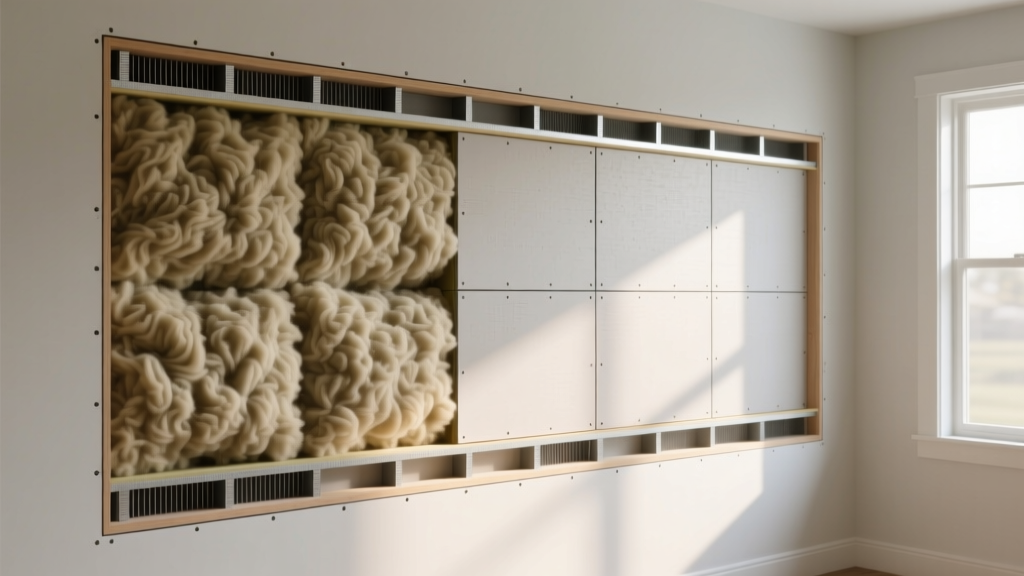
The Closed-Cell Spray Foam Trap
Designing the Assembly: Real-World Scenarios
Knowing what materials are insulators is only half the battle; sequencing them correctly dictates the final acoustic performance. According to testing data published by the Gypsum Association, the arrangement of layers is just as critical as the materials themselves.
Scenario A: The Decoupled Home Theater (Target STC 60+)
For spaces generating high-decibel, low-frequency bass, standard walls will fail due to structural resonance. The solution requires full decoupling and constrained-layer damping.
- Framing: Staggered-stud 2x6 plate, or dual independent 2x4 walls with a 1-inch air gap.
- Cavity Fill: 3-inch ROCKWOOL Safe'n'Sound (do not compress the batts; compression reduces acoustic absorption by altering the fiber matrix).
- Interior Layer 1: 5/8-inch Type X Gypsum Board.
- Damping Layer: 2 tubes of Green Glue compound per 4x8 sheet.
- Interior Layer 2: 5/8-inch Type X Gypsum Board.
- Perimeter: All edges sealed with acoustic caulk (e.g., OSI SC-175 or Tremco Acoustical Sealant) to prevent airborne flanking.
Scenario B: The Budget Bedroom Privacy Upgrade (Target STC 50)
For retrofitting an existing noisy interior wall without losing square footage to double-framing.
- Prep: Remove existing trim and seal all electrical boxes with Putty Pads to block direct airflow paths.
- Decoupling: Install 25-gauge resilient channels horizontally across the studs, spaced 24 inches on center. Screw only into the studs, ensuring drywall screws do not penetrate the studs through the channel (a 'short circuit' that ruins decoupling).
- Cavity: Blow-in dense-pack cellulose or carefully friction-fit mineral wool if the wall is opened.
- Mass & Damping: Apply one layer of 5/8-inch drywall to the resilient channels, backed by MLV (1 lb) stapled directly to the channel before hanging the board.
Flanking Paths: Where Sound Insulators Fail
The Acoustical Society of America notes that a wall's field STC rating is frequently undermined by flanking noise—sound that bypasses the insulated partition entirely. If you invest in an STC 55 wall but ignore the following paths, the effective room isolation will drop to STC 40:
- Electrical Boxes: Back-to-back outlets on a shared stud act as acoustic megaphones. Always offset boxes by at least one stud bay and wrap them in acoustic putty pads.
- HVAC Ductwork: Sound travels effortlessly through rigid sheet metal and flex duct. Install acoustic duct liners or inline duct silencers (baffle boxes) near the plenum.
- Hard Flooring Continuity: Hardwood or tile installed continuously from a living room into a bedroom creates a rigid diaphragm that carries impact and airborne noise under the partition wall. Always break the flooring plane at the doorway and fill the gap with acoustic backer rod and sealant.
Ultimately, selecting the right acoustic insulators requires treating the room as a pressurized vessel. Sound behaves like water; it will exploit the path of least resistance. By combining high-density mineral wool for cavity absorption, viscoelastic compounds for damping, and meticulous acoustic sealants for perimeter containment, you can engineer building assemblies that deliver true, measurable silence.
For further reading on standardized acoustic testing methodologies (ASTM E90), consult the Institute of Noise Control Engineering.
Written by
David NakamuraDavid Nakamura is a licensed architect (AIA) and construction technology writer focused on sustainable building methods, mass timber engineering, and high-performance building envelopes. He holds a Master of Architecture from the University of Washington and is a certified Passive House Consultant (CPHC). David spent eight years at the Seattle firm Mithun, where he led the design of three LEED Platinum projects, before founding his own practice specializing in net-zero residential design. He serves on the editorial advisory board of GreenBuilder Magazine and has authored peer-reviewed papers on cross-laminated timber (CLT) connections for the Journal of Structural Engineering. In his spare time, David teaches woodworking at Pratt Fine Arts Center and kayaks the Puget Sound.
More from David Nakamura
View all
Construction Cost
Labor Cost to Build a Deck Per Sq Ft: 2026 Installation Guide
Discover the exact labor cost to build a deck per sq ft in 2026. This installation guide breaks down contractor rates, complexity factors, and hidden fees.
Aug 4, 2026

Construction Cost
How Much Does It Cost to Build a 3 Bedroom House? Financing Guide
Learn exactly how much it costs to build a 3 bedroom house and explore 2026 financing options, construction loan types, and budget frameworks for your build.
Aug 4, 2026

Construction Cost
Cost to Build a Tennis Court: 2026 Guide
How much does it cost to build a tennis court in 2026? Breakdowns for asphalt, concrete, and synthetic surfaces plus fencing and lighting.
Jul 30, 2026