Artificial Veneer Stone Cost Breakdown & Installation Pricing 2026
Comprehensive 2026 cost analysis for artificial veneer stone. Compare material prices, labor rates, and hidden installation expenses for your project.

The Real Cost of Artificial Veneer Stone in 2026
Artificial veneer stone, technically classified as Adhered Manufactured Stone Masonry Veneer (AMSMV) under ASTM C1670 standards, remains one of the most cost-effective methods to achieve a high-end masonry aesthetic. For 2026, homeowners and contractors should budget between $14.50 and $24.00 per square foot for a fully installed exterior or interior application. This represents a slight stabilization in material costs following the supply chain adjustments of previous years, though skilled masonry labor rates continue to climb.
• Material Only: $5.00 – $9.50 per sq. ft.
• Labor & Prep: $9.50 – $14.50 per sq. ft.
• Total Installed: $14.50 – $24.00 per sq. ft.
• Typical 500 sq. ft. Exterior Project: $7,250 – $12,000
Unlike natural stone, artificial veneer stone is cast from Portland cement, lightweight aggregates, and iron oxide pigments in molds taken from real stone. This manufacturing process yields a product that weighs roughly 10 to 12 pounds per square foot—less than half the weight of full-bed natural stone. This weight reduction eliminates the need for expensive structural footing reinforcements in most residential retrofits, a critical factor in overall project economics.
Material Pricing: Brand and Profile Variations
Material costs fluctuate heavily based on the manufacturer, the complexity of the stone profile, and the color blending technology used. Premium brands like Cultured Stone (by Westlake Royal Building Products) and Eldorado Stone utilize advanced molding and multi-layered pigment applications that closely mimic the geological strata of natural stone, commanding a higher price point than big-box store generic alternatives.
| Manufacturer / Brand | Popular Profile Example | Material Cost (Per Sq. Ft.) |
|---|---|---|
| Cultured Stone | Dressed Fieldstone / Country Ledgestone | $7.50 – $9.50 |
| Eldorado Stone | Ledge Stone / Fieldstone | $7.00 – $9.00 |
| ProVia | Manufactured Stone (Various) | $6.50 – $8.50 |
| Owens Corning / Generic | Basic Stacked Stone Panels | $4.50 – $6.00 |
When sourcing materials, verify that the product meets ASTM C1670 specifications for freeze-thaw durability and water absorption, especially for exterior applications in northern climates. Bargain-bin manufactured stones often lack adequate aggregate density, leading to premature spalling after three or four winter cycles.
Labor and Installation: Where the Budget Expands
Labor accounts for 60% to 70% of the total project cost. Installing artificial veneer stone is not a simple peel-and-stick operation; it requires a meticulous multi-step masonry process. According to HomeGuide's stone veneer cost database, experienced masons charge between $65 and $95 per hour, translating to $9.50 to $14.50 per square foot for the complete installation.
The 4-Step Installation Sequence
- Weather-Resistant Barrier (WRB): Application of two layers of Grade D building paper or a high-grade house wrap over the sheathing.
- Corrosion-Resistant Lath: Stapling or nailing 2.5 lb/sq yd galvanized metal lath to the studs (not just the sheathing) to provide a mechanical grip.
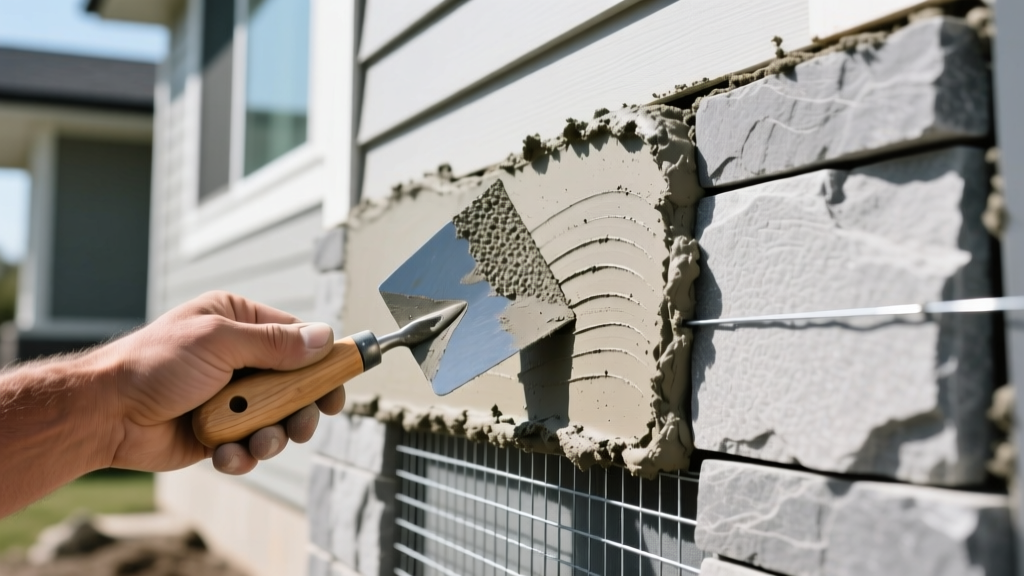
- Scratch Coat: Troweling a 1/2-inch layer of Type S mortar over the lath and scoring it horizontally to create a bonding surface for the stone.
- Stone Setting: Applying mortar to the back of each veneer piece (back-buttering) and pressing it firmly into the scratch coat, maintaining consistent joint widths for grouting.
The Corner Piece Trap: Linear vs. Square Footage
Most budget overruns occur because homeowners calculate only the flat square footage of the wall. Artificial veneer stone corners are sold by the linear foot (LF), not the square foot. Corner pieces typically cost $8.00 to $15.00 per LF. Because one linear foot of corner provides less than one square foot of visual wall coverage, your actual material spend for a wall with multiple exterior corners or window returns can be 20% to 30% higher than a basic length-times-width calculation suggests.
Hidden Expenses and Substrate Requirements
Beyond the stone and the mason's hourly rate, a compliant installation requires specific ancillary materials. The Masonry Veneer Manufacturers Association (MVMA) strictly outlines these requirements to prevent moisture intrusion and efflorescence. Failing to budget for these line items will result in failed inspections or voided manufacturer warranties.
- Weep Screeds: A corrosion-resistant weep screed must be installed at the base of the wall, minimum 4 inches above grade or 2 inches above paved surfaces. Cost: $2.50 – $4.00 per linear foot.
- Type S Mortar: Standard for veneer applications due to its high tensile bond strength. Cost: $15 – $25 per 80-lb bag (covers approx. 12-15 sq. ft. for setting and grouting).
- Sealers (Optional but Recommended): A breathable, silane/siloxane penetrating sealer prevents water ingress and efflorescence without altering the stone's matte appearance. Cost: $0.40 – $0.80 per sq. ft.
- Scaffolding and Site Prep: For second-story applications or steep grades, scaffolding rental and setup can add $800 to $2,500 to the total project invoice.
Artificial Veneer Stone vs. Natural Stone: Cost Matrix
While artificial veneer stone is generally cheaper than full-thickness natural stone, the gap narrows when comparing it to natural thin stone veneer. The decision often comes down to structural limitations and aesthetic preferences.
| Feature | Artificial Veneer Stone (MSV) | Natural Thin Stone Veneer | Full-Bed Natural Stone |
|---|---|---|---|
| Total Installed Cost | $14.50 – $24.00 / sq. ft. | $18.00 – $32.00 / sq. ft. | $35.00 – $55.00+ / sq. ft. |
| Weight | 10 – 12 lbs / sq. ft. | 13 – 15 lbs / sq. ft. | 35 – 50 lbs / sq. ft. |
| Structural Footing | Not required for most retrofits | Not required for most retrofits | Mandatory reinforced concrete footing |
| Color Consistency | High (Batch controlled) | Low (Natural geological variation) | Low (Natural geological variation) |
| Installation Speed | Fast (Uniform shapes, modular) | Moderate (Requires custom fitting) | Slow (Heavy, requires deep bedding) |
ROI and Resale Value Impact
From an investment perspective, artificial veneer stone offers exceptional return on investment (ROI). Exterior upgrades featuring manufactured stone veneer consistently rank among the top remodeling projects for cost recouped at resale. Adding stone accents to a home's facade, particularly around the entryway or as a wainscoting element, breaks up monotonous vinyl or fiber-cement siding profiles and significantly boosts curb appeal. The localized nature of the install means you can achieve a high-end architectural look on a single focal wall without committing to the expense of cladding the entire structure.
Actionable Estimation Framework
To generate a highly accurate budget for your specific project before soliciting contractor bids, follow this precise calculation framework:
- Calculate Gross Wall Area: Multiply total wall height by total wall width.
- Subtract Openings: Deduct the square footage of all windows, doors, and vents.
- Determine Flat Stone Requirement: Take the net square footage and add 10% for waste, cuts, and breakage. Multiply this final number by the per-sq-ft material cost of your chosen profile.
- Measure Linear Corners: Measure the height of all outside and inside corners, plus the perimeter of any windows receiving stone returns. Add 5% for waste. Multiply by the linear foot corner price.
- Factor in Substrate & Mortar: Allocate $2.50 per square foot of net wall area for WRB, lath, weep screed, and Type S mortar.
- Apply Labor Multiplier: Multiply the net square footage by $12.00 (national median labor rate) to establish your baseline installation cost.
By separating flat coverage, linear corners, and substrate prep, you eliminate the guesswork that leads to contractor change orders. Whether you are cladding a 400-square-foot exterior bump-out or installing a 60-square-foot interior fireplace surround, this methodology ensures your artificial veneer stone project remains financially predictable from demolition to final seal.
Written by
Sarah WhitfieldSarah Whitfield is a chartered quantity surveyor (MRICS) and construction cost analyst with 15 years of experience in material pricing, procurement strategy, and project budgeting. She earned her degree in Construction Management from the University of Reading (UK) and has worked on projects ranging from $2M custom homes to $180M mixed-use developments across North America and Europe. Sarah currently leads cost estimating for BuildMat Insight, maintaining a proprietary database of 4,000+ material price points updated quarterly. She is a frequent contributor to RSMeans cost data panels and has presented at the International Cost Engineering Council (ICEC) congress. Based in Denver, CO, Sarah is an avid trail runner and volunteer mentor for Women in Construction.
More from Sarah Whitfield
View all
Wood & Lumber
What Are the Different Types of Wood? A Builder's Guide
Compare structural softwoods, finish hardwoods, and engineered lumber. Analyze Janka ratings, MOE values, and 2026 pricing for construction.
Aug 4, 2026

Walls & Panels
Steel Framing vs Wood Framing: Corrosion and Moisture Defense
Compare steel framing vs wood framing for moisture resistance. Learn about galvanized coatings, condensation risks, and corrosion protection strategies.
Jul 21, 2026

Stone & Masonry
How to Cut Stone Veneer: Wet Saw vs Grinder Comparison
Compare the best tools for cutting stone veneer. We review wet saws, angle grinders, and chop saws to help you achieve clean, chip-free cuts.
Jul 21, 2026