Blue Stone Veneer Comparison: Natural vs Manufactured
Compare natural and manufactured blue stone veneer for 2026 projects. Analyze costs, weight, installation methods, and durability to choose the right material.

Defining the Blue Stone Veneer Market
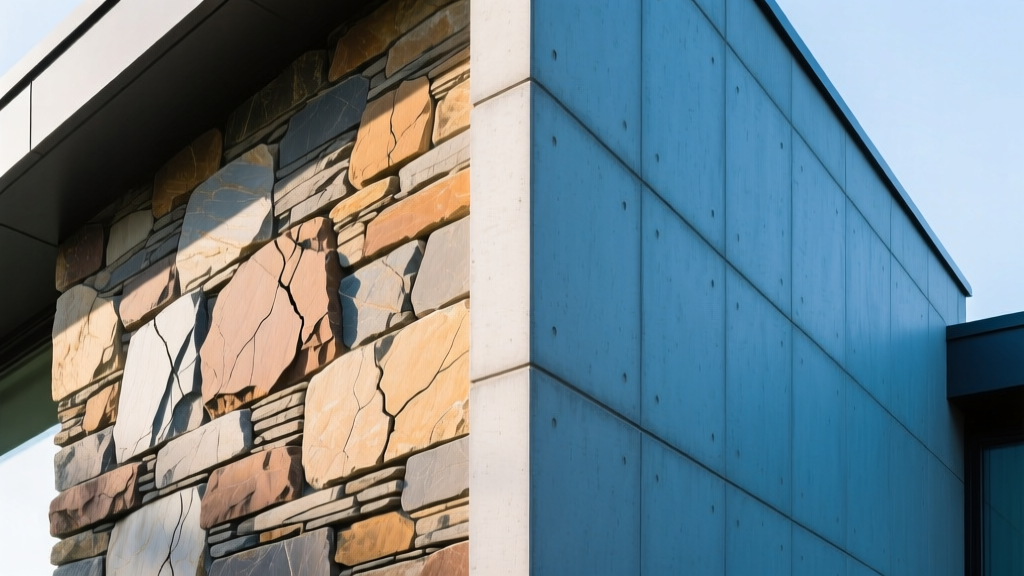
When architects and builders specify blue stone veneer, they are typically referencing the aesthetic of Pennsylvania bluestone—a dense, feldspathic sandstone prized for its deep blue-gray hues and natural cleft texture. However, the modern veneer market extends far beyond quarried stone. To meet structural load limits, budget constraints, and accelerated construction timelines, manufacturers now produce cast concrete replicas and high-density polyurethane (PU) panels that mimic the exact coloration and tooling marks of natural bluestone.
Choosing the correct blue stone veneer requires looking past the surface color. The decision hinges on structural load capacity (dead loads), freeze-thaw durability in northern climate zones, efflorescence risks, and the total installed cost, which includes masonry labor, lath, scratch coats, and structural footings. This comparison evaluates natural quarried bluestone, manufactured cast stone, and polyurethane faux stone across critical 2026 construction metrics.
Material Breakdown: The Three Contenders
Natural Pennsylvania Bluestone Veneer
True bluestone is quarried primarily in the Susquehanna County region of Pennsylvania and adjacent New York counties. For veneer applications, the stone is typically split to a thickness of 0.75 to 1.25 inches. Natural cleft bluestone retains the rugged, uneven texture of the quarry split, while thermal (flamed) bluestone offers a smoother, more uniform surface. Natural bluestone is incredibly dense, boasting a compressive strength often exceeding 15,000 psi and an absorption rate of less than 2%, making it highly resistant to weathering when properly detailed.
Manufactured Cast Concrete Bluestone
Cast stone veneer is produced using Portland cement, lightweight aggregates (like expanded shale or pumice), and iron oxide pigments poured into polyurethane molds taken directly from natural bluestone. The resulting product replicates the cleft texture and color variations of the original stone. While lighter than full-bed natural stone, cast concrete veneer still carries significant weight and requires a traditional masonry installation approach, including a weather-resistant barrier, metal lath, and a scratch coat.
High-Density Polyurethane (PU) Faux Bluestone
Polyurethane panels represent the ultra-lightweight segment of the market. These panels are molded from high-density rigid foam, painted with multi-stage UV-resistant acrylics, and interlocked via hidden flanges. PU blue stone veneer contains no cementitious materials, eliminating the risk of efflorescence and reducing the dead load to a fraction of a pound per square foot. It is designed for direct application over flat substrates, including drywall, plywood, or rigid insulation, using construction adhesive and corrosion-resistant screws.
Quick Decision Matrix
- Specify Natural Bluestone when the project demands premium authenticity, historical accuracy, or a high-end commercial facade with a 100-year lifespan expectancy.
- Specify Cast Concrete when the design requires complex corner returns, custom color blending, or when the budget restricts natural stone procurement but masonry labor is readily available.
- Specify Polyurethane for interior accent walls, retrofit projects lacking structural footings, or DIY installations where wet masonry work is prohibited.
Head-to-Head Technical Comparison
| Metric | Natural Bluestone | Cast Concrete | Polyurethane (PU) |
|---|---|---|---|
| Average Thickness | 0.75' - 1.25' | 1.0' - 2.5' | 1.5' - 2.0' |
| Dead Load (Weight) | 9 - 13 lbs / sq ft | 10 - 15 lbs / sq ft | 1.0 - 1.5 lbs / sq ft |
| Material Cost (2026) | $14.00 - $19.00 / sq ft | $8.00 - $12.00 / sq ft | $10.00 - $14.00 / sq ft |
| Labor Cost (Installed) | $18.00 - $28.00 / sq ft | $14.00 - $22.00 / sq ft | $4.00 - $8.00 / sq ft |
| Substrate Requirement | Masonry, CMU, or framed with lath | Framed with lath and scratch coat | OSB, Plywood, Drywall, or Rigid Foam |
| R-Value Contribution | Negligible (~0.05) | Negligible (~0.10) | Moderate (~3.5 - 5.0) |
2026 Cost Analysis: Material, Labor, and Structural Prep
Calculating the true cost of blue stone veneer requires looking beyond the per-square-foot material price. The total project cost is heavily influenced by structural preparation and masonry labor rates, which have seen steady inflation due to a shortage of skilled tradespeople.
Natural Bluestone: While the raw stone costs $14 to $19 per square foot, the total installed price frequently exceeds $45 per square foot. This high cost is driven by the labor-intensive process of sorting stones for color consistency, cutting dense sandstone with diamond-tipped wet saws, and the potential need for structural steel angle supports (shelf angles) if the veneer height exceeds 30 feet or if the dead load surpasses the wall's design capacity. Furthermore, natural stone requires a concrete masonry unit (CMU) backup or a heavily reinforced wood-framed wall with a proper drainage cavity.
Cast Concrete: Priced at $8 to $12 per square foot for materials, cast stone reduces material expenses but maintains high labor costs ($14 to $22 per square foot). Installers must apply a weather-resistant barrier, fasten galvanized metal lath, trowel on a 0.5-inch cementitious scratch coat, and allow it to cure before setting the stone with Type N or Type S mortar. The total installed cost typically lands between $28 and $38 per square foot.
Polyurethane: PU panels cost $10 to $14 per square foot, making the material slightly more expensive than cast stone. However, the labor cost plummets to $4 to $8 per square foot. Because PU panels interlock and adhere directly to the substrate using polyurethane construction adhesive and exterior-grade screws, a two-person crew can install up to 500 square feet in a single day. The total installed cost ranges from $16 to $24 per square foot, making it the most economical choice for non-masonry crews.
Installation Nuances and Code Compliance
Mortar Selection and Efflorescence
When installing natural or cast blue stone veneer, mortar selection is critical to preventing efflorescence—the white, powdery salt deposits that ruin the aesthetic of dark blue-gray stone. According to guidelines published by the Natural Stone Institute, Type N mortar is generally preferred over Type S for natural sandstone veneer. Type S mortar has a higher Portland cement content, which increases compressive strength but also increases the concentration of soluble salts and reduces vapor permeability. If moisture becomes trapped behind a dense Type S joint, it can force water through the porous face of the stone, depositing salts on the surface and potentially causing spalling in freeze-thaw climates.
For cast concrete bluestone, efflorescence is an inherent risk due to the soluble calcium hydroxide present in the Portland cement used to manufacture the stone itself. Specifying a low-alkali cement in the scratch coat and utilizing integral water repellents in the mortar mix can mitigate this issue.
Weight Limits and TMS 402 Compliance
Adhered masonry veneer is governed by the Building Code Requirements for Masonry Structures (TMS 402). Under TMS 402, adhered veneer is generally limited to a maximum weight of 15 pounds per square foot (psf) without requiring additional structural engineering for the backing wall. Natural bluestone veneer, at 9 to 13 psf, typically complies with this limit. However, if the installer uses excessively thick mortar joints or applies a heavy scratch coat, the combined dead load can inadvertently exceed the 15 psf threshold, requiring the structural engineer to reinforce the wall studs or sheathing.
Long-Term Durability and Failure Modes
Each blue stone veneer variant exhibits distinct failure modes over a 20- to 50-year lifecycle:
- Natural Bluestone Spalling: While Pennsylvania bluestone is highly durable, applying a non-breathable, film-forming acrylic sealer to the stone face traps moisture inside the masonry assembly. In Climate Zones 5 through 8, this trapped water freezes and expands, causing the face of the stone to delaminate or 'spall'. Natural bluestone should remain unsealed or be treated only with penetrating silane/siloxane water repellents.
- Cast Stone Cracking: Cast concrete veneer is prone to shrinkage cracking if the scratch coat is not properly cured or if the mortar joints are too rigid. Control joints must be aligned with the underlying structural backup wall to prevent the veneer from cracking when the building frame deflects under wind or seismic loads.
- Polyurethane Warping: PU panels have a high coefficient of thermal expansion. If installed on a south-facing exterior wall with dark pigments and without the manufacturer-specified 1/8-inch expansion gaps at the panel ends, the heat absorption will cause the panels to buckle and pop off the substrate. Proper fastening schedules and expansion detailing are non-negotiable for PU veneer.
Specification Verdict
There is no universal 'best' blue stone veneer; the correct specification depends entirely on the project parameters. For high-end commercial builds, institutional facades, and luxury residential exteriors where budget allows and a century-long lifespan is expected, natural Pennsylvania bluestone remains unmatched in authenticity and structural permanence. For residential developments, interior feature walls, and remodels where the existing foundation cannot support an additional 12 psf of dead load, polyurethane faux bluestone offers the most practical, cost-effective, and thermally efficient solution. Cast concrete bluestone occupies the middle ground, serving as the ideal choice for complex architectural profiles and custom color-matching requirements where natural stone quarrying limitations prove too restrictive.
Written by
Marcus ChenMarcus Chen is a licensed structural engineer (PE) and building materials analyst with over 12 years of experience across residential, commercial, and industrial construction. He holds a Master of Science in Civil Engineering from UC Berkeley and spent six years at Thornton Tomasetti before transitioning to independent consulting and technical writing. Marcus specializes in material selection for seismic-prone regions, concrete reinforcement strategies, and lifecycle cost analysis. His work has been cited by the American Concrete Institute (ACI) and the Structural Engineers Association of California (SEAOC). When he is not on a job site or at his desk, you will find him hiking the Sierra Nevada or restoring a 1920s craftsman bungalow in Oakland, CA.
More from Marcus Chen
View all
Construction Cost
How Much Did the Eiffel Tower Cost to Build?
How much did the Eiffel Tower cost to build in 1889? We adjust for inflation and compare its budget to modern skyscraper construction.
Aug 4, 2026

Fire Resistance
What Is a Fire Resistant Material? Testing & Certification Guide
Discover what is a fire resistant material through ASTM and UL testing. Learn how fire ratings, certifications, and assemblies work in construction.
Aug 4, 2026

Construction Cost
How Much Did the Burj Khalifa Cost to Build?
How much did the Burj Khalifa cost to build? We break down the $1.5B project and extract 5 money-saving strategies for your next build.
Jul 30, 2026