Maintaining Building Material Limestone: Expert Care Guide
Discover expert maintenance and care techniques for building material limestone. Learn cleaning methods, sealing schedules, and stain removal tips.

The Chemical Vulnerability of Limestone
Limestone is a sedimentary rock composed primarily of calcium carbonate (CaCO3). While its fossiliferous texture and warm, earthy tones make it a premier building material limestone for both interior feature walls and exterior facades, its chemical composition dictates strict maintenance protocols. On the Mohs hardness scale, limestone typically rates between 3 and 4, making it highly susceptible to scratching, abrasion, and acid etching. Furthermore, its natural porosity allows it to absorb between 7% and 10% of its weight in water if left unsealed, creating a pathway for freeze-thaw damage, biological colonization, and salt migration.
Understanding these material properties is the first step in preventing irreversible degradation. The care strategies outlined below rely on current conservation science and industry-tested chemical formulations to preserve the stone's structural integrity and aesthetic profile.
Routine Cleaning: Pressure and pH Limits
Routine removal of atmospheric dirt, pollen, and surface grime requires a delicate balance between mechanical force and chemical action. The National Park Service preservation guidelines strictly warn against aggressive cleaning methods that can strip the stone's natural patina or open its pore structure.
Approved Cleaning Agents
Because calcium carbonate reacts violently with acids, all cleaning solutions must be strictly pH-neutral (pH 7.0) or slightly alkaline. Never use vinegar, lemon juice, bleach, or muriatic acid. For routine washing, utilize specialized stone detergents such as Prosoco DailyKlean or MB Stone MB-5 Multi-Surface Cleaner. These formulations contain chelating agents that lift dirt without altering the stone's surface chemistry.
- Application: Dilute the cleaner according to manufacturer specifications (typically 1:10 to 1:20 for maintenance cleaning).
- Dwell Time: Allow the solution to dwell for 3 to 5 minutes. Do not let the solution dry on the surface.
- Agitation: Use a soft-bristle nylon brush (never wire or stiff synthetic bristles) to agitate heavily soiled areas.
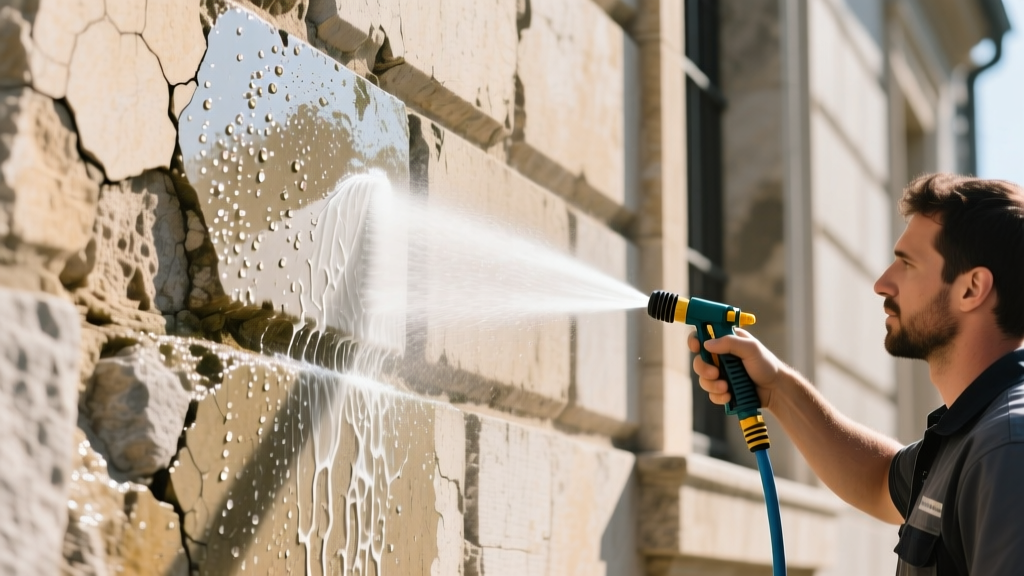
- Rinsing: Rinse thoroughly with clean water at low pressure to remove all detergent residues.
Biological Growth and Efflorescence Management
Limestone's porous nature makes it an ideal substrate for algae, lichen, and moss, particularly in shaded, damp climates. Conversely, efflorescence—the migration of water-soluble salts to the surface—presents a different chemical challenge.
Combating Biological Colonization
While sodium hypochlorite (household bleach) is a common DIY remedy for algae, it is highly discouraged for limestone. Bleach leaves behind soluble salt residues that accelerate efflorescence and can cause micro-fissuring. Instead, use quaternary ammonium compounds (quats) or specialized stone biocides like Prosoco BioKleen. Apply the biocide, allow it to dwell for 15 minutes, and rinse. For entrenched lichen, multiple applications spaced two weeks apart may be necessary to kill the root-like rhizines without mechanical scraping.
Efflorescence Removal Protocol
Efflorescence appears as a white, powdery crust. The most common maintenance error is attempting to wash it off with water, which simply redissolves the salts and drives them back into the stone's pore network.
- Allow the stone and the efflorescence to dry completely.
- Remove the salt deposits using a dry, stiff natural-bristle brush or a HEPA-filtered vacuum.
- Identify and eliminate the source of water intrusion (e.g., failing gutters, missing coping, or rising damp) to prevent recurrence.
Sealer Selection: Vapor Transmission is Non-Negotiable
Applying a sealer to building material limestone is essential for reducing water absorption and stain penetration. However, the type of sealer used can either protect the stone or accelerate its destruction. Exterior limestone must remain 'breathable' to allow trapped moisture vapor to escape. If moisture is trapped behind a non-permeable film, freeze-thaw cycles will cause the stone face to spall and delaminate.
| Sealer Type | Chemical Base | Vapor Permeability | Best Application | Expected Lifespan |
|---|---|---|---|---|
| Penetrating (Impregnator) | Silane / Siloxane | High (Breathable) | Exterior facades, paving, wet areas | 3 to 5 years |
| Enhancing Penetrating | Solvent-based Siloxane | Moderate | Interior feature walls, honed surfaces | 2 to 4 years |
| Topical (Film-Forming) | Acrylic / Urethane | Low / None (Traps Moisture) | Strictly interior, low-traffic decorative | 1 to 2 years |
Targeted Stain Removal Protocols
When spills penetrate the stone's pore structure, surface cleaning is insufficient. Stain removal requires a poultice—a thick paste designed to draw the stain out of the stone via capillary action as it dries. The Natural Stone Institute recommends tailoring the poultice liquid to the specific stain type.
Poultice Mixing and Application
Use an absorbent powder such as diatomaceous earth, kaolin clay, or a commercial poultice powder. Mix the powder with the appropriate chemical liquid until it reaches the consistency of peanut butter.
- Pre-wet the stained area with distilled water to prevent the stone from absorbing the poultice liquid too quickly.
- Apply the poultice over the stain to a thickness of 1/4 to 1/2 inch, extending one inch beyond the stain's perimeter.
- Cover the area with plastic wrap and tape the edges down with painter's tape.
- Poke several small holes in the plastic wrap to allow controlled evaporation.
- Leave the poultice in place for 24 to 48 hours until it is completely dry and powdery.
- Remove the plastic and scrape away the dried poultice using a wooden or plastic scraper. Never use metal, which will scratch the Mohs 3 surface.
Chemical Pairings for Common Stains
- Organic Stains (Leaves, Coffee, Wine, Algae): Mix diatomaceous earth with 12% hydrogen peroxide. For severe cases, a few drops of ammonia can be added to the peroxide to accelerate the oxidation process.
- Oil and Grease Stains: Mix the powder with acetone or mineral spirits. Ensure adequate ventilation and avoid open flames when using flammable solvents.
- Rust and Iron Stains: Rust is notoriously difficult to remove from limestone due to the iron reacting with the calcium. Use a commercial, stone-specific rust remover like Singh's X-treme Clean or Prosoco Rust Remover. Avoid generic hardware store rust removers, as they often contain hydrofluoric acid, which will instantly dissolve limestone.
Maintenance Cost Analysis: DIY vs. Professional
Budgeting for limestone maintenance requires evaluating the scale of the project, the height of the facade, and the severity of the degradation. While routine cleaning and small stain removals are viable DIY projects, large-scale sealing and biological remediation often require professional restoration contractors.
| Maintenance Task | DIY Material Cost (Per Sq. Ft.) | Professional Service Cost (Per Sq. Ft.) | Notes & Variables |
|---|---|---|---|
| Routine pH-Neutral Cleaning | $0.05 - $0.10 | $0.75 - $1.50 | Pro costs increase significantly for scaffolding or lift rentals on multi-story facades. |
| Penetrating Sealer Application | $0.25 - $0.60 | $1.50 - $3.50 | Highly porous limestone may require two coats, increasing material usage by up to 40%. |
| Biological / Efflorescence Remediation | $0.15 - $0.30 | $2.00 - $4.50 | Professional biocide treatments often include follow-up inspections and localized repointing. |
| Poultice Stain Removal | $10 - $25 (Per stain kit) | $150 - $300 (Minimum call-out fee) | DIY is highly recommended for isolated interior stains; pros are needed for widespread exterior staining. |
Proactive maintenance of building material limestone is vastly more cost-effective than reactive restoration. A $500 investment in high-quality siloxane sealers and routine pH-neutral cleaning can prevent tens of thousands of dollars in spalling repair, Dutchman patching, or full block replacement down the line. By respecting the stone's chemical boundaries and utilizing vapor-permeable technologies, property owners can ensure their limestone facades and interiors endure for generations.
Further Reading
For advanced conservation techniques and historical masonry repair, consult the Getty Conservation Institute's research on stone conservation, which provides exhaustive data on the long-term weathering patterns of calcareous stones in varying microclimates.
Written by
David NakamuraDavid Nakamura is a licensed architect (AIA) and construction technology writer focused on sustainable building methods, mass timber engineering, and high-performance building envelopes. He holds a Master of Architecture from the University of Washington and is a certified Passive House Consultant (CPHC). David spent eight years at the Seattle firm Mithun, where he led the design of three LEED Platinum projects, before founding his own practice specializing in net-zero residential design. He serves on the editorial advisory board of GreenBuilder Magazine and has authored peer-reviewed papers on cross-laminated timber (CLT) connections for the Journal of Structural Engineering. In his spare time, David teaches woodworking at Pratt Fine Arts Center and kayaks the Puget Sound.
More from David Nakamura
View all
Construction Cost
Labor Cost to Build a Deck Per Sq Ft: 2026 Installation Guide
Discover the exact labor cost to build a deck per sq ft in 2026. This installation guide breaks down contractor rates, complexity factors, and hidden fees.
Aug 4, 2026

Construction Cost
How Much Does It Cost to Build a 3 Bedroom House? Financing Guide
Learn exactly how much it costs to build a 3 bedroom house and explore 2026 financing options, construction loan types, and budget frameworks for your build.
Aug 4, 2026

Construction Cost
Cost to Build a Tennis Court: 2026 Guide
How much does it cost to build a tennis court in 2026? Breakdowns for asphalt, concrete, and synthetic surfaces plus fencing and lighting.
Jul 30, 2026