How to Install Stone Veneer on Exterior Wall: 2026 Cost Breakdown
Discover the true cost to install stone veneer on an exterior wall in 2026. Detailed breakdown of materials, labor, prep, and hidden expenses.

The True Cost to Install Stone Veneer on Exterior Walls in 2026
Upgrading a home's exterior with stone veneer yields one of the highest returns on investment in residential construction, often recouping over 90% of the project cost at resale. However, understanding how to install stone veneer on exterior wall assemblies requires navigating a complex matrix of material weights, moisture management protocols, and specialized masonry labor. In 2026, while material supply chains have largely stabilized, skilled masonry labor rates have climbed to between $75 and $130 per hour, making precise budget forecasting essential.
For a standard 500-square-foot exterior accent wall, expect to pay between $14,500 and $22,500 fully installed for manufactured stone veneer (MSV), and $21,000 to $35,000 for natural stone.
Material Cost Matrix by Veneer Type
| Veneer Category | Material Cost (per sq. ft.) | Labor Cost (per sq. ft.) | Total Installed Cost |
|---|---|---|---|
| Natural Stone (Granite/Limestone) | $25.00 - $45.00 | $18.00 - $28.00 | $43.00 - $73.00 |
| Manufactured Stone Veneer (MSV) | $12.00 - $22.00 | $14.00 - $22.00 | $26.00 - $44.00 |
| High-Density Polyurethane (Faux) | $8.00 - $16.00 | $6.00 - $12.00 | $14.00 - $28.00 |
Step-by-Step Installation Costs: Where the Budget Goes
Learning how to install stone veneer on exterior wall surfaces is not simply about adhering rocks to siding. The longevity of the installation depends entirely on the substrate preparation and moisture management systems. Skipping these steps leads to efflorescence, mold, and structural rot.
Phase 1: Substrate Preparation & Weatherproofing
Exterior installations mandate a continuous drainage plane. You cannot apply mortar directly to painted wood, vinyl, or rigid foam insulation without a proper mechanical key and moisture barrier.
- Weather-Resistant Barrier (WRB): Two layers of Grade D building paper or a high-performance house wrap (e.g., Tyvek CommercialWrap) costs $0.75 to $1.80 per square foot. The dual-layer approach is critical; the first layer acts as a drainage plane, while the second protects the first from the alkaline degradation caused by wet mortar.
- Corrosion-Resistant Weep Screed: Installed at the base of the wall above the foundation line, a weep screed (minimum 0.019-inch thick galvanized steel or PVC) allows trapped water to escape. Budget $3.50 to $6.00 per linear foot. This is a non-negotiable code requirement in most municipalities to prevent capillary wicking.
- Metal Lath: Self-furring, 18-gauge galvanized woven wire mesh (complying with ASTM C1063) provides the mechanical grip for the mortar. Cost: $2.50 to $4.50 per square foot, including corrosion-resistant staples or nails driven into wall studs every 6 inches.
Phase 2: Mortar, Scratch Coat, and Setting
Once the lath is secured, a scratch coat of mortar is applied and scored horizontally to create a bonding surface for the final setting bed.
- Type S Masonry Mortar: Standard for exterior veneer due to its high tensile strength and flexibility. A 80-lb bag covers roughly 12 square feet at a half-inch thickness and costs $9.00 to $14.00. For a 500 sq. ft. wall, expect to spend $400 to $600 on mortar for both the scratch coat and the setting bed.
- Polymer-Modified Mortars: For areas subject to freeze-thaw cycles or high seismic activity, ANSI A118.4 polymer-modified mortars (like ProSpec or Custom Building Products) are recommended. These cost 30-50% more than standard Type S but drastically reduce the risk of veneer delamination.
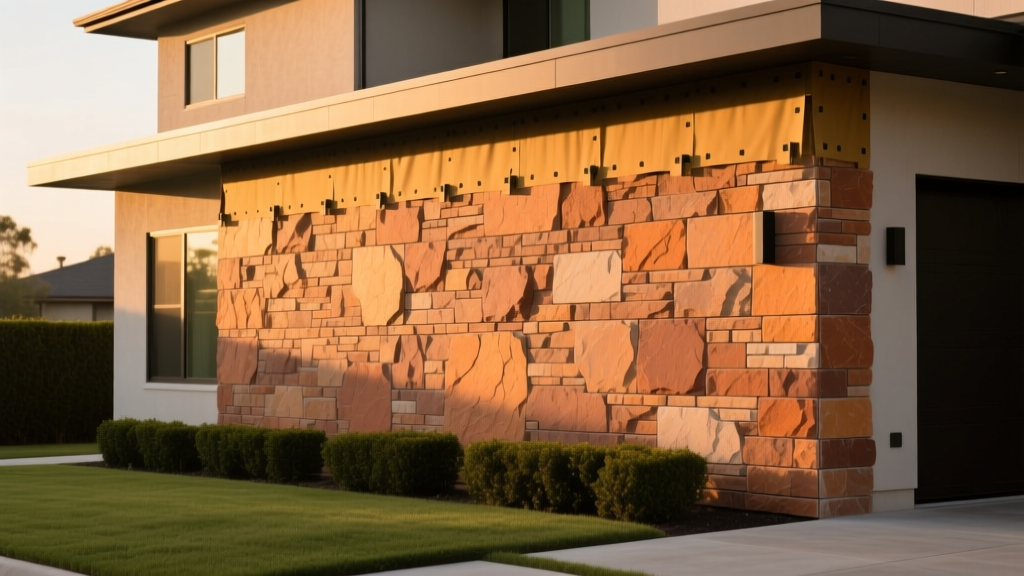
Hidden Costs and Failure Points in Exterior Applications
The most common catastrophic failure in exterior stone veneer is the omission of a capillary break. If the stone veneer or mortar bed makes direct contact with the soil, decking, or concrete patio, groundwater will wick up into the wall. This causes severe efflorescence (white, powdery salt deposits) and rots the bottom plates of the wall framing. Always maintain a minimum 2-inch clearance between the weep screed and any finished grade or hardscape.
Beyond the primary materials, contractors and DIYers frequently underestimate the following ancillary expenses:
- Corner Pieces: Exterior walls require specialized L-shaped corner units to wrap around edges seamlessly. Corners are sold by the linear foot, not the square foot, and carry a 20% to 40% price premium over flat stones. A standard home accent wall may require 40 linear feet of corners, adding $400 to $900 to the material bill.
- Cutting Waste and Breakage: Natural stone and MSV require cutting with a diamond-blade wet saw to fit around windows, outlets, and rooflines. Industry standard dictates ordering a 10% to 15% overage for waste. Failing to account for this results in project delays and mismatched dye-lot shipments.
- Scaffolding and Equipment: For any wall exceeding 8 feet in height, OSHA-compliant scaffolding is required. Renting a Baker scaffold or pump jack system adds $600 to $1,500 to the project overhead. Furthermore, a heavy-duty wet tile saw (e.g., Husqvarna or Felker) rents for about $85 per day.
Material Comparison: Natural vs. Manufactured vs. Polyurethane
When deciding how to install stone veneer on exterior wall projects, the physical properties of the material dictate the structural requirements and labor intensity.
| Feature | Natural Stone | Manufactured (MSV) | Polyurethane (Faux) |
|---|---|---|---|
| Weight | 12 - 18 lbs / sq. ft. | 7 - 12 lbs / sq. ft. | 1 - 2 lbs / sq. ft. |
| Structural Support | Often requires masonry ledge or structural ties | Standard wood framing (up to code limits) | Can mount to almost any surface |
| Installation Speed | 10 - 15 sq. ft. / hour | 15 - 25 sq. ft. / hour | 40 - 60 sq. ft. / hour |
| Freeze-Thaw Durability | Excellent (depends on stone porosity) | Excellent (ASTM C666 tested) | Good (Closed-cell resists water) |
| Lifespan | 75+ Years | 50+ Years | 25 - 40 Years |
DIY vs. Professional Installation: A Financial Decision Framework
Should you hire a licensed masonry contractor or tackle the installation yourself? Use this framework to determine the most financially sound route for your specific project.
When to Hire a Professional Mason
- The project exceeds 150 square feet or involves multi-story scaffolding. The physical toll of mixing hundreds of pounds of mortar and holding heavy stones in place while the mortar cures is immense.
- You are using heavy natural stone (e.g., thick granite or quartzite fieldstone). Natural stone requires an expert eye for load distribution, structural tying, and managing irregular shapes to prevent wall blowouts.
- Your local building code requires a licensed bond for exterior moisture barriers. Improper WRB installation can void your home's structural warranty and lead to catastrophic water damage.
When DIY is Financially Viable
- You are installing High-Density Polyurethane panels. Brands like Novik or GenStone utilize interlocking tongue-and-groove systems that screw directly into the wall sheathing or furring strips. No mortar, no lath, and no curing time. A capable DIYer can install 100 square feet in a single weekend, saving roughly $1,500 in labor.
- The project is a small, single-story accent wall (e.g., wrapping a mailbox, a small porch pillar, or a ground-level skirting). The logistical overhead of scaffolding and commercial mortar mixers is eliminated.
Sourcing and Pro Tips for Budget Optimization
To maximize your budget without compromising the structural integrity of the exterior envelope, implement these procurement strategies:
1. Buy Local Manufactured Stone: MSV is essentially colored concrete. Shipping heavy concrete products across the country incurs massive freight surcharges. Sourcing from a regional manufacturer (or a local distributor of national brands like Cultured Stone or Eldorado) can shave 15% to 25% off the material invoice compared to big-box store ordering.
2. Hunt for Overruns and Discontinued Dye Lots: Masonry supply yards frequently have pallets of discontinued colors or overstock from large commercial jobs. If your project is under 200 square feet, you can often purchase premium manufactured stone at a 40% to 60% discount. Ensure you buy all required flat stones and corners from the exact same batch to avoid color banding.
3. Schedule for the Shoulder Season: Masonry contractors are heavily booked from late spring through early autumn. Scheduling your exterior veneer project for late November or early March (weather permitting, above 40°F for mortar curing) can yield a 10% to 15% discount on labor rates as crews look to fill schedule gaps.
According to recent exterior remodeling data analyzed by Forbes Home Improvement, manufactured stone veneer consistently ranks in the top three exterior upgrades for ROI, often outperforming fiber-cement siding and vinyl replacement. Furthermore, architectural reviews highlighted by Architectural Digest emphasize that the visual depth and shadow lines created by proper mortar joint tooling in MSV are now virtually indistinguishable from natural quarried stone, making the premium for natural rock purely a matter of personal preference rather than a strict aesthetic necessity. By mastering the cost variables and strictly adhering to moisture management protocols, your exterior stone veneer will remain structurally sound and visually striking for decades.
Written by
David NakamuraDavid Nakamura is a licensed architect (AIA) and construction technology writer focused on sustainable building methods, mass timber engineering, and high-performance building envelopes. He holds a Master of Architecture from the University of Washington and is a certified Passive House Consultant (CPHC). David spent eight years at the Seattle firm Mithun, where he led the design of three LEED Platinum projects, before founding his own practice specializing in net-zero residential design. He serves on the editorial advisory board of GreenBuilder Magazine and has authored peer-reviewed papers on cross-laminated timber (CLT) connections for the Journal of Structural Engineering. In his spare time, David teaches woodworking at Pratt Fine Arts Center and kayaks the Puget Sound.
More from David Nakamura
View all
Construction Cost
Labor Cost to Build a Deck Per Sq Ft: 2026 Installation Guide
Discover the exact labor cost to build a deck per sq ft in 2026. This installation guide breaks down contractor rates, complexity factors, and hidden fees.
Aug 4, 2026

Construction Cost
How Much Does It Cost to Build a 3 Bedroom House? Financing Guide
Learn exactly how much it costs to build a 3 bedroom house and explore 2026 financing options, construction loan types, and budget frameworks for your build.
Aug 4, 2026

Construction Cost
Cost to Build a Tennis Court: 2026 Guide
How much does it cost to build a tennis court in 2026? Breakdowns for asphalt, concrete, and synthetic surfaces plus fencing and lighting.
Jul 30, 2026