Split Face Stone Veneer: A Buyer's Guide to Styles and Costs
Compare natural and manufactured split face stone veneer costs, weights, and installation specs. Expert buyer guide for interior and exterior projects.

What Exactly is Split Face Stone Veneer?
Split face stone veneer is created by mechanically or hydraulically splitting a larger block of stone (or cast concrete) to expose the natural, rugged interior fracture plane. Unlike tumbled stone, which is smoothed and rounded, or sawn stone, which features flat, uniform faces, split face profiles retain the raw, three-dimensional texture of the quarry. This manufacturing process yields a highly shadowed, tactile surface that is currently dominating both modern exterior facades and interior feature walls.
For buyers, the primary decision point is not just the aesthetic profile, but the core material composition: natural quarried stone versus manufactured architectural concrete. Each dictates vastly different structural requirements, installation methods, and long-term maintenance protocols.
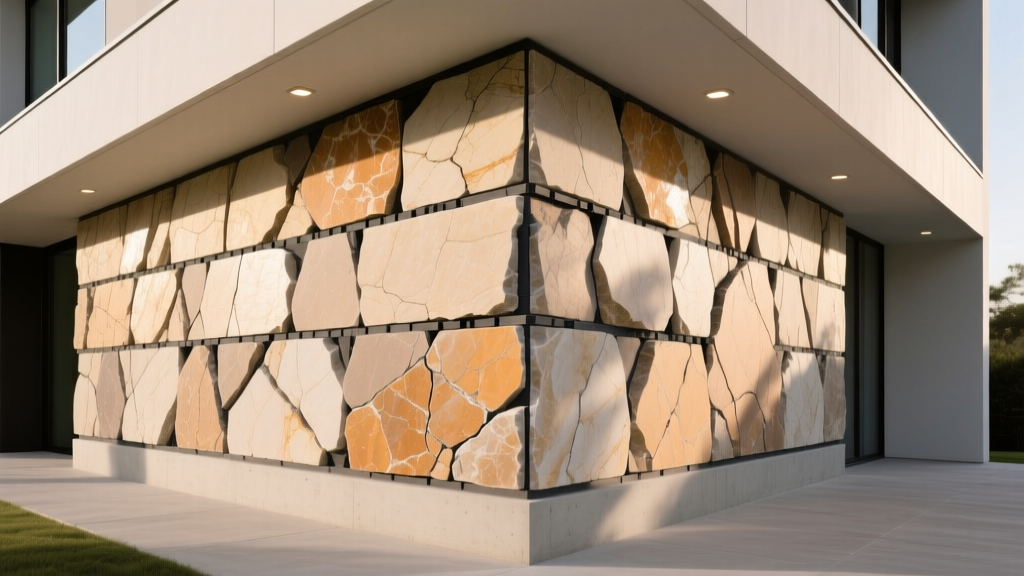
Natural vs. Manufactured: A Buyer's Comparison Matrix
Selecting between natural and manufactured split face veneer requires evaluating the substrate's load-bearing capacity and the project's environmental exposure. The National Concrete Masonry Association (NCMA) provides extensive guidelines on adhered veneer loads, which directly correlate to these material differences.
| Feature | Natural Split Face (Quartzite, Slate, Limestone) | Manufactured Split Face (Concrete/Pumice Blend) |
|---|---|---|
| Weight | 9 - 14 lbs per sq. ft. | 6 - 9 lbs per sq. ft. |
| Thickness | 1.0 - 2.5 inches (highly variable) | 0.75 - 1.5 inches (uniform) |
| Color Consistency | High variation; subject to quarry vein shifts | Controlled; batch-dyed with iron oxide pigments |
| Substrate Requirement | Requires reinforced masonry or heavy-gauge metal lath | Standard wood/steel stud with cement board or lath |
| UV & Frost Resistance | Excellent (if high-density quartzite/slate) | Good (requires air-entrained concrete mix and sealers) |
Installation Formats: Loose Stone vs. Mesh-Backed Panels
A critical evolution in the split face market is the proliferation of mesh-backed panels. While traditional loose stone requires a mason to individually select, dry-fit, and mortar each piece, mesh-backed panels feature pre-arranged split face stones glued to a fiberglass mesh grid (typically in 6" x 24" or 12" x 24" modules).
2026 Cost Breakdown: Material and Installation Rates
Pricing for split face veneer fluctuates based on quarry origin and freight distances. Natural stone imported from overseas (e.g., Indian quartzite or Chinese slate) often carries heavy freight surcharges, whereas domestically manufactured concrete veneer offers more predictable regional pricing.
Average Installed Cost per Square Foot
- Manufactured Split Face (Material): $6.50 - $11.00
- Natural Split Face (Material): $9.00 - $18.00
- Prep Materials (Lath, WRB, Mortar): $2.50 - $4.50
- Professional Masonry Labor: $14.00 - $24.00
- Total Installed Range: $23.00 - $46.50 per sq. ft.
Note: Complex geometries, such as wrapping 90-degree outside corners, require specialized corner pieces that cost 30% to 50% more per linear foot than flat fieldstone.
Code Compliance and Critical Clearances
Adhered masonry veneer is strictly regulated to prevent moisture entrapment and structural overloading. According to the International Code Council (ICC) under IBC Section 1404.10, adhered veneer must be supported on concrete or masonry foundations. Buyers and contractors must enforce the following clearances during installation:
- Earth Clearance: Minimum 4-inch gap between the bottom of the stone veneer and the soil grade to prevent moisture wicking and termite ingress.
- Hardscape Clearance: Minimum 2-inch gap above paved surfaces, decks, or concrete patios.
- Weep Screeds: A corrosion-resistant weep screed must be installed at the base of the wall to allow incidental moisture behind the WRB to drain out. The veneer must terminate above this screed, never resting directly on it.
Common Failure Modes and Expert Mitigation
Split face stone's deep crevices and shadow lines make it uniquely susceptible to specific installation errors. Understanding these failure modes is essential for specifying the right materials.
1. Efflorescence and Salt Migration
The Problem: White, powdery deposits appear on the stone face. This occurs when water-soluble salts from the Portland cement mortar migrate through the porous stone and crystallize on the surface upon evaporation.
The Fix: Specify Type S or Type N mortar rather than high-strength Type M, which has a higher Portland cement content. Ensure the wall assembly includes a capillary break and proper flashing to prevent bulk water intrusion.
2. Acid Etching on Calcite-Based Stones
The Problem: Mortar smears are inevitable during installation. The standard masonry practice is to clean the wall with a diluted muriatic acid solution. However, if your split face veneer is natural limestone, marble, or travertine, acid will instantly etch and dissolve the stone's face, ruining the texture.
The Fix: For calcite-based natural stones, mandate the use of non-acidic, specialized masonry cleaners (such as Sure Klean 600 or equivalent alkaline cleaners) and require masons to use the "dry brushing" method to remove excess mortar before it fully cures.
3. Spalling in Freeze-Thaw Climates
The Problem: Water pools in the horizontal ledges of the split face profile, freezes, expands, and pops the face off the stone (spalling).
The Fix: In climate zones with severe freeze-thaw cycles, avoid low-density sedimentary stones. Specify high-density quartzite or manufactured veneer rated for ASTM C67 freeze-thaw testing. Apply a breathable, silane-siloxane penetrating sealer post-installation to repel bulk water without trapping vapor.
Top Brand Profiles for Split Face Profiles
When sourcing manufactured split face veneer, relying on established brands ensures access to matched mortar colors, UV-stable pigments, and documented technical installation resources.
Eldorado Stone
Eldorado's "Ledgestone" profile is the industry benchmark for manufactured split face aesthetics. It features long, linear cuts with varying thicknesses that mimic dry-stacked quarry stone. Their color blends, such as "Sierra" and "Alderwood," utilize multi-layered iron oxide pigments that resist UV fading.
Cultured Stone (by Westlake Royal)
Cultured Stone offers the "Dressed Fieldstone" and "Ledgestone" profiles. Their proprietary concrete mix is notably lightweight (averaging 7 lbs/sq ft), reducing the need for structural reinforcement on standard wood-framed exterior walls.
Coronado Stone Products
Coronado specializes in ultra-realistic replicas of specific regional geologies. Their "Split-Face Quartzite" line captures the sharp, crystalline fractures of natural quartzite, making it a preferred choice for contemporary commercial facades where natural stone weight restrictions apply.
Frequently Asked Questions
Can I install split face stone veneer over existing brick?
Yes, but not directly. Existing brick must be cleaned, and a layer of building paper or house wrap must be applied, followed by self-furring metal lath anchored into the brick joints with masonry screws. A scratch coat of mortar is then applied before setting the stone. Never apply thinset or mortar directly to painted or sealed brick, as the bond will fail.
Does split face stone require sealing?
Natural stone in exterior applications highly benefits from a breathable penetrating sealer to prevent water absorption and subsequent freeze-thaw damage. Manufactured concrete veneer is generally sealed at the factory, but a secondary application of a silane-siloxane sealer every 5 to 7 years is recommended in harsh climates. Never use film-forming acrylic sealers, which trap moisture and cause peeling.
Written by
David NakamuraDavid Nakamura is a licensed architect (AIA) and construction technology writer focused on sustainable building methods, mass timber engineering, and high-performance building envelopes. He holds a Master of Architecture from the University of Washington and is a certified Passive House Consultant (CPHC). David spent eight years at the Seattle firm Mithun, where he led the design of three LEED Platinum projects, before founding his own practice specializing in net-zero residential design. He serves on the editorial advisory board of GreenBuilder Magazine and has authored peer-reviewed papers on cross-laminated timber (CLT) connections for the Journal of Structural Engineering. In his spare time, David teaches woodworking at Pratt Fine Arts Center and kayaks the Puget Sound.
More from David Nakamura
View all
Construction Cost
Labor Cost to Build a Deck Per Sq Ft: 2026 Installation Guide
Discover the exact labor cost to build a deck per sq ft in 2026. This installation guide breaks down contractor rates, complexity factors, and hidden fees.
Aug 4, 2026

Construction Cost
How Much Does It Cost to Build a 3 Bedroom House? Financing Guide
Learn exactly how much it costs to build a 3 bedroom house and explore 2026 financing options, construction loan types, and budget frameworks for your build.
Aug 4, 2026

Construction Cost
Cost to Build a Tennis Court: 2026 Guide
How much does it cost to build a tennis court in 2026? Breakdowns for asphalt, concrete, and synthetic surfaces plus fencing and lighting.
Jul 30, 2026