The Complete Stone Veneer Pool Surround Material Guide
Expert guide to stone veneer pool surrounds. Compare materials, installation specs, saltwater compatibility, and 2026 costs for durable poolside design.

The Hostile Microclimate of Poolside Environments
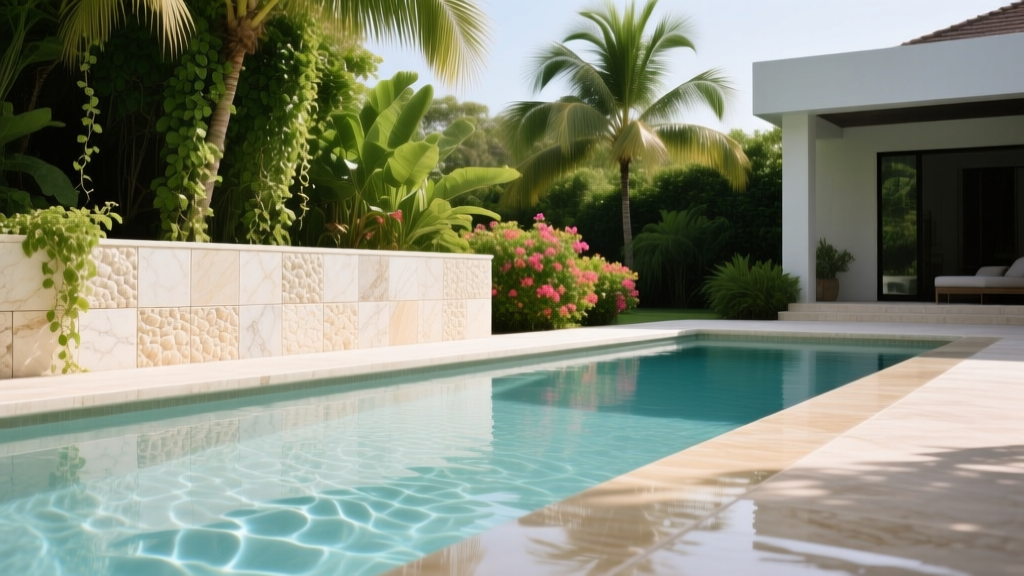
Applying stone veneer to a swimming pool surround, beam face, or adjacent retaining wall introduces the material to one of the most aggressive microclimates in residential construction. Unlike standard exterior facades, a stone veneer pool installation must withstand continuous chemical exposure (chlorine, bromine, muriatic acid), high-velocity UV radiation, constant moisture cycling, and, in many regions, severe freeze-thaw dynamics. Standard exterior installation practices are insufficient here; failure to account for hydrostatic pressure and chemical etching will result in spalling, efflorescence, and catastrophic mortar delamination within two to three seasons.
This guide details the exact material specifications, chemical compatibilities, and installation protocols required for long-lasting poolside stone veneer, drawing on standards from the Natural Stone Institute and the Pool & Hot Tub Alliance (PHTA).
Material Selection Matrix for Stone Veneer Pool Applications
Not all natural or manufactured stones are viable for pool environments. The critical metric for poolside stone is water absorption (tested via ASTM C97). Stones with absorption rates above 3% are highly susceptible to freeze-thaw spalling and chemical infiltration. Below is a comparative matrix of the most common materials used for stone veneer pool projects.
| Material Type | ASTM C97 Absorption | Slip Resistance (Wet) | Saltwater Tolerance | Avg. Material Cost (2026) |
|---|---|---|---|---|
| Quartzite (Siliceous) | 0.1% - 0.5% | High (if cleft/thermal) | Excellent | $14.00 - $22.00 / sq.ft. |
| Travertine (Calcareous) | 2.0% - 4.5% | Very High (tumbled) | Poor (Requires Sealing) | $9.00 - $16.00 / sq.ft. |
| Bluestone (Siliceous) | 0.5% - 1.5% | High (thermal finish) | Good | $11.00 - $18.00 / sq.ft. |
| Manufactured Stone Veneer (MSV) | Variable (2% - 8%) | Moderate | Moderate | $6.00 - $12.00 / sq.ft. |
| Limestone (Calcareous) | 3.0% - 7.0% | Moderate | Very Poor | $10.00 - $15.00 / sq.ft. |
Deep Dive: Quartzite vs. Travertine
Quartzite is the premier choice for high-end pool veneers. As a metamorphic siliceous rock, it is virtually impervious to pool chemicals and salt. Its natural cleft or thermal finishes provide excellent wet slip resistance. However, its density makes cutting and shaping on-site labor-intensive, requiring diamond-tipped continuous rim blades.
Travertine remains highly popular for its aesthetic warmth and naturally cool surface temperature under direct sunlight. However, because it is calcareous (calcium carbonate-based), it will actively react with acidic pool cleaners and saltwater. If you specify travertine for a stone veneer pool surround, it must be tumbled (for slip resistance) and sealed with a high-solids, solvent-based impregnator annually.
Chemical Compatibility: The Saltwater and Chlorine Factor
The rise of saltwater chlorination systems has fundamentally changed poolside material specifications. Saltwater pools do not contain pure saltwater like the ocean; they use salt chlorine generators (SCGs) that electrolyze dissolved salt (typically 3,000 ppm) to produce hypochlorous acid. When pool water splashes onto the stone veneer and evaporates, it leaves behind concentrated salt crystals and acidic residues.
Never install unsealed limestone, marble, or low-density travertine around a saltwater pool. The salt and mild acid will cause 'pitting'—a rapid dissolution of the calcium carbonate matrix that leaves the stone looking like a sponge. If a client insists on calcareous stone for a saltwater environment, mandate a penetrating silane/siloxane sealer applied to all six sides of the veneer prior to installation.
For traditional chlorine pools, the primary threat is not pitting, but rather efflorescence and chloride-induced mortar degradation. Chlorides can penetrate standard cementitious mortars, reaching the metal lath behind the veneer. If the lath is not heavily galvanized (minimum ASTM A653 G60 coating) or if a stainless steel lath is omitted, the resulting rust expansion will blow the stone face off the wall.
Installation Specifications: Mortar, Membranes, and Drainage
The Natural Stone Institute emphasizes that the longevity of exterior stone is dictated as much by the setting materials as the stone itself. A stone veneer pool beam or surrounding retaining wall requires a specialized assembly.
ANSI-Compliant Mortar Selection
Standard Type S or Type N masonry mortars are entirely inappropriate for poolside stone veneer. They lack the chemical resistance and flexural strength to handle the hydrostatic pressure and thermal expansion of a pool shell. You must specify an ANSI A118.15 (Improved Modified Dry-Set Cement Mortar) or a high-performance polymer-modified thin-set.
- Recommended Product Class: ANSI A118.4 or A118.15 polymer-modified mortars.
- Specific Formulations: LATICRETE 4-XLT or Custom Building Products MegaLite. These offer non-sag properties crucial for vertical pool beam applications and contain polymers that resist chloride penetration.
- Jointing: Use a sanded, latex-Portland cement grout (ANSI A118.7) for joints wider than 1/8 inch, mixed with a liquid latex additive rather than plain water to reduce porosity.
Waterproofing and Hydrostatic Relief
Water will inevitably penetrate the face of the stone veneer through micro-fissures and mortar joints. If this water reaches the substrate (concrete block or poured concrete) and cannot escape, hydrostatic pressure will build, causing the veneer to delaminate.
- Substrate Prep: Apply a fluid-applied waterproofing membrane (e.g., LATICRETE Hydro Ban or Custom RedGard) to the concrete substrate before attaching the metal lath. This creates a secondary barrier protecting the structural pool beam.
- Lath and Scratch Coat: Use 2.5 lb self-furring galvanized or stainless steel woven wire lath. Apply a 3/8-inch scratch coat of polymer-modified mortar, scoring it horizontally to provide a mechanical key for the veneer.
- Weep Screeds and Flashing: Install a corrosion-resistant weep screed at the base of the veneer (where it meets the pool deck). This allows trapped moisture to exit the wall cavity. Never let the stone veneer extend below the pool deck grade; always terminate it at least 1/2 inch above the finished deck surface to prevent wicking.
Sealing Protocols for Calcareous and Siliceous Stones
Sealing is not optional for stone veneer pool surrounds; it is a critical maintenance requirement. The type of sealer must be matched to the stone's mineralogy and the desired aesthetic.
Before applying any sealer to an existing or newly installed pool veneer, perform a water drop test. Place a few drops of water on the stone. If it darkens the stone within 3 minutes, the stone is highly porous and requires a high-solids impregnating sealer. If the water beads up, the stone is either dense (like quartzite) or already sealed.
- Penetrating Sealers (Silane/Siloxane): The gold standard for pool surrounds. These sealers penetrate the stone's pores and react chemically to form a hydrophobic barrier below the surface. They do not alter the stone's natural slip resistance or create a glossy film, which is vital for safety around wet pool edges.
- Enhancing Sealers: Solvent-based enhancers can be used on travertine or slate to deepen the color and highlight the stone's natural veining. However, they must be UV-stable to prevent yellowing under direct poolside sun exposure.
- Film-Forming Sealers (Acrylics/Urethanes): Avoid these entirely for pool coping and horizontal veneer caps. They create a surface film that becomes dangerously slippery when wet and will peel or blister under UV and chemical assault.
2026 Cost Breakdown: Materials, Labor, and Maintenance
Budgeting for a stone veneer pool project requires looking beyond the raw material cost. The specialized labor, setting materials, and waterproofing required for poolside environments add a significant premium over standard exterior wall veneers.
| Project Component | Standard Exterior Wall | Poolside Veneer Premium | Notes |
|---|---|---|---|
| Material (Mid-Range Natural) | $8.00 - $12.00 / sq.ft. | $12.00 - $18.00 / sq.ft. | Requires tighter sorting for density and slip resistance. |
| Setting Materials & Membranes | $1.50 - $2.50 / sq.ft. | $3.50 - $5.00 / sq.ft. | Includes fluid-applied waterproofing and A118.15 mortars. |
| Specialized Masonry Labor | $14.00 - $22.00 / sq.ft. | $24.00 - $38.00 / sq.ft. | Slower installation due to precise cuts and pool safety protocols. |
| Initial Sealing (6-Sided) | $0.50 - $1.00 / sq.ft. | $2.00 - $3.50 / sq.ft. | Mandatory chemical-resistant impregnation for pool environments. |
| Total Estimated Installed Cost | $24.00 - $37.50 / sq.ft. | $41.50 - $64.50 / sq.ft. | Based on 2026 national averages for residential pools. |
When specifying a stone veneer pool surround, prioritize siliceous stones like quartzite or thermal bluestone for the lowest lifecycle maintenance. If the design demands the warmth of travertine, ensure the client understands the mandatory annual sealing schedule and the risks associated with saltwater chlorination. By strictly adhering to polymer-modified mortars, integrating weep screeds, and utilizing penetrating silane sealers, you can deliver a poolside environment that remains structurally sound and visually pristine for decades.
Written by
Sarah WhitfieldSarah Whitfield is a chartered quantity surveyor (MRICS) and construction cost analyst with 15 years of experience in material pricing, procurement strategy, and project budgeting. She earned her degree in Construction Management from the University of Reading (UK) and has worked on projects ranging from $2M custom homes to $180M mixed-use developments across North America and Europe. Sarah currently leads cost estimating for BuildMat Insight, maintaining a proprietary database of 4,000+ material price points updated quarterly. She is a frequent contributor to RSMeans cost data panels and has presented at the International Cost Engineering Council (ICEC) congress. Based in Denver, CO, Sarah is an avid trail runner and volunteer mentor for Women in Construction.
More from Sarah Whitfield
View all
Wood & Lumber
What Are the Different Types of Wood? A Builder's Guide
Compare structural softwoods, finish hardwoods, and engineered lumber. Analyze Janka ratings, MOE values, and 2026 pricing for construction.
Aug 4, 2026

Walls & Panels
Steel Framing vs Wood Framing: Corrosion and Moisture Defense
Compare steel framing vs wood framing for moisture resistance. Learn about galvanized coatings, condensation risks, and corrosion protection strategies.
Jul 21, 2026

Stone & Masonry
How to Cut Stone Veneer: Wet Saw vs Grinder Comparison
Compare the best tools for cutting stone veneer. We review wet saws, angle grinders, and chop saws to help you achieve clean, chip-free cuts.
Jul 21, 2026