Indoor Stone Veneer Design Showcase: Modern Interior Ideas
Discover stunning indoor stone veneer design ideas. Explore modern interior applications, material pairings, and expert styling tips for your home.

The integration of natural textures into interior architecture has shifted from a rustic novelty to a foundational element of modern biophilic design. Indoor stone veneer offers the tactile depth and visual weight of quarried masonry without the structural load-bearing requirements of full-thickness stone. When executed with precision, manufactured and natural thin stone veneers transform flat drywall surfaces into dynamic, light-catching focal points. This showcase explores advanced design strategies, material pairings, and technical specifications for deploying indoor stone veneer in contemporary residential and commercial spaces.
Curating the Right Stone Profile for Your Room
The visual impact of an interior stone wall is dictated primarily by its profile—the shape, size, and arrangement of the individual stones. Selecting a profile requires analyzing the room's scale, ceiling height, and existing architectural lines. A massive, irregular fieldstone will overwhelm a compact powder room, while a tight, linear stacked ledger stone might look lost on a towering two-story great room wall.
| Stone Profile | Visual Characteristics | Best Interior Application | Design Style Alignment |
|---|---|---|---|
| Stacked Ledger | Uniform, linear, tight joints, horizontal emphasis | Fireplace surrounds, media walls, narrow corridors | Contemporary, Minimalist, Mid-Century Modern |
| Fieldstone / Rubble | Irregular shapes, deep grout lines, organic flow | Wine cellars, rustic kitchen islands, accent walls | Farmhouse, Rustic, Transitional, Craftsman |
| Ashlar / Cut Stone | Rectangular, varied heights, clean edges, masonry look | Range hoods, wainscoting, home office feature walls | Traditional, Industrial, Urban Loft |
| Ledge / Classic | Elongated, varied thickness, shadow-heavy, natural cleft | Stairwell columns, vaulted ceiling transitions | Organic Modern, Southwestern, Lodge |
For a highly tailored contemporary look, specify profiles like Eldorado Stone's RoughCut or Coronado Stone's Venetian Villa, which offer sharp, geometric lines. For organic, textural warmth, Cultured Stone's Country Rubble provides the deep, undulating shadows characteristic of historic European masonry.
The Architecture of Light: Grazing vs. Washing
The most common design failure in indoor stone veneer installation is improper lighting. Stone relies on shadow to reveal its texture. If you illuminate a textured veneer with a wide-angle floodlight from a distance, you effectively "wash" the wall, flattening the texture and turning a premium material into a muddy, monochromatic surface.
Expert Lighting Specification: Wall Grazing
To maximize the three-dimensional quality of indoor stone veneer, utilize wall grazing. This technique places the light source extremely close to the wall (typically 6 to 12 inches from the surface) and angles the beam sharply downward or upward.
- Fixture Placement: Recessed adjustable gimbal lights or linear LED tape channels mounted 6" to 10" from the stone face.
- Beam Angle: Specify narrow beam angles between 15 and 30 degrees. Avoid 60-degree wide floods.
- Color Temperature: Use 2700K to 3000K LEDs. Warmer temperatures enhance the earthy ochres, siennas, and grays inherent in natural stone, whereas 4000K+ daylight bulbs can make manufactured veneer look sterile and artificial.
Material Pairings and Palette Curation
Indoor stone veneer should never exist in a vacuum; it must be anchored by complementary materials that balance its visual heaviness. The goal is to create a dialogue between the rough, cold nature of the stone and softer or more refined elements.
Wood and Timber
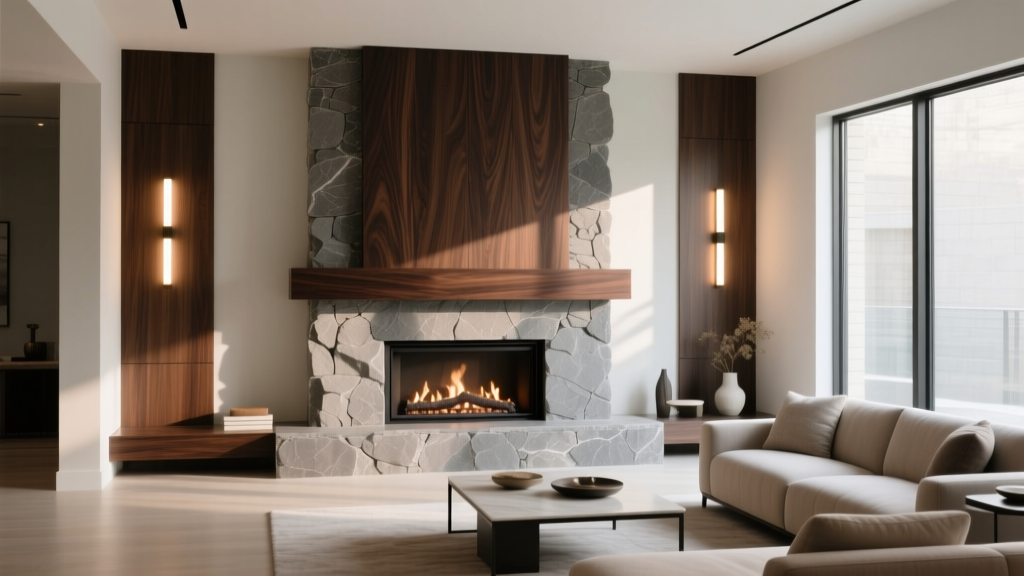
Pairing stone with warm wood is a cornerstone of biophilic design. For dark, charcoal, or slate-gray veneers, contrast with rich, dark timbers like black walnut or stained white oak. If the stone features warm earth tones (tans, golds, rust), utilize lighter, wire-brushed white oak or bleached ash to prevent the space from feeling overly heavy or dated. Floating wooden mantels (minimum 3-inch thick solid slab) provide a striking horizontal break against vertical stone applications.
Metals and Hardware
Matte black steel and brushed brass are the premier metal pairings for modern stone interiors. Matte black offers a sharp, graphic contrast against light limestone or sandstone profiles. Brushed brass or unlacquered copper introduces a reflective, luxurious element that catches the grazing light, working exceptionally well in sophisticated spaces like master bathrooms or high-end kitchen range hoods.
Paint and Wall Coverings
The walls adjacent to the stone veneer should act as a neutral canvas. Avoid high-gloss paints, which compete with the stone's texture. Opt for matte or flat finishes. Limewash paints (such as those by Color Atelier or Sydney Harbour) offer a subtle, cloudy depth that bridges the gap between the raw stone and the smooth drywall, creating a highly curated, Old World aesthetic.
High-Impact Applications Beyond the Accent Wall
While the living room fireplace remains the most popular application, interior designers are increasingly deploying indoor stone veneer in high-utility zones to elevate everyday spaces.
Kitchen Islands and Range Hoods
Cladding a kitchen island base or a custom plaster range hood in thin stone veneer grounds the kitchen and adds architectural permanence. When cladding an island, ensure the stone profile is relatively flat (like an Ashlar or tight Stacked profile) to prevent snagging clothing or scraping the knees of seated guests. Overhang the stone countertop by at least 1.5 inches to protect the veneer from spills and foot traffic.
Spa-Inspired Wet Areas
Using stone veneer inside a shower or behind a freestanding soaking tub creates a luxurious, spa-like environment. However, wet areas require strict technical adherence to prevent failure.
Critical Technical Warning: Wet Area Substrates
Never install stone veneer directly over standard drywall or greenboard in wet zones. The substrate must be a cementitious backer board (e.g., 1/2" HardieBacker or Durock) coated with a liquid waterproofing membrane like Custom Building Products RedGard. Furthermore, use a polymer-modified Type S mortar for adhesion, and seal the finished stone with a breathable, penetrating siloxane sealer to prevent soap scum buildup and efflorescence.
Budgeting for Premium Interior Veneer
Understanding the cost breakdown of indoor stone veneer is essential for accurate project forecasting. Prices fluctuate based on whether you select natural thin veneer (NTV) or manufactured stone veneer (MSV), as well as the complexity of the installation.
| Cost Component | Manufactured Stone Veneer (MSV) | Natural Thin Stone Veneer (NTV) |
|---|---|---|
| Material Cost (per sq. ft.) | $7.50 - $12.00 | $11.00 - $18.00+ |
| Corner Pieces (per linear ft.) | $8.00 - $14.00 | $12.00 - $22.00 |
| Substrate & Mortar Materials | $2.50 - $4.00 per sq. ft. | $2.50 - $4.00 per sq. ft. |
| Professional Installation Labor | $12.00 - $20.00 per sq. ft. | $18.00 - $30.00 per sq. ft. |
| Total Estimated Installed Cost | $22.00 - $36.00 per sq. ft. | $31.50 - $54.00+ per sq. ft. |
Note: Complex installations involving multiple outside corners, arched openings, or high-ceiling scaffolding requirements will push labor costs toward the upper end of these ranges.
Frequently Asked Design Questions
Can indoor stone veneer be installed over an existing brick fireplace?
Yes, but not directly. Existing brick must be cleaned of soot and sealed, then covered with a layer of metal lath and a 1/2-inch scratch coat of mortar to provide a uniform, stable bonding surface. Alternatively, you can furr out the brick with pressure-treated 2x2s, attach cement backer board, and install the veneer over that substrate.
How do I clean and maintain interior stone veneer?
Routine maintenance requires only dusting with a soft brush or vacuuming with a brush attachment. For deeper cleaning, use a mild, pH-neutral detergent and a soft bristle brush. Never use acid-based cleaners, wire brushes, or high-pressure washers, as these will degrade the surface of manufactured stones and strip the protective sealers off natural stones.
Does stone veneer add resale value to a home?
According to industry data tracked by the National Kitchen & Bath Association (NKBA) and various real estate appraisal studies, high-quality interior stone applications—particularly in kitchens and primary bathrooms—consistently rank among the top interior upgrades for perceived value and buyer appeal. For further technical installation standards and profile specifications, resources from manufacturers like Eldorado Stone provide comprehensive guidelines to ensure your design translates flawlessly into reality.
Written by
Sarah WhitfieldSarah Whitfield is a chartered quantity surveyor (MRICS) and construction cost analyst with 15 years of experience in material pricing, procurement strategy, and project budgeting. She earned her degree in Construction Management from the University of Reading (UK) and has worked on projects ranging from $2M custom homes to $180M mixed-use developments across North America and Europe. Sarah currently leads cost estimating for BuildMat Insight, maintaining a proprietary database of 4,000+ material price points updated quarterly. She is a frequent contributor to RSMeans cost data panels and has presented at the International Cost Engineering Council (ICEC) congress. Based in Denver, CO, Sarah is an avid trail runner and volunteer mentor for Women in Construction.
More from Sarah Whitfield
View all
Wood & Lumber
What Are the Different Types of Wood? A Builder's Guide
Compare structural softwoods, finish hardwoods, and engineered lumber. Analyze Janka ratings, MOE values, and 2026 pricing for construction.
Aug 4, 2026

Walls & Panels
Steel Framing vs Wood Framing: Corrosion and Moisture Defense
Compare steel framing vs wood framing for moisture resistance. Learn about galvanized coatings, condensation risks, and corrosion protection strategies.
Jul 21, 2026

Stone & Masonry
How to Cut Stone Veneer: Wet Saw vs Grinder Comparison
Compare the best tools for cutting stone veneer. We review wet saws, angle grinders, and chop saws to help you achieve clean, chip-free cuts.
Jul 21, 2026