Price to Install Stone Veneer: Technical Cost Breakdown
Analyze the price to install stone veneer with 2026 technical specs, covering mortar types, lath requirements, substrate prep, and exact labor costs.

The Anatomy of Stone Veneer Installation Costs
Calculating the exact price to install stone veneer requires moving beyond superficial per-square-foot averages and examining the structural, chemical, and labor-driven variables that dictate final project costs. In 2026, the baseline price to install stone veneer ranges from $16.50 to $34.00 per square foot for manufactured architectural products, and $24.00 to $48.00 for natural quarry stone. However, these figures are meaningless without contextualizing the technical specifications required for a code-compliant, moisture-managed assembly.
The total installed cost is an equation of substrate preparation, material weight, mortar chemistry, and labor complexity. A standard flat-wall application on a prepared concrete masonry unit (CMU) substrate will sit at the lower end of the pricing spectrum. Conversely, wood-framed exterior walls requiring a full weather-resistive barrier (WRB), weep screeds, metal lath, and a scratch coat will push the price to install stone veneer toward the upper limits due to the compounded material and labor phases.
Substrate Preparation & Moisture Management Specs
Before a single stone is set, the substrate must be engineered to handle both the dead load of the masonry and the hydrostatic pressure of bulk water intrusion. The cost of substrate preparation typically accounts for 15% to 22% of the total project budget.
Wood Framing vs. CMU Substrates
For wood or steel stud framing, the assembly requires two layers of Grade D building paper or a continuous fluid-applied WRB over the structural sheathing (OSB or plywood). This is followed by the installation of a corrosion-resistant weep screed at the base, which must be positioned a minimum of 2 inches above grade or 1/2 inch above paving. The National Veneer Stone Association (NVSA) mandates that all flashing integrate seamlessly with the WRB to create a continuous drainage plane.
When installing directly over CMU or poured concrete, the substrate prep cost drops significantly. Provided the concrete is clean, unpainted, and structurally sound, the lath and scratch coat can be applied directly using mechanical fasteners or powder-actuated pins, eliminating the need for a separate WRB and weep screed system.
Material Specifications & Unit Pricing Matrix
The selection of the veneer product itself dictates the baseline material cost. Manufactured stone veneer (MSV) is composed of Portland cement, lightweight aggregates, and iron oxide pigments, making it significantly lighter and more uniform than natural stone.
| Material Type | ASTM Standard | Unit Cost (per sq ft) | Weight (psf) |
|---|---|---|---|
| Manufactured Stone (Standard Profile) | ASTM C1670 | $6.50 - $10.00 | 10 - 12 lbs |
| Manufactured Stone (Premium/Ledge) | ASTM C1670 | $10.00 - $14.50 | 12 - 15 lbs |
| Natural Limestone / Sandstone | ASTM C616 / C568 | $14.00 - $22.00 | 15 - 25 lbs |
| Natural Granite / Slate | ASTM C615 / C629 | $22.00 - $35.00 | 25 - 35 lbs |
Mortar Chemistry and Lath Requirements
The hidden cost drivers in any masonry project are the bonding agents and armatures. Mortar is not a universal adhesive; its chemical composition must be matched to the environment and the substrate.
Type S vs. Type N Mortar Selection
According to technical guidelines published by the Portland Cement Association, Type S mortar is mandatory for exterior veneer applications. Type S features a higher compressive strength (minimum 1,800 psi) and superior tensile bond strength compared to Type N, making it resistant to wind-driven rain and freeze-thaw cycling. Type N mortar (minimum 750 psi) is strictly reserved for interior, climate-controlled applications where structural movement and moisture intrusion are negligible.
Using Type N on an exterior facade to save approximately $0.40 per square foot on material costs is a critical failure point that will result in joint cracking and stone detachment.
Lath and Scratch Coat Specifications
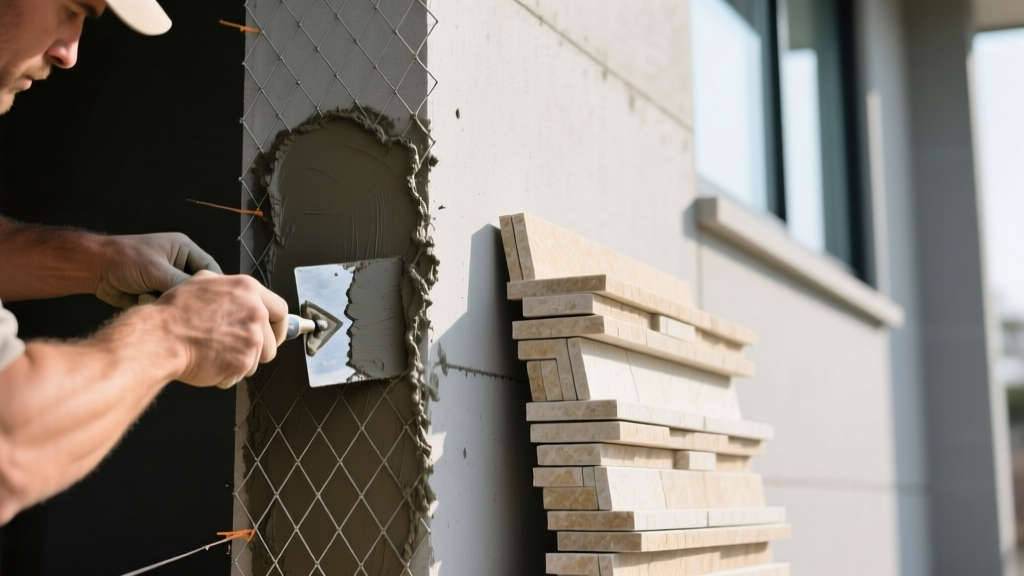
For framed assemblies, ASTM A641 galvanized diamond mesh lath (minimum 2.5 lbs per square yard) must be applied with a 1/4-inch self-furring dimple. Fasteners must be 1-1/4 inch galvanized roofing nails or staples, penetrating wood studs by a minimum of 1 inch, spaced at 6 inches on center vertically and 16 inches horizontally. The lath must be overlapped by 1 inch on horizontal seams and 2 inches on vertical seams.
Following lath installation, a 1/2-inch thick scratch coat of Type S mortar is applied and scored horizontally to a depth of 1/16 inch to provide a mechanical key. This scratch coat requires a minimum 24-hour curing period before the setting bed and veneer can be applied, directly impacting labor scheduling and overall project timelines.
Labor Rates by Technical Complexity
Labor constitutes 50% to 65% of the total price to install stone veneer. Skilled mason rates in 2026 average between $65 and $95 per hour, but the effective square-footage rate fluctuates wildly based on architectural complexity.
- Flat Wall Runs (Exterior): $8.00 to $11.00 per sq ft. Continuous, unbroken wall planes allow for rapid setting bed application and consistent course alignment.
- Interior Feature Walls (Fireplaces/Accents): $12.00 to $16.00 per sq ft. Tight spaces, intricate cuts around mantels, and the need for meticulous dry-stacking aesthetics slow production rates by up to 40%.
- Outside Corners and Quoins: Priced per linear foot ($14.00 to $22.00/LF). Pre-formed corner units require precise mitering and back-buttering to ensure structural interlock and visual continuity.
- Soffits and Overhead Arches: $18.00 to $25.00 per sq ft. Gravity-defying installations require mechanical pinning (stainless steel masonry ties driven into the substrate and embedded in the mortar joint) in addition to standard mortar adhesion, drastically increasing labor time.
Estimating Framework: Commercial vs. Residential
When budgeting for large-scale deployments, the pricing model shifts from artisan-crafted residential rates to production-based commercial metrics.
Commercial Multi-Family & Hospitality: Projects exceeding 5,000 square feet benefit from economies of scale. Material procurement is palletized directly from the manufacturer, reducing waste from 8% to roughly 3%. Scaffolding erection costs are amortized over a larger area, and specialized masonry crews utilizing mortar pumps and silos can reduce the labor cost per square foot by 15% to 20% compared to residential hand-mixing methods.
For residential renovations under 500 square feet, contractors will apply a premium to the price to install stone veneer to account for mobilization, small-batch material ordering, and the inability to maintain continuous crew momentum.
Technical FAQs on Veneer Pricing
How does stone weight affect structural framing costs?
Manufactured stone veneer weighs between 10 and 15 pounds per square foot (psf). Standard 2x6 wood framing with 16-inch on-center spacing can easily support this dead load without reinforcement. However, if you specify dense natural granite or slate (up to 35 psf), structural engineering may require reducing stud spacing to 12 inches on-center or upgrading to engineered lumber, adding $1.50 to $3.00 per square foot to the underlying framing budget before the masonry work even begins.
Are mortarless or interlocking panel systems cheaper to install?
Mortarless, high-density polyurethane or aluminum-backed interlocking stone panels reduce labor costs by up to 50% because they eliminate the need for lath, scratch coats, and wet masonry work. However, the material cost for these proprietary systems is often 30% to 40% higher than traditional manufactured stone. The net price to install stone veneer using panel systems usually evens out with traditional methods, though the timeline is compressed from days to hours.
What is the maintenance cost difference between natural and manufactured stone?
Natural stone is highly porous and typically requires a breathable, silane-based penetrating sealer every 3 to 5 years in exterior applications, adding $0.75 to $1.25 per square foot to long-term maintenance. High-quality manufactured stone, manufactured with integral color and low water-absorption aggregates (complying with ASTM C1670), generally requires zero chemical sealing, relying solely on proper flashing and weep screeds for moisture management.
Written by
Sarah WhitfieldSarah Whitfield is a chartered quantity surveyor (MRICS) and construction cost analyst with 15 years of experience in material pricing, procurement strategy, and project budgeting. She earned her degree in Construction Management from the University of Reading (UK) and has worked on projects ranging from $2M custom homes to $180M mixed-use developments across North America and Europe. Sarah currently leads cost estimating for BuildMat Insight, maintaining a proprietary database of 4,000+ material price points updated quarterly. She is a frequent contributor to RSMeans cost data panels and has presented at the International Cost Engineering Council (ICEC) congress. Based in Denver, CO, Sarah is an avid trail runner and volunteer mentor for Women in Construction.
More from Sarah Whitfield
View all
Wood & Lumber
What Are the Different Types of Wood? A Builder's Guide
Compare structural softwoods, finish hardwoods, and engineered lumber. Analyze Janka ratings, MOE values, and 2026 pricing for construction.
Aug 4, 2026

Walls & Panels
Steel Framing vs Wood Framing: Corrosion and Moisture Defense
Compare steel framing vs wood framing for moisture resistance. Learn about galvanized coatings, condensation risks, and corrosion protection strategies.
Jul 21, 2026

Stone & Masonry
How to Cut Stone Veneer: Wet Saw vs Grinder Comparison
Compare the best tools for cutting stone veneer. We review wet saws, angle grinders, and chop saws to help you achieve clean, chip-free cuts.
Jul 21, 2026