Stackable Stone Veneer Buyer's Guide: Materials, Costs, and Top Brands
Compare top stackable stone veneer materials, costs, and brands. Our expert buyer's guide covers installation specs, durability, and design applications.

The Material Matrix: Natural vs. Manufactured vs. Polyurethane
Stackable stone veneer provides the rugged, linear aesthetic of dry-stacked masonry without the structural load-bearing requirements of full-thickness stone. For buyers navigating the 2026 market, the primary decision hinges on selecting the right core material. The industry currently segments stackable veneer into three distinct categories, each with specific weight profiles, durability metrics, and installation requirements.
| Material Type | Average Weight | Material Cost (per sq. ft.) | Best Application | Core Limitation |
|---|---|---|---|---|
| Natural Stone Veneer | 12 - 18 lbs | $15.00 - $28.00 | High-end exteriors, permanent architectural features | Requires heavy structural lath and mortar base |
| Manufactured Stone (AMSV) | 8 - 12 lbs | $6.50 - $12.00 | Interior fireplaces, exterior wainscoting, full-home cladding | Color can fade if exposed to intense, direct UV without sealant |
| High-Density Polyurethane | 1.5 - 3 lbs | $9.00 - $14.00 | DIY interiors, skirting, non-load-bearing accent walls | Susceptible to warping under high heat; not for fireboxes |
Manufactured stone veneer (often referred to as Architectural Manufactured Stone Veneer or AMSV) dominates the residential market. According to ASTM C1670 standards, high-quality AMSV must pass rigorous freeze-thaw and flexural strength testing, ensuring it performs comparably to natural stone in exterior climates while costing roughly 50% less.
Mortared vs. Mortarless Stackable Systems
The term "stackable" can be misleading in the masonry supply chain. Buyers must distinguish between the visual profile of the stone and the actual installation methodology.
Mortared Dry-Stack Profile
Most "stacked stone" products sold by major masonry brands are actually designed to be installed with a mortar scratch coat and a setting bed. The stones are manufactured with tight, straight edges that allow them to be pushed closely together. The installer wipes the joints clean or uses a dry-brush technique to hide the mortar, creating the illusion of a mortarless dry-stack wall. This method is mandatory for exterior applications in climates with driving rain, as the mortar base provides a secondary water-resistive barrier.
True Mortarless Interlocking Panels
True mortarless stackable systems utilize high-density polyurethane or specialized lightweight concrete panels with tongue-and-groove or shiplap interlocking edges. These are screwed directly into furring strips or structural sheathing. While installation is 70% faster and requires no masonry skills, the interlocking seams can sometimes be visible under raking light, and the panels lack the thermal mass and acoustic dampening of cementitious alternatives.
Choose Mortared AMSV if: You are cladding an exterior wall, building a wood-burning fireplace surround, or require a Class A fire rating.
Choose Mortarless Panels if: You are executing a DIY interior accent wall, upgrading mobile home skirting, or working on a tight timeline where curing time is prohibitive.
2026 Cost Analysis & ROI Breakdown
Pricing for stackable stone veneer extends beyond the per-square-foot material cost. A comprehensive budget must account for substrate preparation, waste factors, and specialized corner pieces, which are priced per linear foot.
| Cost Component | Manufactured Stone (AMSV) | Polyurethane Panels |
|---|---|---|
| Flat Wall Material | $6.50 - $12.00 / sq. ft. | $9.00 - $14.00 / sq. ft. |
| Corner Pieces | $10.00 - $18.00 / lin. ft. | $15.00 - $22.00 / lin. ft. |
| Substrate Prep (Lath, WRB, Mortar) | $2.50 - $4.00 / sq. ft. | $0.50 - $1.50 / sq. ft. (Furring strips) |
| Professional Installation Labor | $12.00 - $22.00 / sq. ft. | $4.00 - $8.00 / sq. ft. |
| Total Installed Cost | $21.00 - $38.00 / sq. ft. | $13.50 - $23.50 / sq. ft. |
Pro Tip on Waste Calculation: When ordering stackable stone, always calculate a 10% waste factor for flat pieces and a 15% waste factor for corners. The tight, linear nature of dry-stack profiles means cut pieces cannot easily be hidden in wide mortar joints like traditional fieldstone profiles.
Top Brands & Specific Product Lines
The market is heavily consolidated among a few major manufacturers, each offering distinct stackable profiles.
Eldorado Stone: Ledgestone Collection
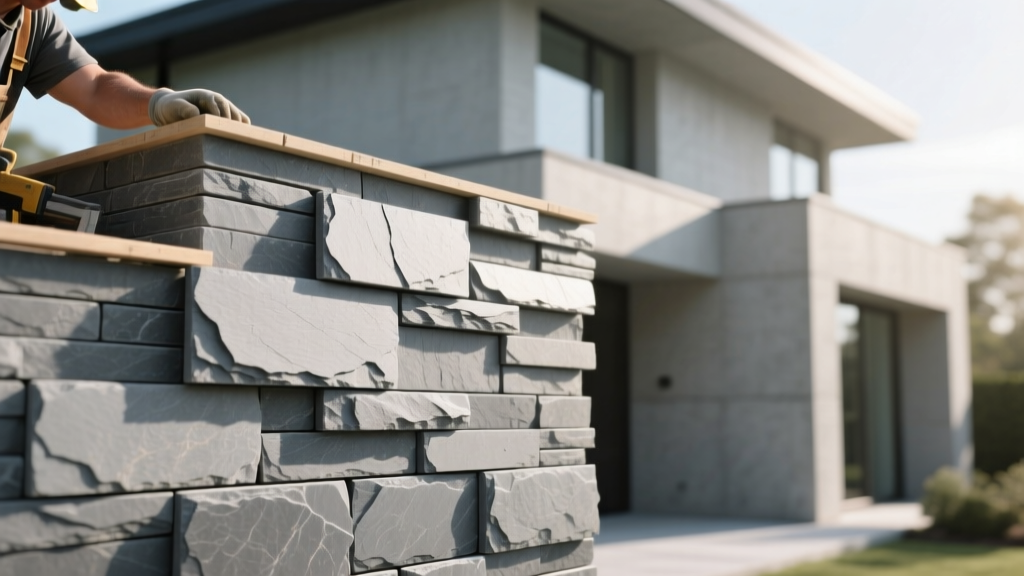
Eldorado Stone remains the benchmark for AMSV. Their Ledgestone profile features long, narrow rectangular stones (typically 2 to 6 inches high and 8 to 18 inches long) that naturally guide the eye horizontally. The color blends are highly variegated, utilizing iron oxide pigments baked into the concrete matrix. For exterior applications, Eldorado requires a weep screed and a weather-resistive barrier (WRB) per their official installation guidelines.
Cultured Stone: Country Ledgestone
Owned by Westlake Royal Building Products, Cultured Stone offers the Country Ledgestone line. This profile is slightly thicker and more irregular than Eldorado's, providing a more rustic, reclaimed aesthetic. It is exceptionally well-suited for interior fireplace surrounds where a heavy, shadow-casting profile is desired. Expect to pay a 10-15% premium over standard manufactured veneer for this specific line.
GenStone: Dry Stack Panels
For the mortarless category, GenStone dominates with their high-density polyurethane panels. Their Dry Stack panels measure 12 inches high by 42 inches long, covering exactly 3.5 square feet per panel. They feature a built-in shiplap edge that hides fasteners. While highly resistant to moisture and impact, GenStone panels must be kept at least 6 inches away from direct heat sources like stove pipes due to the polyurethane core's thermal limitations.
Critical Installation Specs & Moisture Management
The most common failure mode for exterior stackable stone veneer is not the stone itself falling off, but moisture trapping within the wall assembly leading to structural rot. Because dry-stack profiles lack wide, sloped mortar joints to shed water, they rely entirely on the hidden drainage plane.
Manufactured and natural stone act as a moisture reservoir. When driven rain hits the wall, the stone absorbs water. As the sun heats the exterior, that moisture is driven inward (solar vapor drive). According to building science research from Building Science Corporation, you must install a ventilated rainscreen gap or a dimpled drainage mat between the WRB and the metal lath. Failing to include this capillary break will result in OSB sheathing rot within 3 to 5 years in humid or marine climates.
Ensure your contractor utilizes a corrosion-resistant weep screed at the base of the wall, terminating at least 4 inches above grade or 2 inches above paved surfaces. The metal lath must be self-furring, dimpled paper-backed lath (minimum 2.5 lbs per square yard) to ensure the scratch coat fully encapsulates the wire mesh.
Frequently Asked Questions
Can stackable stone veneer be installed directly over drywall or painted brick?
No. Drywall lacks the shear strength to support the 10-12 lbs per square foot dead load of cementitious veneer, and the moisture from the mortar will destroy the paper facing. Painted brick prevents the mortar scratch coat from achieving a mechanical bond. You must strip the drywall to the studs, install sheathing, WRB, and lath, or sandblast/scarify painted brick to expose the raw masonry substrate before installation.
Do I need to seal exterior stackable stone veneer?
High-quality AMSV that meets ASTM C1670 standards does not strictly require sealing for water protection. However, applying a breathable, silane/siloxane-based penetrating sealer (avoiding film-forming acrylics which trap moisture) is highly recommended in regions with heavy pollen, dust, or acid rain to prevent surface staining and reduce efflorescence.
How do I clean mortar haze off a newly installed dry-stack profile?
Because dry-stack profiles have no recessed joints, aggressive acid washing will stain the stone and leave white residue in the tight crevices. Use a stiff, dry natural-bristle brush to knock off loose mortar chunks immediately after the setting bed reaches a thumb-print hard state. For stubborn haze, use a specialized, non-acidic masonry cleaner diluted exactly to the manufacturer's specifications, testing on an inconspicuous area first.
Written by
Marcus ChenMarcus Chen is a licensed structural engineer (PE) and building materials analyst with over 12 years of experience across residential, commercial, and industrial construction. He holds a Master of Science in Civil Engineering from UC Berkeley and spent six years at Thornton Tomasetti before transitioning to independent consulting and technical writing. Marcus specializes in material selection for seismic-prone regions, concrete reinforcement strategies, and lifecycle cost analysis. His work has been cited by the American Concrete Institute (ACI) and the Structural Engineers Association of California (SEAOC). When he is not on a job site or at his desk, you will find him hiking the Sierra Nevada or restoring a 1920s craftsman bungalow in Oakland, CA.
More from Marcus Chen
View all
Construction Cost
How Much Did the Eiffel Tower Cost to Build?
How much did the Eiffel Tower cost to build in 1889? We adjust for inflation and compare its budget to modern skyscraper construction.
Aug 4, 2026

Fire Resistance
What Is a Fire Resistant Material? Testing & Certification Guide
Discover what is a fire resistant material through ASTM and UL testing. Learn how fire ratings, certifications, and assemblies work in construction.
Aug 4, 2026

Construction Cost
How Much Did the Burj Khalifa Cost to Build?
How much did the Burj Khalifa cost to build? We break down the $1.5B project and extract 5 money-saving strategies for your next build.
Jul 30, 2026