How Much Does Stone Veneer Cost? Complete Material & Labor Breakdown
Discover exactly how much stone veneer costs per square foot. We break down natural vs. manufactured stone pricing, labor rates, and hidden expenses.

The Baseline: National Average Costs for Stone Veneer
When calculating how much stone veneer costs for your exterior or interior project, the national average for fully installed stone veneer ranges from $18 to $55 per square foot as of 2026. This wide variance is primarily driven by the choice between Manufactured Stone Veneer (MSV) and Natural Stone Veneer (NSV), the complexity of the architectural detailing, and regional masonry labor rates. Unlike full-thickness masonry, veneer is a non-load-bearing cladding, but it still requires rigorous substrate preparation to prevent moisture intrusion and structural failure.
- Manufactured Stone Veneer (MSV): $18 – $32 per sq. ft.
- Natural Stone Veneer (NSV): $35 – $55+ per sq. ft.
- Interior Accent Walls (No weatherproofing): $15 – $28 per sq. ft.
The Core Pricing Matrix: Natural vs. Manufactured Stone
The material itself accounts for roughly 30% to 45% of the total project cost. Manufactured stone is cast from lightweight concrete aggregates and iron oxide pigments, while natural stone is quarried and sliced into thin profiles. Below is a detailed comparison of material costs and physical properties that dictate installation pricing.
| Material Type | Material Cost (per sq. ft.) | Weight Profile | Structural Requirements | Best Application |
|---|---|---|---|---|
| Manufactured (Standard) | $8.00 – $12.00 | 7 – 10 lbs/sq. ft. | Standard wood framing | Full exterior cladding, large facades |
| Manufactured (Premium/Architectural) | $12.00 – $16.00 | 9 – 12 lbs/sq. ft. | Standard wood framing | High-end custom homes, commercial |
| Natural (Limestone/Sandstone) | $18.00 – $25.00 | 12 – 15 lbs/sq. ft. | Reinforced framing, brick ledges | Accent bands, wainscoting, fireplaces |
| Natural (Granite/Slate) | $25.00 – $35.00+ | 15 – 20+ lbs/sq. ft. | Heavy-duty structural support | Luxury estates, high-impact focal points |
Labor Costs and the Anatomy of Installation
Masonry labor rates in 2026 average between $85 and $150 per hour, translating to $10 to $22 per square foot for installation. However, stone veneer installation is not simply sticking stones to a wall. The Masonry Institute of America emphasizes that substrate preparation is the most critical phase. A proper exterior installation involves multiple distinct labor phases:
- Weather Resistive Barrier (WRB): Applying two layers of Grade D building paper or a high-performance house wrap over the sheathing. (10% of labor time)
- Flashing and Weep Screeds: Installing corrosion-resistant weep screeds at the base of the wall to allow trapped moisture to escape. (10% of labor time)
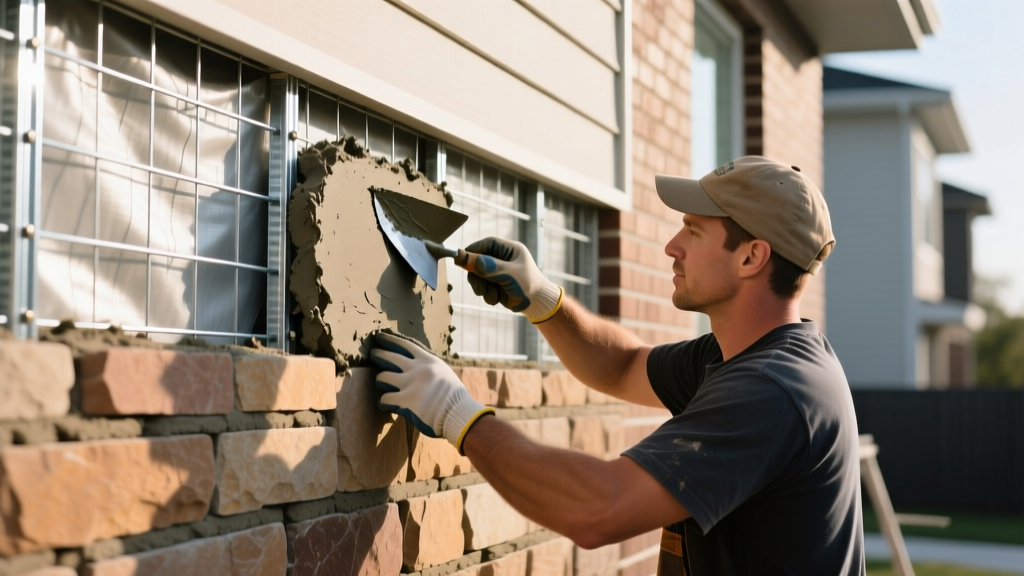
- Metal Lath and Scratch Coat: Stapling 2.5 lb or 3.4 lb galvanized expanded metal lath (meeting ASTM C847) over the WRB, followed by a 1/2-inch thick cementitious scratch coat. The scratch coat must be scarified and cured for 24 to 48 hours. (35% of labor time)
- Setting the Stone: Applying Type S mortar to the back of each stone (back-buttering) and pressing it into the setting bed. (35% of labor time)
- Pointing and Cleanup: Filling joints with a grout bag and tooling the mortar, followed by dry-brushing the stone faces. (10% of labor time)
Hidden Budget Killers: The 'Gotchas' of Stone Veneer
Contractors often quote a base square-footage price that excludes critical accessories and architectural complexities. When budgeting, you must account for these frequently overlooked expenses:
One of the most common budgeting errors is calculating corner pieces by square footage. Both natural and manufactured stone corners are sold by the linear foot. Depending on the profile, linear corner pieces cost between $12 and $28 per linear foot (material only). A house with numerous juts, window returns, and outside corners can see material costs increase by 15% to 20% over a flat-elevation estimate.
- Mortar and Additives: Standard Type S mortar mix costs about $8 to $12 per 80 lb bag, covering roughly 15 square feet. For colored mortars or acrylic fortifiers required in freeze-thaw climates, add $0.50 to $1.50 per square foot.
- Scaffolding and Equipment: For two-story exteriors, scaffolding rental and setup will add $800 to $2,500 to the total project cost.
- Structural Reinforcement: If you are retrofitting natural stone veneer onto an older home, the existing rim joists or foundation may require structural sistering or the addition of a steel angle iron shelf to bear the 15+ lbs per square foot dead load.
Mortar Specifications: Type N vs. Type S
Using the wrong mortar is a primary cause of veneer delamination and efflorescence. According to guidelines referenced by the National Association of the Remodeling Industry (NARI), mortar selection must match the stone's density and the local climate.
Type S Mortar (High Strength)
Mixed at a ratio of 1 part Portland cement, 1/2 part hydrated lime, and 4-5 parts sand. Type S provides a compressive strength of over 1,800 psi. This is the mandatory choice for exterior applications, below-grade applications, and heavy natural stones like granite or thick limestone. It provides the necessary bond strength to resist wind loads and freeze-thaw cycling.
Type N Mortar (Medium Strength)
Mixed at 1 part Portland cement, 1 part lime, and 6 parts sand. Yielding around 750 psi, Type N is more flexible and breathable. It is strictly reserved for interior applications, manufactured stone (which is lighter and more porous), and historic masonry restoration where a rigid mortar would crack the softer substrate.
Decision Framework: Which Stone Veneer Should You Choose?
Selecting between natural and manufactured stone requires balancing aesthetic demands, structural limitations, and budget constraints. Use this framework to finalize your material choice:
Choose Manufactured Stone Veneer (MSV) if:
- You are cladding a large surface area (over 500 sq. ft.) and need to control weight and material costs.
- You are installing over standard wood framing without the ability to add structural brick ledges or angle irons.
- You require a uniform color consistency and specific modular sizing to speed up installation labor.
- You want integrated corner returns that perfectly mimic full-thickness masonry without the structural mass.
Choose Natural Stone Veneer (NSV) if:
- You are designing a high-end custom home where unique, non-repeating geological variations are a primary selling point.
- You are building a dry-climate exterior or an interior feature wall where freeze-thaw spalling is not a concern.
- You are doing a localized accent (e.g., a 100 sq. ft. entryway facade or fireplace surround) where the premium material cost is absorbed by the small square footage.
Expert Tips for Maximizing ROI and Longevity
To ensure your investment lasts decades without moisture damage or aesthetic degradation, implement these best practices during the bidding and construction phases:
- Mandate a Weep Screed: Never allow a contractor to install stone veneer directly to the ground or flush against a concrete patio. The Eldorado Stone Installation Guide and international building codes require a minimum 4-inch clearance above grade and a 2-inch clearance above paved surfaces to prevent capillary water action and termite ingress.
- Back-Butter Every Stone: 'Glop-setting' (applying mortar only to the wall) creates voids behind the stone where water can pool and freeze, popping the stone off the wall. Insist on 100% back-buttering for exterior applications.
- Seal Only When Necessary: Do not blindly apply silane/siloxane sealers to manufactured stone. MSV is designed to breathe; trapping moisture inside with a non-breathable film-forming sealer will cause spalling in winter. Only use penetrating, breathable water repellents if the stone is subjected to constant sprinkler overspray.
Written by
Sarah WhitfieldSarah Whitfield is a chartered quantity surveyor (MRICS) and construction cost analyst with 15 years of experience in material pricing, procurement strategy, and project budgeting. She earned her degree in Construction Management from the University of Reading (UK) and has worked on projects ranging from $2M custom homes to $180M mixed-use developments across North America and Europe. Sarah currently leads cost estimating for BuildMat Insight, maintaining a proprietary database of 4,000+ material price points updated quarterly. She is a frequent contributor to RSMeans cost data panels and has presented at the International Cost Engineering Council (ICEC) congress. Based in Denver, CO, Sarah is an avid trail runner and volunteer mentor for Women in Construction.
More from Sarah Whitfield
View all
Wood & Lumber
What Are the Different Types of Wood? A Builder's Guide
Compare structural softwoods, finish hardwoods, and engineered lumber. Analyze Janka ratings, MOE values, and 2026 pricing for construction.
Aug 4, 2026

Walls & Panels
Steel Framing vs Wood Framing: Corrosion and Moisture Defense
Compare steel framing vs wood framing for moisture resistance. Learn about galvanized coatings, condensation risks, and corrosion protection strategies.
Jul 21, 2026

Stone & Masonry
How to Cut Stone Veneer: Wet Saw vs Grinder Comparison
Compare the best tools for cutting stone veneer. We review wet saws, angle grinders, and chop saws to help you achieve clean, chip-free cuts.
Jul 21, 2026