Stone Veneer House Maintenance: Cleaning, Sealing, and Repair Guide
Learn expert stone veneer house maintenance techniques. Discover cleaning protocols, efflorescence removal, and the best breathable sealers for exterior care.

A stone veneer house exterior offers the aesthetic weight of solid masonry at a fraction of the cost and structural load. However, because manufactured and natural stone veneers are non-structural cladding systems, their longevity depends entirely on moisture management and surface maintenance. Unlike solid masonry, veneer systems rely on a concealed drainage plane. When maintenance is neglected, trapped moisture leads to efflorescence, mortar degradation, and in severe cases, structural rot behind the cladding.
Moisture Intrusion: The Primary Failure Mode
The most critical aspect of maintaining a stone veneer house is not cleaning the stone itself, but managing the water that hits it. Veneer systems must be installed over a weather-resistive barrier (WRB) with a weep screed at the base. Over time, landscaping changes, soil settling, or improper mulching can compromise these clearances.
Safe Washing Parameters
When washing your exterior, never use high-pressure settings. High pressure can force water behind the veneer through micro-cracks in the mortar joints and damage the soft face of manufactured stone. Limit pressure washers to a maximum of 1,200 PSI, use a 40-degree white spray tip, and always spray at a downward angle to prevent driving water upward behind the cladding.
Cleaning Protocols: Manufactured vs. Natural Stone
Manufactured stone veneer (MSV) is a Portland cement-based product cast in molds. Natural stone is quarried rock. Their chemical compositions dictate entirely different cleaning approaches. Using an acidic cleaner on MSV will etch the cement paste, exposing the aggregate and permanently altering the color, while alkaline cleaners can leave stubborn white residues on porous natural stones like limestone.
| Cleaning Agent | pH Level | Target Stain | Compatibility |
|---|---|---|---|
| Mild Dish Soap & Water | Neutral (7.0) | Dirt, dust, pollen | All MSV and Natural Stone |
| White Vinegar Solution (1:4) | Mild Acid (2.5) | Light efflorescence, hard water | Natural Stone ONLY (Test first) |
| Specialty MSV Cleaner | Mild Alkaline (8.5) | Organic growth, algae, deep dirt | Manufactured Stone Veneer |
| Muriatic Acid | Strong Acid (-1.0) | Heavy mortar smears | NEVER USE ON VENEER |
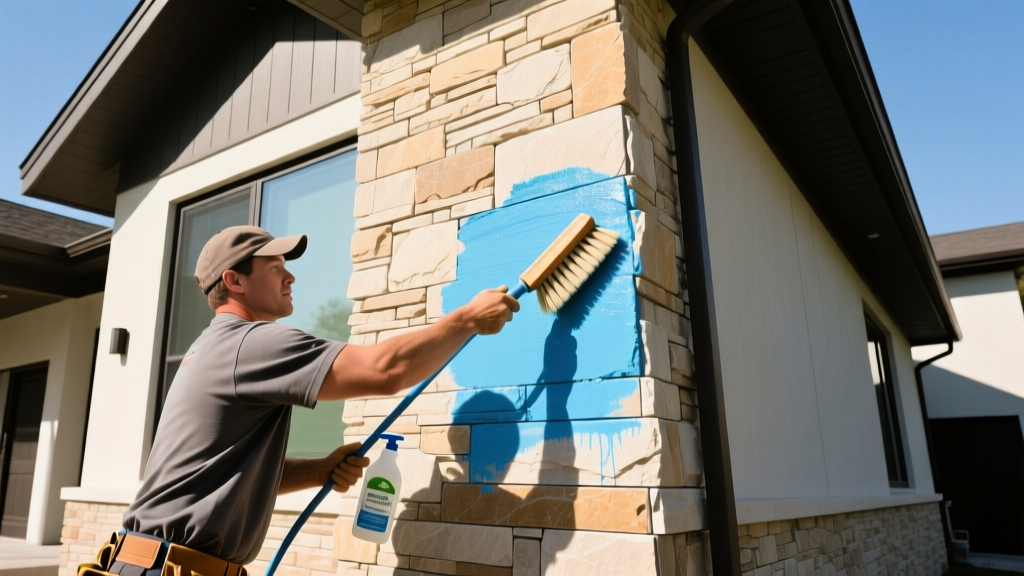
For routine cleaning of a stone veneer house, mix a pH-neutral detergent with warm water. Apply using a garden sprayer, agitate gently with a soft-bristle nylon brush, and rinse thoroughly with a garden hose. For stubborn organic stains or algae, commercial masonry cleaners formulated specifically for concrete-based products, such as those detailed in PROSOCO's masonry care guidelines, are highly effective without risking surface etching.
Eradicating Efflorescence Without Damaging Mortar
Efflorescence is the white, powdery deposit of water-soluble salts left on the surface of masonry when water evaporates. According to the Brick Industry Association's Technical Note 23, efflorescence requires three conditions: water-soluble salts, moisture to dissolve them, and a path for the solution to migrate to the surface. In a stone veneer house, this usually indicates that moisture is penetrating the mortar joints and migrating outward.
Step-by-Step Removal Process
- Dry Brush First: Always attempt to remove efflorescence with a stiff, dry, non-metallic brush. Introducing water to light efflorescence can push the salts back into the pores of the stone, worsening the problem.
- Vacuum the Surface: Remove the dislodged salt powder immediately using a shop vac with a brush attachment.
- Apply a Dedicated Efflorescence Cleaner: If dry brushing fails, use a proprietary, non-acidic efflorescence remover. Apply it strictly according to the manufacturer's dilution rates.
- Address the Moisture Source: Chemical removal is temporary. If efflorescence returns, inspect your roof gutters, downspouts, and flashing above the affected area. The moisture intrusion must be stopped mechanically.
The Sealer Debate: Film-Forming vs. Penetrating
Homeowners often ask if they should seal their stone veneer house exterior. The answer depends entirely on the type of sealer used. Applying the wrong sealer can trap moisture inside the wall assembly, leading to catastrophic freeze-thaw damage in colder climates.
Sealer Comparison Matrix
| Sealer Type | Mechanism | Vapor Permeability | Lifespan | Verdict for Veneer |
|---|---|---|---|---|
| Acrylic (Film-Forming) | Creates a plastic shell on the surface | Low (Traps Vapor) | 1-3 Years | Avoid. Causes spalling. |
| Silane/Siloxane (Penetrating) | Lines pores with hydrophobic resin | High (Breathable) | 5-10 Years | Highly Recommended. |
Always select a silane or siloxane-based penetrating sealer for a stone veneer house. These sealers penetrate deep into the capillary pores of the stone and mortar, creating a hydrophobic barrier that repels liquid water while allowing water vapor to escape. This breathability is non-negotiable; as noted by the National Park Service's guidelines on masonry preservation, trapping vapor behind a film-forming sealer accelerates masonry deterioration during freeze-thaw cycles.
Annual Inspection and Mortar Repointing
Manufactured stone veneer relies on Type N or Type S mortar for joint integrity. Because veneer is non-structural, the mortar is primarily cosmetic and weather-resistant. Over time, thermal expansion and contraction will cause hairline cracks in the mortar joints.
The Annual Checklist
- Joint Inspection: Scan the mortar joints for cracks wider than 1/16 inch. Any crack exceeding this width compromises the water-resistant barrier and requires repointing.
- Flashing Verification: Check the metal flashing above windows, doors, and deck ledgers integrated into the stone veneer. Ensure no gaps exist between the flashing and the masonry.
- Vegetation Control: Trim back ivy, shrubs, and tree branches. Ivy rootlets can penetrate microscopic fissures in manufactured stone, prying the veneer off the scratch coat as the roots expand.
- Soffit and Gutter Check: Ensure gutters above the stone veneer are free of debris. Overflowing gutters create concentrated waterfalls that will rapidly erode mortar joints and saturate the underlying WRB.
When repointing is necessary, do not use standard hardware store mortar mixes, which are often too hard and rigid for veneer applications. Use a pre-blended Type N masonry cement, which offers the necessary flexibility to accommodate the slight movements of wood-framed houses without cracking. Rake out the deteriorated mortar to a depth of at least 1/2 inch, dampen the joint with water to prevent the old masonry from sucking moisture out of the new mortar too quickly, and pack the new mortar tightly using a pointing trowel.
Written by
Elena RodriguezElena Rodriguez is a civil engineer and technical writer specializing in concrete technology, masonry systems, and ASTM/ACI compliance. She earned her B.S. in Civil Engineering from Texas A&M University and spent a decade at a materials testing laboratory, performing over 2,000 concrete compressive strength tests and masonry prism evaluations. Elena is an ACI-certified Field Testing Technician (Grade I) and a member of ASTM Committee C12 on Natural Building Stone. She currently consults on forensic engineering cases involving concrete failures and moisture intrusion. Based in San Antonio, TX, Elena is a proud member of the Society of Women Engineers (SWE) and coaches her daughter's FIRST Robotics team.
More from Elena Rodriguez
View all
Walls & Panels
Cost Analysis: Light Gauge Steel Framing Advantages and Disadvantages
Evaluate light gauge steel framing advantages and disadvantages through a strict cost analysis lens, comparing material, labor, and lifecycle expenses.
Aug 4, 2026

Walls & Panels
Gypsum Board Types: Exact Specifications, Thickness & Dimensions
Compare standard, Type X, and moisture-resistant gypsum board types. Get exact specifications, thicknesses, dimensions, and ASTM standards for your project.
Aug 4, 2026

Fire Resistance
Best Fire-Resistant Outdoor Decking Materials: 2026 Buyer Guide
Discover the best fire-resistant outdoor decking materials for 2026. Compare Class A PVC, aluminum, and hardwood options for WUI compliance and safety.
Aug 4, 2026