Stone Veneer Tile Cost Guide: 2026 Pricing & Installation Analysis
Comprehensive 2026 cost analysis for stone veneer tile. Explore material pricing, labor rates, and hidden installation expenses for your next project.

The 2026 Stone Veneer Tile Cost Landscape
Stone veneer tile delivers the visual weight and texture of full-thickness masonry without the structural reinforcement requirements or exorbitant material costs. As of 2026, the national average for professionally installed stone veneer tile ranges from $18 to $42 per square foot. This wide variance is driven by three primary factors: the origin of the stone (manufactured vs. natural), the complexity of the substrate preparation, and regional labor rates for specialized masonry contractors.
Unlike traditional full-bed stone, which requires poured concrete footings and wall ties to support 35+ pounds per square foot, stone veneer tile typically weighs between 9 and 18 pounds per square foot. This allows it to be installed directly over standard wood or steel framing, provided the correct cementitious backer board and adhesives are utilized. Understanding the granular breakdown of these costs is critical for avoiding the budget overruns that plague 30% of residential masonry veneer projects.
Material Pricing Matrix: Natural vs. Manufactured Veneer
The choice between manufactured (architectural) stone and natural stone veneer tile dictates the baseline of your material budget. Manufactured stone is cast from Portland cement, lightweight aggregates, and iron oxide pigments, while natural veneer is sliced from quarried stone to a uniform 1-inch thickness.
| Material Type | Cost per Sq. Ft. (Material Only) | Weight (lbs/sq. ft.) | Best Application |
|---|---|---|---|
| Manufactured Ledger Stone | $7.50 - $12.00 | 10 - 12 lbs | Interior accent walls, fireplace surrounds |
| Manufactured Fieldstone | $6.00 - $10.50 | 9 - 11 lbs | Exterior siding, foundation skirting |
| Natural Slate Veneer Tile | $14.00 - $22.00 | 15 - 18 lbs | High-end interior feature walls |
| Natural Limestone Veneer | $18.00 - $28.00 | 14 - 17 lbs | Exterior facades, luxury entryways |
| Natural Quartzite Veneer | $20.00 - $32.00 | 16 - 19 lbs | Wet areas, high-impact commercial spaces |
Labor Rates and Substrate Preparation Costs
Labor typically accounts for 50% to 65% of the total installed cost of stone veneer tile. According to the Bureau of Labor Statistics, the median hourly wage for specialized stonemasons and masonry workers has climbed steadily, with licensed contractors charging between $75 and $130 per hour in major metropolitan markets in 2026.
The Substrate Imperative
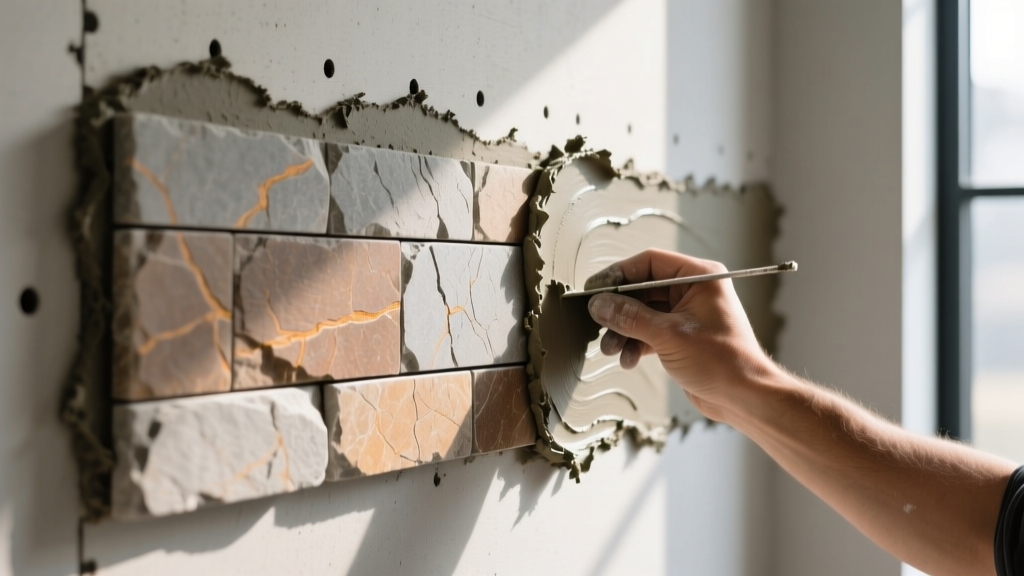
The most common point of failure in stone veneer tile installation is improper substrate preparation. Veneer tile cannot be adhered directly to drywall, plywood, or painted surfaces. The required substrate buildup adds to both material and labor costs:
- Interior Walls: Requires the removal of existing drywall down to the studs, followed by the installation of 1/2-inch or 5/8-inch cement backer board (such as Durock or HardieBacker). Cost: $2.50 - $4.00 per sq. ft. installed.
- Exterior Walls: Requires a weather-resistive barrier (WRB), followed by a corrosion-resistant metal lath and a scratch coat of Type S mortar. Cost: $4.50 - $7.00 per sq. ft. installed.
- Wet Areas (Showers/Steam Rooms): Requires a liquid-applied waterproofing membrane (e.g., RedGard or Hydro Ban) over the cement board before thinset application. Cost: $1.50 - $2.50 per sq. ft.
Hidden Cost Triggers in Veneer Estimating
Novice estimators frequently underbudget stone veneer tile projects by ignoring the peripheral materials and logistical requirements. Factor the following variables into your 2026 cost projections:
- The Waste Factor: Standard flat walls require a 10% overage for cuts and breakage. Complex layouts with multiple windows, outlets, or tight corners demand a 15% to 20% waste factor. Natural stone requires more waste allowance than manufactured stone due to irregular edges.
- Adhesive and Mortar: Interior mesh-backed veneer tiles require polymer-modified thinset (e.g., Custom Building Products MegaFlex), costing approximately $60 per 50-lb bag, covering roughly 40 square feet. Traditional unbacked veneer requires a mortar bed and scratch coat, increasing material volume.
- Sealing and Maintenance: Natural stone veneer (especially porous limestone and sandstone) must be sealed with an impregnating penetrating sealer to prevent efflorescence and staining. High-quality sealers cost $45 to $80 per quart, covering 100 square feet per coat.
- Scaffolding and Access: For exterior projects exceeding 8 feet in height, scaffolding rental adds $150 to $300 per day to the project timeline, significantly impacting the final invoice.
Stone Veneer Tile vs. Full-Bed Natural Stone: ROI Comparison
When evaluating whether to upgrade from veneer to full-bed stone, the structural costs often outweigh the aesthetic benefits. The National Association of Home Builders consistently notes that exterior masonry upgrades yield strong curb appeal, but the return on investment diminishes when structural modifications are required.
Stone Veneer Tile
Pros: No footing required; installs over wood framing; 1/3 the weight; DIY-friendly (mesh-backed options); lower labor costs.
Cons: Can chip to reveal concrete aggregate core (manufactured); lower thermal mass.
Average ROI: 75% - 85% at resale.
Full-Bed Natural Stone
Pros: Authentic depth and shadow lines; can be chipped without revealing core; high thermal mass; century-long lifespan.
Cons: Requires engineered concrete footings; requires masonry wall ties; extreme structural load; highly specialized labor.
Average ROI: 60% - 70% at resale (due to massive upfront structural costs).
Expert Guidelines for Budget Optimization
To maximize your budget without compromising the structural integrity or visual quality of the installation, implement the following strategies:
- Blend Batches: Manufactured stone veneer is produced in distinct dye lots. Purchase 100% of your required material from a single batch to avoid drastic color variations, and physically blend stones from at least three different boxes during installation to ensure natural color distribution.
- Limit Corner Pieces: Corner pieces are the most expensive component of a veneer system. Design your layout to minimize external corners, or use architectural trim (like Schluter profiles) for a modern, deliberate transition edge where appropriate.
- Specify Type S Mortar for Exteriors: For exterior scratch coats and mortar beds, always specify ASTM C270 Type S mortar. It offers higher tensile bond strength and flexibility than Type N, which is critical for withstanding freeze-thaw cycles and preventing veneer delamination. Consult the Eldorado Stone installation guidelines for exact mortar mix ratios approved for their specific veneer profiles.
"The most expensive mistake in stone veneer installation isn't buying the wrong stone; it's failing to account for the linear footage of corners and the structural prep of the substrate. A $5,000 stone budget can easily become an $11,000 project once cement board, lath, thinset, and corner pieces are factored in."
Frequently Asked Questions
Can I install stone veneer tile directly over existing brick or painted block?
Yes, but only with specific preparation. Unpainted, unpainted, and structurally sound brick or CMU (concrete masonry units) can serve as a substrate. However, you must mechanically scarify the surface to remove any efflorescence or laitance, then apply a bonding agent before the scratch coat. If the brick is painted, the paint must be completely removed via sandblasting or chemical strippers, as thinset and mortar will only bond to the paint film, leading to catastrophic delamination.
Does stone veneer tile require a weep screed on exterior walls?
Absolutely. When installing stone veneer tile on exterior wood-framed walls, a corrosion-resistant weep screed must be installed at the base of the wall, minimum 4 inches above grade or 2 inches above paved surfaces. This allows incidental moisture that penetrates the veneer to drain out of the wall cavity, preventing rot in the bottom plate of the framing.
How does climate affect the installation cost of exterior stone veneer?
In regions with severe freeze-thaw cycles (e.g., the Northeast and Midwest), contractors must use premium polymer-modified mortars and high-quality penetrating sealers to prevent moisture ingress and subsequent spalling. This adds approximately $2.50 to $4.00 per square foot in material costs compared to installations in arid, mild climates like the Southwest.
Written by
Marcus ChenMarcus Chen is a licensed structural engineer (PE) and building materials analyst with over 12 years of experience across residential, commercial, and industrial construction. He holds a Master of Science in Civil Engineering from UC Berkeley and spent six years at Thornton Tomasetti before transitioning to independent consulting and technical writing. Marcus specializes in material selection for seismic-prone regions, concrete reinforcement strategies, and lifecycle cost analysis. His work has been cited by the American Concrete Institute (ACI) and the Structural Engineers Association of California (SEAOC). When he is not on a job site or at his desk, you will find him hiking the Sierra Nevada or restoring a 1920s craftsman bungalow in Oakland, CA.
More from Marcus Chen
View all
Construction Cost
How Much Did the Eiffel Tower Cost to Build?
How much did the Eiffel Tower cost to build in 1889? We adjust for inflation and compare its budget to modern skyscraper construction.
Aug 4, 2026

Fire Resistance
What Is a Fire Resistant Material? Testing & Certification Guide
Discover what is a fire resistant material through ASTM and UL testing. Learn how fire ratings, certifications, and assemblies work in construction.
Aug 4, 2026

Construction Cost
How Much Did the Burj Khalifa Cost to Build?
How much did the Burj Khalifa cost to build? We break down the $1.5B project and extract 5 money-saving strategies for your next build.
Jul 30, 2026