Stone vs Stone Veneer Cost Analysis & ROI Guide 2026
Compare stone vs stone veneer costs for 2026. Analyze material pricing, structural prep, freight logistics, and ROI to choose the right masonry option.
The Core Financial Divide: Material vs. Installed Cost
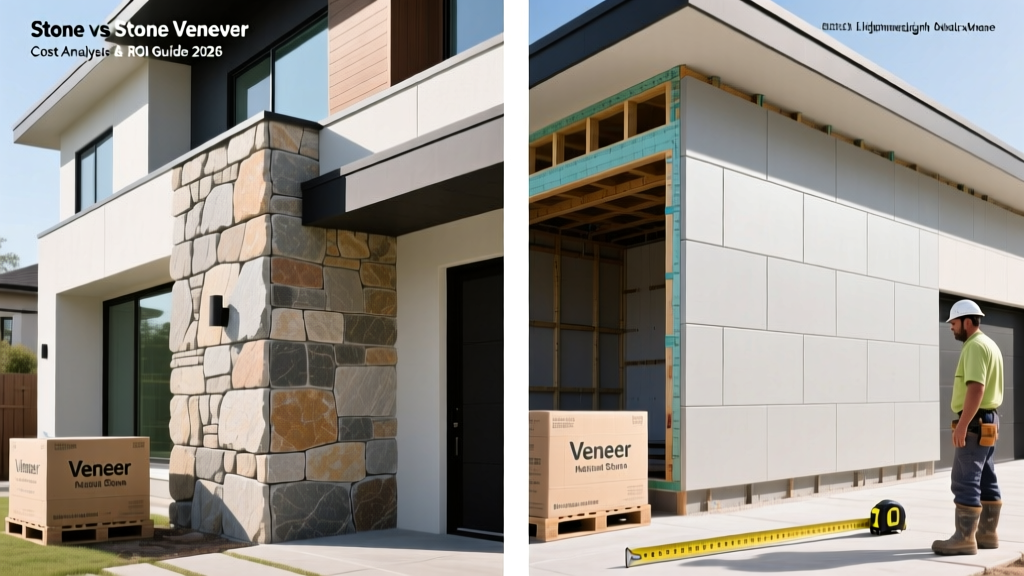
When evaluating stone vs stone veneer for exterior cladding or interior feature walls, the initial material price per square foot is only a fraction of the true project cost. Full-bed natural stone and thin stone veneer (both manufactured and natural) operate on entirely different structural and logistical financial models. In 2026, labor shortages and supply chain shifts have widened the gap between these two masonry approaches, making a comprehensive cost analysis essential before breaking ground.
| Cost Category | Full-Bed Natural Stone | Natural Thin Veneer (NTV) | Manufactured Stone Veneer (MSV) |
|---|---|---|---|
| Material Cost | $18.00 - $35.00 / sq ft | $14.00 - $26.00 / sq ft | $8.50 - $16.00 / sq ft |
| Labor & Installation | $22.00 - $38.00 / sq ft | $15.00 - $25.00 / sq ft | $12.00 - $22.00 / sq ft |
| Prep & Structural | $8.00 - $18.00 / sq ft | $2.00 - $5.00 / sq ft | $2.00 - $5.00 / sq ft |
| Total Installed Cost | $48.00 - $91.00 / sq ft | $31.00 - $56.00 / sq ft | $22.50 - $43.00 / sq ft |
Manufactured stone veneer (MSV) consistently delivers a 40% to 50% cost savings over full-bed natural stone. However, Natural Thin Veneer (NTV)—which is real stone sliced to a 1-inch thickness—bridges the gap, offering the exact mineral composition of full-bed stone at a labor rate comparable to MSV.
Hidden Structural Costs That Break the Budget
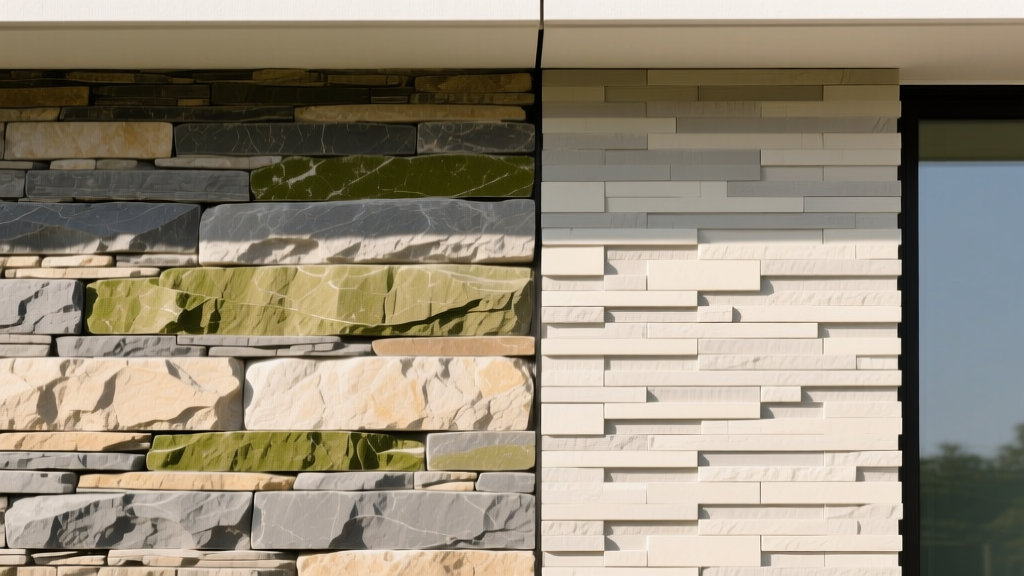
The most frequent budget overrun in masonry projects occurs when builders fail to account for the dead load of full-bed stone. Natural full-bed stone weighs between 35 and 50 pounds per square foot. This immense weight cannot simply be adhered to standard wood framing or drywall.
Conversely, stone veneer weighs only 10 to 15 pounds per square foot. According to guidelines from the Masonry Institute of America, adhered veneer can be installed directly over standard wood or steel stud framing, provided it is backed by a proper weather-resistive barrier (WRB) and metal lath. This eliminates the need for foundation reinforcement, making veneer the only financially viable option for second-story applications or existing remodels without massive structural intervention.
Freight and Logistics: The Overlooked Expense
Material weight directly dictates freight costs, an expense rarely itemized in initial contractor bids. Full-bed natural stone is shipped via Less-Than-Truckload (LTL) freight, and carriers charge based on weight and freight class.
- Full-Bed Stone Freight: Covering 1,000 square feet requires approximately 40,000 pounds of material. LTL shipping for this weight easily adds $2.50 to $4.00 per square foot to your material cost, especially if the quarry is out-of-state.
- Veneer Freight: The same 1,000 square foot coverage in MSV or NTV weighs roughly 12,000 to 15,000 pounds. Freight costs drop to $0.60 to $1.20 per square foot.
Furthermore, full-bed stone carries a higher waste factor. Because the stones are irregular and require cutting to fit corners and openings, expect a 10% to 15% waste factor. Veneer panels and pre-cast corner pieces reduce the waste factor to 5% to 8%, further tightening the budget.
Long-Term ROI and Resale Value Metrics
Does the premium paid for full-bed natural stone yield a higher return on investment at resale? Data from the National Association of Home Builders (NAHB) and annual remodeling impact reports indicate that while natural stone carries prestige, the visual ROI of high-quality manufactured veneer is nearly identical to the untrained buyer's eye.
"Manufactured stone veneer consistently ranks among the top exterior upgrades for cost recouped at resale, often returning 90% to 95% of the project cost, primarily because it delivers the exact aesthetic of natural masonry without the structural premium."
In luxury housing markets (homes valued over $1.5M), appraisers may assign a slight premium to full-bed natural limestone or granite due to its permanence and regional authenticity. However, in mid-tier and starter-home markets, MSV provides the maximum aesthetic uplift for the lowest capital outlay, making it the superior financial instrument for pre-sale renovations.
Expert Installation Specifications & Failure Modes
Cutting corners on installation specifications will void warranties and lead to catastrophic moisture intrusion, regardless of whether you choose full stone or veneer. When reviewing contractor bids, ensure they explicitly include the following manufacturer-mandated and code-compliant steps:
1. Mortar Selection
Do not allow masons to use standard brick mortar for adhered veneer. Veneer requires Type N mortar (minimum 750 psi compressive strength) or a specialized polymer-modified veneer mortar. Type S mortar (1800 psi) is too rigid and can cause the lighter veneer stones to crack under thermal expansion and contraction.
2. Weep Screeds and Flashing
Per ASTM C1063 standards, a weep screed must be installed at the base of all adhered masonry. This screed must be placed a minimum of 2 inches above final earth grade and 6 inches above paved surfaces. Failure to install a weep screed traps moisture behind the weather-resistive barrier, leading to wood rot and efflorescence (white salt deposits) on the stone face within the first freeze-thaw cycle.
3. Lath and Scratch Coat
For MSV and NTV, 2.5 lb self-furring galvanized metal lath must be mechanically fastened to the studs (not just the sheathing) with a minimum 3/8-inch scratch coat. Bids that omit the scratch coat and attempt to adhere stone directly to the WRB will fail within three to five years.
The 2026 Decision Framework: Which Should You Choose?
Use this scenario-based matrix to make your final material selection based on your specific project constraints:
Choose Full-Bed Natural Stone If:
- You are building a new-construction luxury home where the foundation is already engineered for heavy masonry dead loads.
- The project involves a retaining wall, heavy-duty landscape terracing, or a commercial facade requiring extreme impact resistance.
- You are sourcing local, regional stone (e.g., Texas Limestone, Pennsylvania Bluestone) to minimize LTL freight costs and satisfy local historical zoning boards.
Choose Manufactured or Natural Thin Veneer If:
- You are remodeling an existing home and do not want to spend $20,000+ pouring new concrete footings.
- The cladding is going above the first floor (second-story walls, chimneys, or interior vaulted ceilings) where structural weight limits are strict.
- You are operating in a high seismic zone, where building codes heavily restrict the weight of adhered masonry above certain heights to prevent collapse during tremors.
- Your primary goal is maximizing curb appeal and ROI for a home sale within the next 3 to 5 years.
Ultimately, the choice between stone vs stone veneer is rarely about which material looks better—modern MSV molds are cast directly from natural stone and are virtually indistinguishable from a distance. The decision is strictly governed by structural capacity, freight logistics, and labor availability. By pricing out the hidden structural prep and freight costs early in the design phase, you can accurately forecast the true cost of your masonry investment.
Written by
David NakamuraDavid Nakamura is a licensed architect (AIA) and construction technology writer focused on sustainable building methods, mass timber engineering, and high-performance building envelopes. He holds a Master of Architecture from the University of Washington and is a certified Passive House Consultant (CPHC). David spent eight years at the Seattle firm Mithun, where he led the design of three LEED Platinum projects, before founding his own practice specializing in net-zero residential design. He serves on the editorial advisory board of GreenBuilder Magazine and has authored peer-reviewed papers on cross-laminated timber (CLT) connections for the Journal of Structural Engineering. In his spare time, David teaches woodworking at Pratt Fine Arts Center and kayaks the Puget Sound.
More from David Nakamura
View all
Construction Cost
Labor Cost to Build a Deck Per Sq Ft: 2026 Installation Guide
Discover the exact labor cost to build a deck per sq ft in 2026. This installation guide breaks down contractor rates, complexity factors, and hidden fees.
Aug 4, 2026

Construction Cost
How Much Does It Cost to Build a 3 Bedroom House? Financing Guide
Learn exactly how much it costs to build a 3 bedroom house and explore 2026 financing options, construction loan types, and budget frameworks for your build.
Aug 4, 2026

Construction Cost
Cost to Build a Tennis Court: 2026 Guide
How much does it cost to build a tennis court in 2026? Breakdowns for asphalt, concrete, and synthetic surfaces plus fencing and lighting.
Jul 30, 2026