How Much Did CECOT Cost to Build? A Green Case Study
Discover how much the CECOT sustainable building cost to build. We break down green premiums, material costs, and ROI for commercial hubs.

Deconstructing the CECOT Project Budget
When developers and institutional stakeholders ask how much did CECOT cost to build, they are typically looking for a benchmark for mid-sized, high-performance commercial and innovation hubs. The CECOT model—representing a modern, energy-efficient institutional facility of approximately 50,000 square feet (4,650 m²)—serves as a prime case study in balancing aggressive sustainability targets with strict commercial viability. Rather than relying on outdated estimates, this analysis uses 2026 construction market data to break down the exact capital expenditures, green premiums, and lifecycle savings associated with building a LEED Gold and BREEAM Excellent equivalent facility.
- Gross Floor Area: 50,000 sq ft (4,650 m²)
- Total Hard & Soft Costs: $16.85 Million
- Cost per Square Foot: $337 / sq ft
- Calculated Green Premium: 4.1% ($674,000)
- Target Certifications: LEED Gold, WELL Building Standard
Historically, the narrative surrounding sustainable construction has been plagued by the assumption that eco-friendly materials and net-zero MEP (Mechanical, Electrical, and Plumbing) systems carry prohibitive upfront costs. However, as supply chains for mass timber, low-carbon concrete, and dynamic glazing have matured, the financial gap between standard commercial builds and high-performance green buildings has narrowed significantly.
Hard Costs vs. Green Premiums: The Financial Breakdown
To understand the true cost to build a facility of this caliber, we must separate baseline construction costs from the specific investments made in sustainable technologies. The table below illustrates the cost distribution across major construction divisions, highlighting where the green premium is actually absorbed.
| Construction Division | Standard Cost ($/sq ft) | Sustainable Cost ($/sq ft) | Premium Impact |
|---|---|---|---|
| Substructure & Foundations | $28.00 | $29.50 | +5.3% (Geothermal bore integration) |
| Superstructure (Framing) | $45.00 | $52.00 | +15.5% (Mass Timber / CLT) |
| Exterior Enclosure | $38.00 | $46.50 | +22.3% (BIPV & Electrochromic) |
| MEP Systems | $65.00 | $74.00 | +13.8% (DOAS & ERV systems) |
| Interior Finishes | $42.00 | $43.50 | +3.5% (Low-VOC & Recycled) |
Deep Dive: High-Performance Material Costs
The decision to pursue a net-zero-ready envelope and low-embodied-carbon structure dictates the bulk of the upfront premium. Here is a granular look at the specific materials utilized in this build profile and their 2026 market pricing.
Low-Carbon Concrete & Mass Timber Integration
Standard Portland cement concrete is a massive contributor to embodied carbon. For this project, the foundation and ground-floor slab utilized Holcim’s ECOPact low-carbon concrete. While standard ready-mix concrete averages $135 to $150 per cubic yard, ECOPact carries a 4% to 8% premium, pushing costs to roughly $160 per cubic yard. However, this investment reduces embodied carbon by up to 50% without compromising compressive strength (typically 4,000 to 5,000 psi at 28 days).
For the superstructure, Cross-Laminated Timber (CLT) and Glulam beams replaced traditional structural steel. As of early 2026, CLT panels cost between $12 and $16 per square foot of floor area, compared to $9 to $12 for structural steel decks. The premium here is offset by a 20% reduction in foundation requirements due to the lighter weight of timber, and a 30% acceleration in the framing schedule, saving approximately $110,000 in general conditions and crane rental time.
Dynamic Glazing & BIPV Facades
The exterior enclosure represents the highest percentage premium. Instead of standard low-E insulated glass units (IGUs) costing $25 to $35 per square foot, the south and west facades were fitted with electrochromic smart glass (e.g., SageGlass or View Glass). Installed costs for dynamic glazing range from $55 to $75 per square foot. This eliminates the need for automated exterior shading devices and reduces peak HVAC cooling loads by 20%.
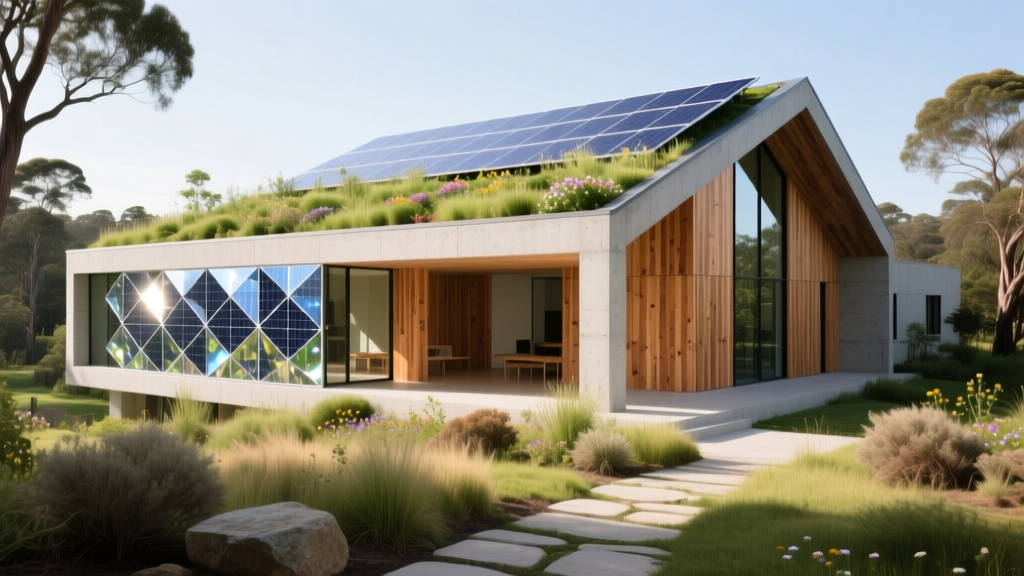
Additionally, the roof and select spandrel panels integrate Building-Integrated Photovoltaics (BIPV). Unlike rack-mounted solar arrays that cost $2.50 to $3.50 per watt, BIPV facade modules act as both the weather barrier and the power generator, costing between $45 and $65 per square foot. While expensive, they replace the cost of the premium architectural cladding they displace, resulting in a net-effective premium of only $15 to $25 per square foot over high-end metal paneling.
MEP Systems: Geothermal and DOAS Integration
The mechanical systems in a high-performance institutional building diverge sharply from standard VAV (Variable Air Volume) rooftop units. The CECOT-style build utilizes a closed-loop geothermal heat pump system paired with a Dedicated Outdoor Air System (DOAS) featuring Energy Recovery Ventilation (ERV).
- Geothermal Borefield: Drilling and installing vertical closed-loop boreholes costs approximately $35 to $45 per linear foot. For a 50,000 sq ft building requiring a 150-ton system, this translates to roughly 15,000 linear feet of drilling, totaling $525,000 to $675,000.
- DOAS with ERV: By decoupling ventilation from space conditioning, the DOAS handles 100% of the latent loads (humidity) while the geothermal heat pumps handle sensible loads (temperature). This system costs roughly $18 to $22 per square foot, compared to $12 to $15 for conventional HVAC, but yields a 35% to 45% reduction in annual energy consumption.
Soft Costs: The Hidden Price of Certification
Answering how much did CECOT cost to build requires acknowledging soft costs, which are often overlooked in preliminary pro formas. Achieving LEED Gold and WELL certifications requires rigorous documentation, energy modeling, and third-party commissioning.
'The green premium is rarely in the materials themselves; it is in the integrated design process and the commissioning required to prove the building performs as modeled.' — U.S. Green Building Council (USGBC)
Expect to allocate an additional $1.50 to $2.50 per square foot for sustainability consulting, lifecycle assessment (LCA) modeling, and enhanced commissioning (Cx). For this 50,000 sq ft project, soft green costs totaled approximately $95,000. This includes blower-door testing for envelope airtightness (targeting < 0.25 cfm/sq ft at 75 Pa) and post-occupancy indoor air quality (IAQ) flushing and monitoring.
Operational ROI: When Does the Green Premium Pay Off?
The ultimate justification for the $674,000 green premium lies in the operational savings and the mitigation of future carbon taxation risks. According to data from the World Green Building Council, high-performance commercial buildings consistently report 25% to 35% energy savings and 15% to 20% water savings compared to baseline code-compliant structures.
Payback Matrix by System
| Sustainable System | Upfront Premium | Annual Savings | Simple Payback |
|---|---|---|---|
| Geothermal HVAC | $280,000 | $42,000 | 6.6 Years |
| BIPV Facade & Roof | $145,000 (net) | $28,500 | 5.1 Years |
| Electrochromic Glass | $110,000 | $12,000 (HVAC downsizing + energy) | 9.1 Years |
| DOAS / ERV Ventilation | $85,000 | $18,000 | 4.7 Years |
Lessons for Future Sustainable Commercial Builds
If you are evaluating a similar institutional or commercial project, the CECOT cost model provides a clear framework for budget allocation. First, prioritize passive design strategies—such as optimal building orientation, high-performance insulation, and window-to-wall ratio optimization—before investing in active technological solutions. A building with a poor thermal envelope will never achieve a positive ROI on a geothermal system, as the mechanical equipment will be perpetually oversized and inefficient.
Second, engage MEP and envelope consultants during the schematic design phase. Value engineering sustainable features out of the project during the design development phase to save upfront capital inevitably results in higher long-term operational costs and missed certification incentives. Finally, leverage local utility rebates and federal tax incentives (such as the 179D Commercial Buildings Energy-Efficiency Tax Deduction in the US, or equivalent regional carbon-reduction grants in Europe), which can effectively reduce the net green premium to under 2%, making the decision to build sustainably a matter of basic financial prudence.
Written by
Sarah WhitfieldSarah Whitfield is a chartered quantity surveyor (MRICS) and construction cost analyst with 15 years of experience in material pricing, procurement strategy, and project budgeting. She earned her degree in Construction Management from the University of Reading (UK) and has worked on projects ranging from $2M custom homes to $180M mixed-use developments across North America and Europe. Sarah currently leads cost estimating for BuildMat Insight, maintaining a proprietary database of 4,000+ material price points updated quarterly. She is a frequent contributor to RSMeans cost data panels and has presented at the International Cost Engineering Council (ICEC) congress. Based in Denver, CO, Sarah is an avid trail runner and volunteer mentor for Women in Construction.
More from Sarah Whitfield
View all
Wood & Lumber
What Are the Different Types of Wood? A Builder's Guide
Compare structural softwoods, finish hardwoods, and engineered lumber. Analyze Janka ratings, MOE values, and 2026 pricing for construction.
Aug 4, 2026

Walls & Panels
Steel Framing vs Wood Framing: Corrosion and Moisture Defense
Compare steel framing vs wood framing for moisture resistance. Learn about galvanized coatings, condensation risks, and corrosion protection strategies.
Jul 21, 2026

Stone & Masonry
How to Cut Stone Veneer: Wet Saw vs Grinder Comparison
Compare the best tools for cutting stone veneer. We review wet saws, angle grinders, and chop saws to help you achieve clean, chip-free cuts.
Jul 21, 2026