Selection Criteria for Eco Friendly Green Building Materials
Master the selection criteria for eco friendly green building materials. Compare EPDs, VOC limits, and lifecycle costs for sustainable construction.

The Core Framework: Moving Beyond Prescriptive Labels
Evaluating eco friendly green building materials requires a shift from prescriptive checklists to performance-based lifecycle analysis. In the current 2026 construction landscape, a 'green' label is no longer sufficient to guarantee environmental or economic viability. Procurement teams and architects must rely on quantifiable metrics—specifically Environmental Product Declarations (EPDs), strict Indoor Air Quality (IAQ) thresholds, and verified Chain of Custody documentation—to make defensible material selections.
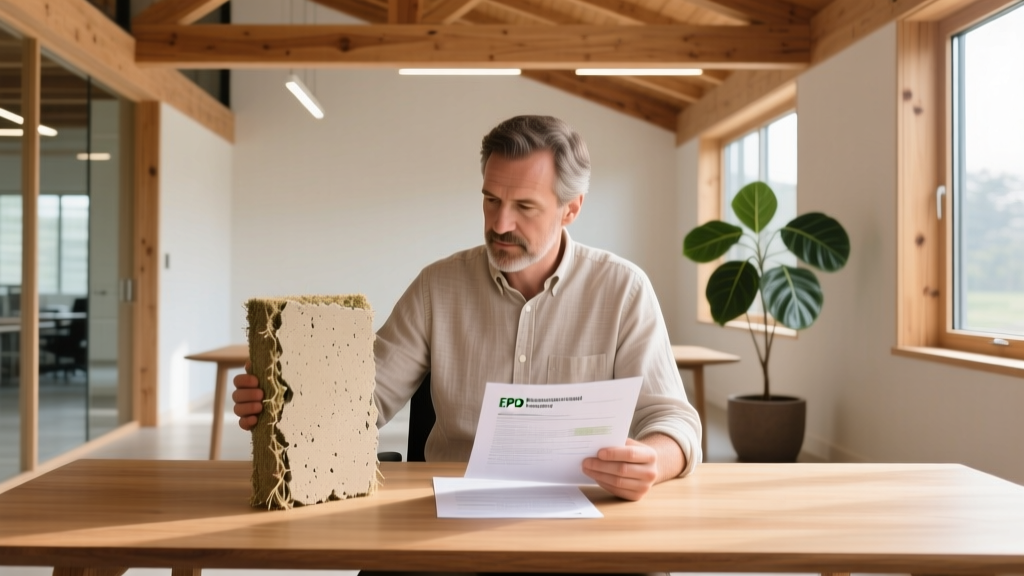
Decoding Environmental Product Declarations (EPDs)
An EPD is a standardized document (governed by ISO 14025) that quantifies a product's environmental impact across its lifecycle. When selecting materials, prioritize Type III EPDs, which are third-party verified and based on Product Category Rules (PCRs). According to UL Solutions, Type III EPDs provide the most rigorous, apples-to-apples comparison data for Global Warming Potential (GWP), measured in kg CO2 equivalent.
Key EPD Metrics for Material Selection
- Global Warming Potential (GWP): The total embodied carbon. Look for cradle-to-gate (A1-A3) and cradle-to-grave (A1-C4) boundaries.
- Ozone Depletion Potential (ODP): Must be strictly zero for all insulation and foam products.
- Acidification & Eutrophication Potential: Critical when selecting materials near sensitive watersheds or agricultural zones.
Tools like One Click LCA and Tally now integrate directly with BIM software, allowing specifiers to set maximum GWP thresholds per assembly before finalizing material schedules.
Material-Specific Selection Matrix
The following matrix compares conventional baseline materials with high-performance sustainable alternatives available in the 2026 market, highlighting the specific selection metrics and cost premiums.
| Material Category | Top Sustainable Choice (2026) | Key Selection Metric | Avg. Upfront Premium |
|---|---|---|---|
| Batt Insulation | Hempitecture HempWool | Carbon negative (A1-A3); 30% lower GWP than mineral wool | +35% to +45% |
| Structural Concrete | CarbonCure Injected Mix | Injects post-industrial CO2; reduces cement content by 5-8% | +$2 to +$4 per CY |
| Exterior Sheathing | Huber ZIP System (FSC-Certified) | Eliminates housewrap waste; integrated air/water barrier | +12% to +15% |
| Acoustic Ceiling | Armstrong BioAcoustic (Recycled PET) | Up to 92% post-consumer recycled content; Red List Free | Cost Neutral |
| Interior Framing | Cold-Formed Steel (90%+ Recycled) | Zero jobsite wood waste; fully recyclable at end-of-life | +5% to +10% |
Health and Indoor Air Quality: Strict VOC Thresholds
Sustainable materials must not compromise occupant health. The baseline standard for interior finishes, adhesives, and sealants is the California Department of Public Health (CDPH) Standard Method v1.2. This standard tests for specific VOC emissions, not just content.
Non-Negotiable IAQ Limits
When reviewing product cut sheets, verify compliance with these exact thresholds:
- Formaldehyde: Must not exceed 0.016 ppm (parts per million) over a 14-day testing period.
- Total Volatile Organic Compounds (TVOC): Must remain below 0.5 mg/m³.
- Individual VOCs: No single VOC can exceed 50% of its Chronic Reference Exposure Level (CREL).
Products holding GREENGUARD Gold certification or the Declare Label 'Red List Free' designation inherently meet or exceed these thresholds. The EPA's Sustainable Marketplace explicitly recommends prioritizing third-party IAQ certifications over manufacturer self-declarations to mitigate liability in commercial and healthcare projects.
Lifecycle Cost Analysis (LCCA) vs. Upfront Premium
The most common failure in selecting eco friendly green building materials is rejecting a product based solely on initial procurement costs. A robust LCCA evaluates installation labor, maintenance, energy performance, and end-of-life disposal.
Expert Insight: 'A 40% upfront premium for high-performance triple-pane fiberglass windows with low-e coatings is typically offset within 7 to 9 years through HVAC downsizing and reduced utility loads, while simultaneously securing LEED v4.1 Energy & Atmosphere credits.' — 2026 Commercial Building Performance Report.
For example, specifying structural insulated panels (SIPs) or insulated concrete forms (ICFs) carries a 10-15% material premium over traditional stick framing. However, this is offset by a 30-50% reduction in framing labor time and a significant decrease in exterior air infiltration, which allows mechanical engineers to specify smaller, less expensive HVAC equipment.
Sourcing and Chain of Custody: Verifying Claims
Biophilic and wood-heavy designs rely heavily on Forest Stewardship Council (FSC) certification. However, specifying 'FSC wood' is insufficient; the procurement contract must mandate specific Chain of Custody (CoC) compliance.
FSC Claim Verification
- FSC 100%: All material originates from FSC-certified forests. (Ideal for high-visibility architectural millwork).
- FSC Mix Credit: Allows blending of FSC, recycled, and controlled wood. (Acceptable for structural framing and sheathing).
- CoC Documentation: The supplier must provide an FSC-STD-40-004 V3-1 compliant invoice explicitly stating their CoC certificate number and the exact FSC claim for the line items.
For non-wood materials, look for Cradle to Cradle (C2C) Certified products at the Silver level or higher, which verifies material health, renewable energy use in manufacturing, and water stewardship.
Troubleshooting Common Selection Failures
Symptom: Material fails local fire marshal inspection despite 'green' label.
Cause: The product was selected for its low embodied carbon but lacks the necessary ASTM E84 Class A (flame spread index ≤ 25) or ASTM E119 fire-resistance rating required for the specific assembly type.
Fix: Cross-reference the EPD with the manufacturer's UL Fire Resistance Directory listing. Never assume a bio-based insulation (like cellulose or hemp) meets code without verifying its specific borate treatment and tested assembly rating.
Symptom: Project misses LEED Materials & Resources credits.
Cause: The team focused entirely on recycled content (MR Credit) but ignored the regional sourcing radius or the requirement for a minimum number of products with EPDs, as mandated by LEED BD+C v4.1.
Fix: Use a tracking spreadsheet from schematic design. Mandate that at least 20 permanently installed products from 5 different manufacturers have Type III EPDs, and ensure 10 products are sourced within a 100-mile radius of the project site to maximize the Sourcing of Raw Materials credit.
Symptom: Bio-based adhesives fail under high humidity during installation.
Cause: Soy-based or low-VOC waterborne adhesives often have stricter temperature and humidity application windows (typically 50°F–90°F and <65% RH) compared to solvent-based alternatives.
Fix: Review the Technical Data Sheet (TDS) for specific application tolerances. If the project schedule requires installation during unconditioned, high-humidity phases, switch to a moisture-curing polyurethane adhesive that still meets CDPH v1.2 VOC limits but offers a wider application envelope.
Finalizing the Procurement Strategy
Successful integration of eco friendly green building materials hinges on early specification and rigid contract language. Include EPD delivery, FSC CoC invoices, and IAQ test reports as mandatory submittals tied to payment milestones. By enforcing these selection criteria, project teams eliminate greenwashing risks, ensure code compliance, and deliver buildings that perform optimally across their entire lifecycle.
Written by
Sarah WhitfieldSarah Whitfield is a chartered quantity surveyor (MRICS) and construction cost analyst with 15 years of experience in material pricing, procurement strategy, and project budgeting. She earned her degree in Construction Management from the University of Reading (UK) and has worked on projects ranging from $2M custom homes to $180M mixed-use developments across North America and Europe. Sarah currently leads cost estimating for BuildMat Insight, maintaining a proprietary database of 4,000+ material price points updated quarterly. She is a frequent contributor to RSMeans cost data panels and has presented at the International Cost Engineering Council (ICEC) congress. Based in Denver, CO, Sarah is an avid trail runner and volunteer mentor for Women in Construction.
More from Sarah Whitfield
View all
Wood & Lumber
What Are the Different Types of Wood? A Builder's Guide
Compare structural softwoods, finish hardwoods, and engineered lumber. Analyze Janka ratings, MOE values, and 2026 pricing for construction.
Aug 4, 2026

Walls & Panels
Steel Framing vs Wood Framing: Corrosion and Moisture Defense
Compare steel framing vs wood framing for moisture resistance. Learn about galvanized coatings, condensation risks, and corrosion protection strategies.
Jul 21, 2026

Stone & Masonry
How to Cut Stone Veneer: Wet Saw vs Grinder Comparison
Compare the best tools for cutting stone veneer. We review wet saws, angle grinders, and chop saws to help you achieve clean, chip-free cuts.
Jul 21, 2026