Sustainable Building Decorative Materials: 2026 Green Guide
Discover the best sustainable building decorative materials for 2026. Compare eco-friendly wall panels, countertops, and flooring with LEED specs.

The Shift Toward Low-Embodied Carbon Decor
As the construction industry aligns with the 2026 updates to LEED v5 and the Living Building Challenge, the specification of building decorative materials has moved far beyond simple low-VOC requirements. Today, interior finishes must demonstrate verified low embodied carbon, circular lifecycle potential, and strict chemical transparency. Decorative elements—wall panels, countertops, and flooring—traditionally account for up to 15% of a commercial interior's total embodied carbon footprint. By shifting from virgin petroleum-based laminates and quarried stone to bio-composites and reclaimed surfaces, project teams can drastically reduce this impact while achieving high-end aesthetic results.
Top Eco-Friendly Building Decorative Materials Compared
Selecting the right material requires balancing upfront costs, lifecycle durability, and specific environmental certifications. The matrix below outlines the primary sustainable decorative materials dominating the 2026 market.
| Material Type | Best Application | Avg. Cost (Installed) | Key Certifications |
|---|---|---|---|
| Recycled Paper Composite | Countertops, wall cladding, lab surfaces | $65 - $95 / sq ft | FSC, GREENGUARD Gold, NSF/ANSI 51 |
| Natural Clay Plaster | Interior accent walls, humidity buffering | $12 - $18 / sq ft | Cradle to Cradle, Declare Label |
| Bio-Based Linoleum | High-traffic commercial flooring | $8 - $14 / sq ft | EPD verified, FloorScore, EU Ecolabel |
| Reclaimed Wood Veneer | Feature walls, ceiling baffles | $22 - $40 / sq ft | FSC Recycled, CARB Phase 2 |
Deep Dive: Recycled Paper Composite Surfaces
Recycled paper composites have evolved from niche laboratory surfaces to premier decorative materials for hospitality and corporate interiors. These panels are manufactured by saturating post-consumer recycled paper with resins and curing them under high heat and pressure, resulting in a dense, non-porous material that mimics the feel of honed stone.
Product Spotlight: Richlite vs. PaperStone
While both brands dominate the category, their chemical compositions differ significantly, impacting their sustainability profiles and installation requirements.
- Richlite: Utilizes a petroleum-based phenolic resin. While it contains up to 65% recycled paper content and holds GREENGUARD Gold certification for indoor air quality, its reliance on petrochemicals limits its end-of-life biodegradability.
- PaperStone (PetroFree line): Uses a proprietary, 100% petroleum-free resin derived from cashew nut shell liquid (CNSL). This bio-resin significantly lowers the embodied carbon of the panel. It is available in 100% post-consumer recycled paper variants.
Wall Finishes: Beyond Zero-VOC Paints
The EPA's guidelines on indoor air quality emphasize that zero-VOC is merely the baseline. True sustainable decorative wall finishes actively improve indoor environmental quality (IEQ) by regulating humidity and absorbing airborne pollutants.
Clay Plasters and Limewash
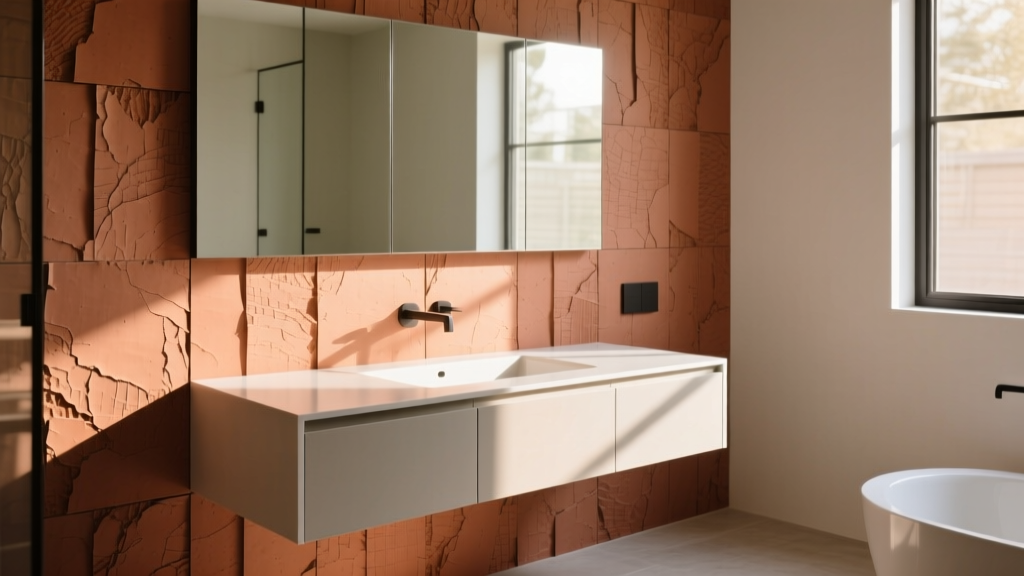
Unlike acrylic paints that form a plastic film, clay plasters remain vapor-permeable. Brands like American Clay and BioPaint offer pre-mixed, mineral-based plasters that provide a rich, tactile aesthetic while functioning as a passive humidity buffer.
Application Specifics: Clay plaster requires a strict 3-coat system (scratch, brown, and finish) totaling roughly 3/8-inch in thickness. It must be applied over a high-suction substrate. Applying clay plaster directly over standard painted drywall without first applying a specialized sand-primer mix will result in catastrophic delamination as the clay dries and shrinks. For commercial projects, specify a mechanical fastener or a high-grade fiberglass mesh embedded in the scratch coat to prevent cracking at drywall seams.
Flooring Decor: Bio-Based and Reclaimed
Flooring represents the largest surface area in most interior projects, making its material choice critical for both carbon accounting and LEED credit optimization.
Linoleum vs. Luxury Vinyl Tile (LVT)
Despite the rise of 'bio-based' LVT marketing, true sustainable flooring specification heavily favors sheet linoleum. Forbo Marmoleum remains the industry benchmark, composed of linseed oil, pine rosin, wood flour, and a jute backing. It is naturally bacteriostatic and fully biodegradable at the end of its 30-to-40-year lifecycle.
Conversely, many products marketed as 'bio-LVT' simply replace a fraction of the PVC plasticizers with vegetable oils while retaining a polyurethane wear layer and a fiberglass core. These hybrid products cannot be recycled in standard municipal streams and still off-gas trace phthalates under high thermal loads.
LEED v5 and WELL Integration for Decorative Elements
To maximize points under the updated USGBC LEED v5 Materials and Resources credits, decorative materials must be documented rigorously. Relying solely on manufacturer claims is no longer sufficient; third-party verified Environmental Product Declarations (EPDs) are mandatory.
- Request Type III EPDs: Ensure the EPD is product-specific, not industry-wide, and covers the cradle-to-gate scope at minimum.
- Chemical Transparency: Source materials with Health Product Declarations (HPDs) that disclose all ingredients down to 100 ppm, avoiding the 'Red List' chemicals defined by the International Living Future Institute.
- Regional Sourcing: Prioritize decorative materials manufactured within a 100-mile radius of the project site to capitalize on the localized supply chain multiplier in LEED v5.
Sourcing and Procurement Framework
Procuring sustainable building decorative materials requires a shift in how specifications are written. Instead of naming a single manufacturer, design teams should utilize performance-based specifications that mandate environmental criteria. For example, specify 'Recycled Paper Composite Countertops' with mandatory requirements for 'minimum 50% post-consumer recycled content, NSF/ANSI 51 food safety compliance, and a verified EPD showing a Global Warming Potential (GWP) of less than 15 kg CO2e per square meter.' This framework prevents value-engineering teams from substituting high-performance bio-composites with cheaper, high-carbon laminates during the bidding phase, ensuring the project's sustainability intent survives through to final installation.
Written by
Elena RodriguezElena Rodriguez is a civil engineer and technical writer specializing in concrete technology, masonry systems, and ASTM/ACI compliance. She earned her B.S. in Civil Engineering from Texas A&M University and spent a decade at a materials testing laboratory, performing over 2,000 concrete compressive strength tests and masonry prism evaluations. Elena is an ACI-certified Field Testing Technician (Grade I) and a member of ASTM Committee C12 on Natural Building Stone. She currently consults on forensic engineering cases involving concrete failures and moisture intrusion. Based in San Antonio, TX, Elena is a proud member of the Society of Women Engineers (SWE) and coaches her daughter's FIRST Robotics team.
More from Elena Rodriguez
View all
Walls & Panels
Cost Analysis: Light Gauge Steel Framing Advantages and Disadvantages
Evaluate light gauge steel framing advantages and disadvantages through a strict cost analysis lens, comparing material, labor, and lifecycle expenses.
Aug 4, 2026

Walls & Panels
Gypsum Board Types: Exact Specifications, Thickness & Dimensions
Compare standard, Type X, and moisture-resistant gypsum board types. Get exact specifications, thicknesses, dimensions, and ASTM standards for your project.
Aug 4, 2026

Fire Resistance
Best Fire-Resistant Outdoor Decking Materials: 2026 Buyer Guide
Discover the best fire-resistant outdoor decking materials for 2026. Compare Class A PVC, aluminum, and hardwood options for WUI compliance and safety.
Aug 4, 2026