Evaluating Sustainable Flooring Options: A Selection Criteria Guide
Discover the exact selection criteria for evaluating sustainable flooring options, including LEED metrics, VOC limits, and lifecycle cost analysis.

The Core Metrics of Sustainable Flooring Selection
Specifying eco-friendly surfaces requires moving beyond superficial marketing claims to evaluate quantifiable environmental and performance data. When assessing sustainable flooring options, architects and builders must analyze three primary vectors: embodied carbon, indoor air quality (IAQ) emissions, and end-of-life (EOL) circularity. A material that utilizes recycled content but off-gasses high levels of volatile organic compounds (VOCs) or requires energy-intensive adhesives fails the holistic sustainability test.
Comparative Matrix: Evaluating Top Sustainable Flooring Options
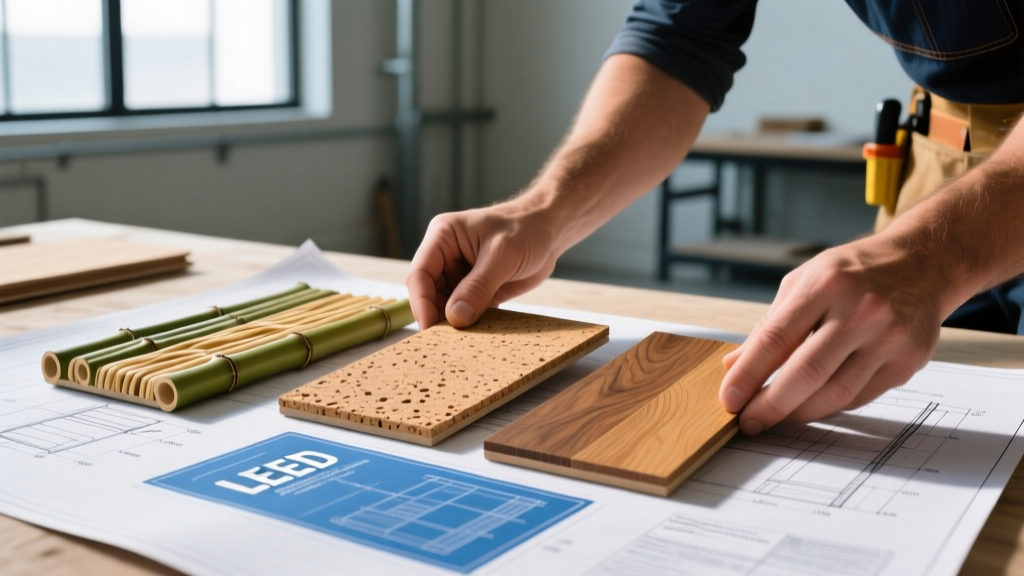
The following matrix breaks down the technical specifications, installed costs, and environmental profiles of the leading sustainable flooring options available in the current market. Pricing reflects 2026 commercial installation averages, including standard subfloor preparation and low-VOC adhesives.
| Material | Installed Cost ($/sq ft) | Janka Hardness (lbf) | Embodied Carbon Profile | Expected Lifespan |
|---|---|---|---|---|
| Stranded Bamboo | $5.50 - $8.00 | ~3,000 | Low (Rapidly renewable, 5-year harvest cycle) | 25 - 40 years |
| Natural Cork | $6.00 - $10.00 | ~200 | Carbon Negative (Biogenic carbon storage) | 30 - 50 years |
| Marmoleum (Sheet Linoleum) | $7.50 - $11.00 | N/A (Resilient) | Low (Linseed oil, jute, wood flour) | 30 - 45 years |
| Reclaimed Oak | $12.00 - $20.00 | ~1,290 | Near Zero (Diverts waste, no new harvesting) | 75+ years |
Deep Dive: Lifecycle Assessment (LCA) and Embodied Carbon
Embodied carbon represents the total greenhouse gas emissions generated by the extraction, manufacturing, transportation, and installation of a flooring product. To accurately compare sustainable flooring options, specifiers must utilize Lifecycle Assessment (LCA) data rather than relying on generic material categories.
Calculating the Carbon Payback Period
For bio-based materials like cork and bamboo, the concept of biogenic carbon is critical. Cork oak trees (Quercus suber) are not felled during harvest; only the bark is stripped, allowing the tree to continue sequestering carbon. According to LCA data modeled through the NIST BEES (Building for Environmental and Economic Sustainability) database, natural cork flooring often achieves a carbon-negative status at the factory gate because the carbon stored in the bark exceeds the emissions from processing and transport. When selecting cork, require an EPD that explicitly breaks down biogenic carbon storage versus fossil fuel emissions to verify these claims.
Health and Indoor Air Quality (IAQ) Standards
Sustainable flooring must not compromise occupant health. Off-gassing from flooring assemblies is a primary contributor to poor indoor air quality, which can lead to sick building syndrome. The EPA's guidelines on VOCs emphasize that flooring emissions must be evaluated as a complete system, not just the surface material.
A zero-VOC bamboo floor becomes a high-VOC assembly if installed using a solvent-based urethane adhesive or a recycled-rubber underlayment containing unregulated sulfides. Always mandate that the adhesive, primer, and leveling compounds carry the FloorScore certification. The Resilient Floor Covering Institute (RFCI) FloorScore standard tests the entire installation system against California Section 01350 limits, ensuring formaldehyde emissions remain below 0.05 ppm as measured by ASTM E1333.
Step-by-Step Selection Framework for Architects and Builders
To systematically narrow down the best sustainable flooring options for a specific project, follow this four-step technical framework:
- Define Traffic and Load Requirements: Match the Janka hardness rating to the expected foot traffic. For heavy commercial corridors, specify stranded bamboo (3,000 lbf) or reclaimed hickory (1,820 lbf). Avoid natural cork (200 lbf) in high-rolling-load environments like hospital corridors or warehouse aisles, as it will compress and fail to recover under continuous point loads exceeding 250 psi.
- Verify EPDs and HPDs: Request third-party verified Type III EPDs from the manufacturer. Scrutinize the 'Use Stage' and 'End-of-Life Stage' modules within the EPD. If the manufacturer only provides a 'Cradle-to-Gate' EPD, you lack the data required to calculate the full lifecycle impact or LEED credit eligibility.
- Audit the Adhesive Ecosystem: Specify water-based, low-VOC silane-modified polymer (SMP) adhesives for engineered woods and bamboo. SMP adhesives cure without releasing isocyanates or solvents and provide superior moisture vapor transmission resistance (up to 15 lbs/1000 sq ft/24 hours), eliminating the need for separate, high-carbon epoxy moisture barriers.
- Calculate End-of-Life (EOL) Scenarios: Prioritize mechanically fastened or floating floor systems over full-spread glue-down installations. A floating cork or click-lock bamboo floor can be disassembled and reused or recycled at the end of its service life. Glue-down floors typically end up in landfills because separating the material from the concrete subfloor is economically unviable.
Frequently Asked Questions
Is luxury vinyl plank (LVP) ever considered a sustainable flooring option?
Standard LVP is fundamentally a petroleum-derived PVC product and carries a high embodied carbon footprint. However, some manufacturers now produce bio-based LVP alternatives utilizing polyurethane (PUR) topcoats and limestone-rich cores without phthalate plasticizers. While these bio-attributed options improve IAQ and reduce fossil-fuel reliance, they still fall short of the circularity and biogenic carbon benefits provided by natural linoleum or cork.
How does moisture affect the sustainability lifespan of bamboo flooring?
Stranded bamboo is highly susceptible to dimensional instability when exposed to moisture vapor emission rates (MVER) exceeding 3 lbs/1000 sq ft/24 hours. If installed over a damp concrete slab without a proper vapor retarder, the planks will cup and delaminate, prematurely ending the floor's lifecycle and negating its environmental benefits. Always perform a calcium chloride test (ASTM F1869) or relative humidity probe test (ASTM F2170) before installation.
What maintenance chemicals are required for natural linoleum?
Unlike vinyl, which requires periodic stripping and waxing with high-VOC acrylic finishes, natural linoleum (Marmoleum) develops a protective patina over time. It requires only neutral pH cleaners (between 6.0 and 8.0) and occasional buffing with a water-based, plant-derived finish. This drastically reduces the chemical footprint and operational carbon associated with long-term facility maintenance.
Written by
Elena RodriguezElena Rodriguez is a civil engineer and technical writer specializing in concrete technology, masonry systems, and ASTM/ACI compliance. She earned her B.S. in Civil Engineering from Texas A&M University and spent a decade at a materials testing laboratory, performing over 2,000 concrete compressive strength tests and masonry prism evaluations. Elena is an ACI-certified Field Testing Technician (Grade I) and a member of ASTM Committee C12 on Natural Building Stone. She currently consults on forensic engineering cases involving concrete failures and moisture intrusion. Based in San Antonio, TX, Elena is a proud member of the Society of Women Engineers (SWE) and coaches her daughter's FIRST Robotics team.
More from Elena Rodriguez
View all
Walls & Panels
Cost Analysis: Light Gauge Steel Framing Advantages and Disadvantages
Evaluate light gauge steel framing advantages and disadvantages through a strict cost analysis lens, comparing material, labor, and lifecycle expenses.
Aug 4, 2026

Walls & Panels
Gypsum Board Types: Exact Specifications, Thickness & Dimensions
Compare standard, Type X, and moisture-resistant gypsum board types. Get exact specifications, thicknesses, dimensions, and ASTM standards for your project.
Aug 4, 2026

Fire Resistance
Best Fire-Resistant Outdoor Decking Materials: 2026 Buyer Guide
Discover the best fire-resistant outdoor decking materials for 2026. Compare Class A PVC, aluminum, and hardwood options for WUI compliance and safety.
Aug 4, 2026