Advanced Ecological Building Materials: 2026 Innovation Guide
Explore 2026 innovations in ecological building materials, including mycelium insulation, carbon-injected concrete, and hemp bio-composites with real costs.

The Shift from Niche to Code-Compliant Mainstream
The specification of ecological building materials has transitioned from a niche sustainability pursuit to a core compliance requirement under updated 2026 building codes and LEED v5 frameworks. Driven by stringent embodied carbon limits in the IECC 2024/2027 addenda and regional mandates like California's CALGreen, architects and general contractors are rapidly adopting bio-fabricated and carbon-sequestering alternatives. This innovation spotlight examines the technical specifications, real-world costs, and critical failure modes of the most viable advanced ecological materials currently available for commercial and high-performance residential construction.
Bio-Fabricated Insulation: Mycelium Composites
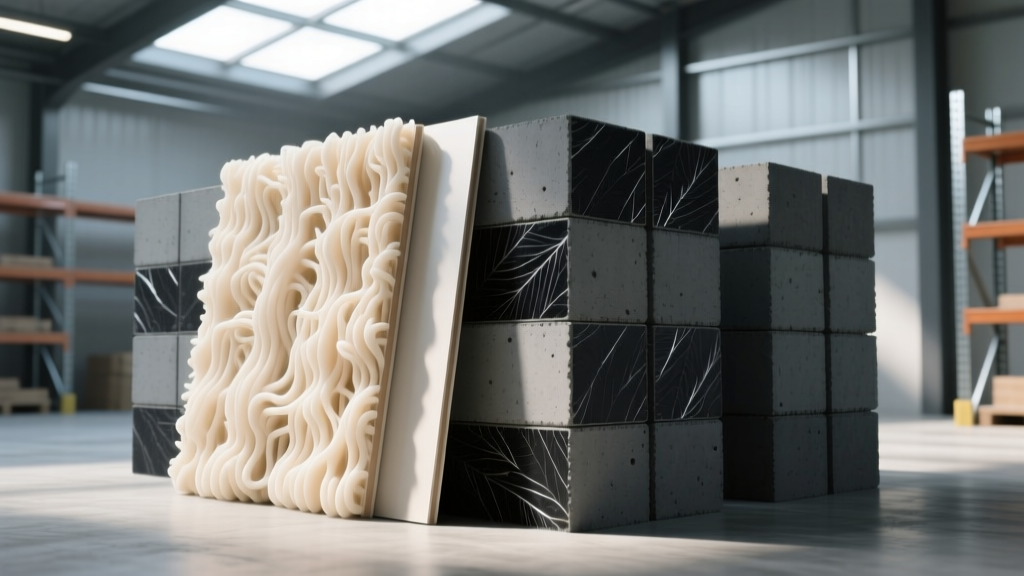
Mycelium—the vegetative root structure of fungi—has matured from a conceptual prototype into a commercially viable insulation and acoustic dampening material. Companies like Ecovative Design utilize mycelium to bind agricultural byproducts (such as hemp hurd or corn stalks) into rigid panels that replace traditional expanded polystyrene (EPS) and fiberglass batts.
Technical Specifications: Mycelium Insulation Panels
- Thermal Resistance: R-3.8 to R-4.2 per inch (tested per ASTM C518)
- Density: 4.0 to 8.0 lbs/ft³
- Fire Rating: Class A (ASTM E84), inherently fire-retardant without chemical treatments
- Acoustic Performance: NRC (Noise Reduction Coefficient) of 0.85
- Installed Cost: $2.80 to $3.50 per square foot (material only)
Real-World Failure Mode & Mitigation: The primary vulnerability of mycelium panels is moisture exposure during the construction phase before the building envelope is sealed. If exposed to bulk water or sustained relative humidity above 80% for more than 72 hours, the dormant mycelium can reactivate or attract secondary mold growth. Mitigation: Specify mycelium insulation only for interior partition walls, floor assemblies, or roofs where the primary water-resistive barrier (WRB) is fully installed and flashed before insulation delivery. Store materials on-site in climate-controlled, elevated staging areas.
Carbon-Injected Concrete: Mineralization Technology
Traditional ordinary Portland cement (OPC) is responsible for roughly 8% of global CO2 emissions. Carbon-injected concrete, pioneered by CarbonCure Technologies, addresses this by injecting captured industrial CO2 into the concrete mix during batching. The CO2 reacts with calcium ions to form calcium carbonate nanoparticles, which act as nucleation sites for cement hydration.
This process permanently sequesters the CO2 while simultaneously increasing the compressive strength of the concrete by 8% to 12%. This strength gain allows mix designers to reduce the overall cement content by up to 8%, compounding the carbon reduction.
| Material Metric | Traditional OPC (4000 psi) | Carbon-Injected OPC | Fly Ash Geopolymer |
|---|---|---|---|
| Embodied Carbon (kgCO2e/m³) | 380 - 420 | 290 - 320 | 150 - 200 |
| 28-Day Compressive Strength | 4,000 psi | 4,400+ psi | 3,500 - 4,000 psi |
| Cost Premium (per cubic yard) | Baseline ($145) | +$4.00 to +$6.00 | +$15.00 to +$25.00 |
| Curing Time to 75% Strength | 7 Days | 5 to 6 Days | 10 to 14 Days |
Batching Gotcha: Carbon injection can cause a slight acceleration in slump loss (workability reduction) during transit. Ready-mix suppliers must adjust polycarboxylate ether (PCE) superplasticizer dosages by 2% to 4% to maintain a 5-inch slump upon arrival at the job site, especially in ambient temperatures exceeding 85°F.
Advanced Hemp Bio-Composites
Hempcrete—a mixture of hemp hurd, lime binder, and water—has historically been limited to cast-in-place, non-load-bearing infill walls due to its long curing times and low compressive strength. However, 2026 market offerings have shifted toward pre-cast hemp bio-composites and high-density hemp fiber batts, such as Hempitecture's HempWool.
These advanced ecological building materials offer exceptional vapor permeability (perms > 10), making them ideal for unvented roof assemblies and mass timber enclosures where hygrothermal buffering is critical to prevent interstitial condensation.
Material Selection Decision Matrix
Use this framework to specify the correct bio-insulation for your specific assembly:
- If the assembly is a vented rain-screen wall: Specify standard HempWool batts (R-3.5/inch). The high vapor permeability allows outward drying, and the material's natural alkalinity deters pest infiltration.
- If the assembly requires high acoustic isolation (STC 50+): Specify high-density mycelium panels. The cellular structure of the fungal network absorbs mid-to-high frequency sound waves more effectively than fibrous hemp.
- If the assembly is a below-grade foundation: Avoid both hemp and mycelium. Specify rigid mineral wool or cellular glass (e.g., Foamglas), which provide ecological benefits through high recycled content and zero moisture absorption.
Navigating LEED v5 and Life Cycle Assessment (LCA)
Specifying advanced ecological building materials is only half the equation; documenting their impact is required for certification. Under the U.S. Green Building Council's LEED v5 framework, the Materials and Resources (MR) credits heavily weight whole-building Life Cycle Assessments (LCA) and Environmental Product Declarations (EPDs).
Pro-Tip for Specifiers: Do not accept generic, industry-average EPDs for bio-materials. Require manufacturers to provide product-specific, cradle-to-gate EPDs verified by a third party like NSF or UL Solutions. A product-specific EPD for mycelium insulation will demonstrate a negative or near-zero global warming potential (GWP), whereas an industry-average EPD might dilute this data with older, less efficient manufacturing runs.
Furthermore, the U.S. Department of Energy emphasizes that the operational energy savings of high-performance envelopes must not be negated by massive upfront embodied carbon spikes. By utilizing carbon-injected concrete for the structural frame and mycelium or hemp composites for the enclosure, project teams can achieve a 30% to 45% reduction in whole-building embodied carbon compared to 2020 baseline designs.
Procurement and Supply Chain Realities
While the performance data for these materials is robust, the supply chain requires proactive management. Mycelium panels are primarily manufactured in specialized bio-fabrication facilities in the Northeast and Pacific Northwest. For projects in the Southeast or Midwest, factor in a 15% to 20% freight premium and a 4-to-6-week lead time.
Carbon-injected concrete, conversely, has achieved widespread availability. Over 700 ready-mix plants across North America are currently equipped with injection hardware. To secure this material, simply add 'CarbonCure injected mix' to the structural specifications and require the batch plant to provide the CO2 sequestration report alongside the standard concrete delivery ticket. This ensures the carbon data is seamlessly integrated into your project's final LCA documentation without requiring post-construction forensic accounting.
Written by
Elena RodriguezElena Rodriguez is a civil engineer and technical writer specializing in concrete technology, masonry systems, and ASTM/ACI compliance. She earned her B.S. in Civil Engineering from Texas A&M University and spent a decade at a materials testing laboratory, performing over 2,000 concrete compressive strength tests and masonry prism evaluations. Elena is an ACI-certified Field Testing Technician (Grade I) and a member of ASTM Committee C12 on Natural Building Stone. She currently consults on forensic engineering cases involving concrete failures and moisture intrusion. Based in San Antonio, TX, Elena is a proud member of the Society of Women Engineers (SWE) and coaches her daughter's FIRST Robotics team.
More from Elena Rodriguez
View all
Walls & Panels
Cost Analysis: Light Gauge Steel Framing Advantages and Disadvantages
Evaluate light gauge steel framing advantages and disadvantages through a strict cost analysis lens, comparing material, labor, and lifecycle expenses.
Aug 4, 2026

Walls & Panels
Gypsum Board Types: Exact Specifications, Thickness & Dimensions
Compare standard, Type X, and moisture-resistant gypsum board types. Get exact specifications, thicknesses, dimensions, and ASTM standards for your project.
Aug 4, 2026

Fire Resistance
Best Fire-Resistant Outdoor Decking Materials: 2026 Buyer Guide
Discover the best fire-resistant outdoor decking materials for 2026. Compare Class A PVC, aluminum, and hardwood options for WUI compliance and safety.
Aug 4, 2026