How to Evaluate the Building Materials Company Nichiha on Shake Siding
Learn how to evaluate the building materials company Nichiha on shake siding. Compare profiles, costs, and installation specs for your exterior project.

The Nichiha Shake Siding Evaluation Matrix
When architects and custom home builders evaluate the building materials company Nichiha on shake siding applications, the decision rarely comes down to a single factor. Fiber cement shakes represent a premium cladding category where aesthetic authenticity must be balanced against structural weight, labor intensity, and long-term moisture management. Nichiha, a Japanese-founded manufacturer with extensive North American production, approaches shake siding with a focus on deep shadow lines and high-density Portland cement formulations.
To systematically assess whether Nichiha's shake portfolio fits your specific build, use the following evaluation matrix. This framework compares their two primary shake profiles against the industry baseline.
| Evaluation Metric | Nichiha Empire Shake | Nichiha Vintage Wood | Industry Baseline (HardieShingle) |
|---|---|---|---|
| Profile Thickness | 5/8" (Heavy Shadow) | 5/16" (Traditional Shingle) | 5/16" (Standard Shingle) |
| Edge Style | Staggered / Rough-Sawn | Straight / Half-Round Options | Straight / Staggered |
| Weight per Sq. Ft. | ~3.8 lbs | ~2.9 lbs | ~3.0 lbs |
| Max Exposure | 7" to 10" (Panel dependent) | 7" (Standard courses) | 7" (Standard courses) |
| Ideal Architectural Style | Craftsman, Tudor, Mountain Modern | Cape Cod, Colonial, Coastal | Universal / Suburban Traditional |
Profile Depth and Aesthetic Authenticity
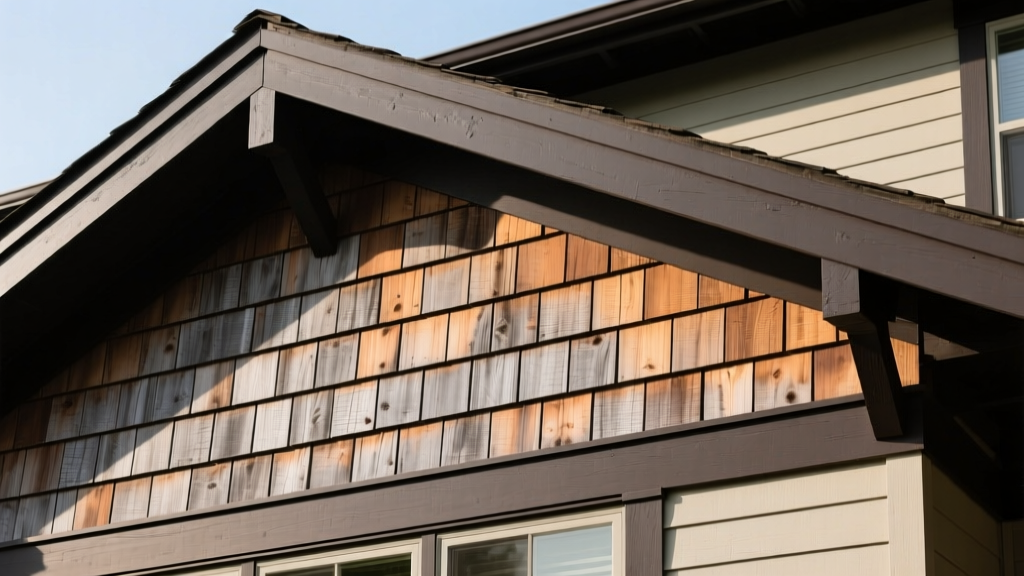
The primary reason specifiers choose Nichiha over competitors is the dimensional depth of the Empire Shake line. At 5/8 inches thick, Empire Shake provides a shadow line that closely mimics real hand-split cedar. When evaluating this material for a facade, consider the sightlines. If the shakes are being installed on a second story or a steep gable, the 5/8-inch thickness prevents the cladding from looking "flat" or manufactured when viewed from the ground.
Color and Finish Technology
Nichiha utilizes a multi-coat acrylic finish system applied in the factory. Unlike site-primed and painted alternatives, their pre-finished shakes feature a primer layer, a base coat, and a topcoat with UV-resistant pigments. When evaluating color retention, request the manufacturer's Delta-E rating data. A Delta-E shift of less than 2.0 over a 10-year period is the benchmark for premium fiber cement, ensuring the "weathered cedar" or "aged teak" tones do not chalk or fade unevenly on south-facing elevations.
Climate Resilience and Material Science
Fiber cement is inherently immune to wood-boring insects and rot, but its performance in extreme climates depends on the specific formulation and installation clearances. Nichiha's shakes are manufactured to meet ASTM C1186 (Standard Specification for Flat Non-Asbestos Fiber-Cement Sheets), specifically Type A for exterior weathering.
Critical Climate Considerations
- Freeze-Thaw Cycles: Nichiha's high-density formulation limits water absorption to less than 15% by weight. In regions with severe freeze-thaw cycling (e.g., the Upper Midwest or Northeast), maintaining the factory-applied sealant on all cut edges is non-negotiable to prevent micro-spalling.
- Coastal Salt Spray: For homes within 1,500 feet of the ocean, the cementitious matrix outperforms wood and engineered wood. However, you must upgrade the fasteners from standard hot-dipped galvanized to 316-grade stainless steel ring-shank nails to prevent rust-bleeding through the shake face.
- Fire Resistance: Nichiha shakes carry a Class A fire rating per ASTM E84. This makes them a code-compliant choice for structures in Wildland-Urban Interface (WUI) zones where the National Fire Protection Association (NFPA) and local forestry services mandate non-combustible exterior envelopes.
Installation Realities: Labor, Cutting, and Silica Management
Evaluating any fiber cement product requires a hard look at labor costs and job-site safety protocols. Nichiha shakes are heavier and denser than wood, demanding specialized handling and cutting equipment.
Silica Dust and OSHA Compliance
Cutting fiber cement generates respirable crystalline silica. Under OSHA's respirable crystalline silica standard (29 CFR 1926.1153), contractors must use engineering controls to keep dust below the Permissible Exposure Limit (PEL) of 50 micrograms per cubic meter. When evaluating Nichiha for your project, ensure your general contractor budgets for HEPA-filtered dust extraction systems and polycrystalline diamond (PCD) tipped blades with 4 to 6 teeth. Using standard abrasive masonry blades will not only violate OSHA regulations but will also fray the edges of the shakes, ruining the aesthetic authenticity.
Fastening Protocols
Unlike horizontal lap siding which can often be blind-nailed, shake siding typically requires face-nailing to secure the thicker, overlapping layers. Nichiha specifies the use of 6d or 8d hot-dipped galvanized or stainless steel ring-shank siding nails. Nails must penetrate a minimum of 1.5 inches into the wood studs or structural sheathing. Blind nailing shakes is strongly discouraged by the manufacturer, as wind uplift can easily compromise the top edge of the shingle if it is not mechanically pinned through the face.
Cost Breakdown and ROI Framework
To accurately evaluate the building materials company Nichiha on shake siding against your budget, you must separate material costs from the premium labor required for detailed shake work. The following breakdown reflects current market averages for a 2,500-square-foot exterior envelope.
| Cost Category | Nichiha Empire Shake (5/8") | Nichiha Vintage Wood (5/16") |
|---|---|---|
| Material Cost (per sq. ft.) | $8.50 - $11.00 | $6.50 - $8.50 |
| Accessories & Trim | $1.50 - $2.50 / sq. ft. | $1.50 - $2.50 / sq. ft. |
| Labor & Installation | $9.00 - $14.00 / sq. ft. | $7.00 - $11.00 / sq. ft. |
| Total Installed Cost (per sq. ft.) | $19.00 - $27.50 | $15.00 - $22.00 |
| Estimated Total (2,500 sq. ft. home) | $47,500 - $68,750 | $37,500 - $55,000 |
Note: Labor costs scale exponentially with architectural complexity. A simple rectangular facade will sit at the lower end of the labor range, while homes with multiple dormers, gables, and intricate trim detailing will push labor costs to the maximum threshold due to the time required for precise cutting and flashing.
Final Selection Decision Tree
Use this logical framework to make your final procurement decision. Refer to the Nichiha official fiber cement portfolio for the most up-to-date profile availability and regional manufacturing lead times.
Project Suitability Decision Matrix
- IF your project is a high-end custom build in a WUI fire zone requiring heavy shadow lines → THEN specify Nichiha Empire Shake. The 5/8" thickness and Class A rating justify the premium labor cost.
- IF you are renovating a historical Cape Cod or Coastal home where traditional, thinner shingle profiles are architecturally mandated → THEN specify Nichiha Vintage Wood. It provides the rot-resistance of cement with the historically accurate 5/16" profile.
- IF your budget is strictly constrained and the shakes are only being used as an accent on a front gable → THEN either Nichiha line is viable, but ensure your contractor factors in the cost of HEPA dust extraction and specialized PCD blades for the cutting phase.
- IF the structure is located in a severe marine environment → THEN select Nichiha shakes, but immediately upgrade your fastener specification to 316 stainless steel to prevent galvanic corrosion and face-staining.
Evaluating Nichiha for shake siding ultimately requires prioritizing long-term durability and architectural depth over initial material savings. By aligning the specific profile thickness with your architectural style, enforcing strict OSHA-compliant cutting protocols, and budgeting for premium face-nailing labor, you secure a cladding system that will outperform natural wood by decades without sacrificing visual authenticity.
Written by
Elena RodriguezElena Rodriguez is a civil engineer and technical writer specializing in concrete technology, masonry systems, and ASTM/ACI compliance. She earned her B.S. in Civil Engineering from Texas A&M University and spent a decade at a materials testing laboratory, performing over 2,000 concrete compressive strength tests and masonry prism evaluations. Elena is an ACI-certified Field Testing Technician (Grade I) and a member of ASTM Committee C12 on Natural Building Stone. She currently consults on forensic engineering cases involving concrete failures and moisture intrusion. Based in San Antonio, TX, Elena is a proud member of the Society of Women Engineers (SWE) and coaches her daughter's FIRST Robotics team.
More from Elena Rodriguez
View all
Walls & Panels
Cost Analysis: Light Gauge Steel Framing Advantages and Disadvantages
Evaluate light gauge steel framing advantages and disadvantages through a strict cost analysis lens, comparing material, labor, and lifecycle expenses.
Aug 4, 2026

Walls & Panels
Gypsum Board Types: Exact Specifications, Thickness & Dimensions
Compare standard, Type X, and moisture-resistant gypsum board types. Get exact specifications, thicknesses, dimensions, and ASTM standards for your project.
Aug 4, 2026

Fire Resistance
Best Fire-Resistant Outdoor Decking Materials: 2026 Buyer Guide
Discover the best fire-resistant outdoor decking materials for 2026. Compare Class A PVC, aluminum, and hardwood options for WUI compliance and safety.
Aug 4, 2026