Siding Material Cost vs Energy Savings: 2026 ROI Guide
Analyze 2026 siding material cost against long-term energy ROI. Compare insulated vinyl, fiber cement, and thermal bridging impacts on HVAC loads.

The Hidden Metric: Upfront Siding Material Cost vs. Thermal Performance
When evaluating exterior cladding, most builders and homeowners fixate on the immediate siding material cost per square foot. However, in an era of stringent 2026 IECC (International Energy Conservation Code) requirements and volatile utility rates, analyzing cladding purely as an aesthetic weather barrier is a financial miscalculation. The true cost of siding must be calculated as a combined metric: initial capital expenditure plus the lifecycle energy burden created by the wall assembly's thermal resistance (R-value) and thermal bridging characteristics.
Evaluating siding material cost through an energy-efficiency lens reveals a counterintuitive reality. Premium-priced cladding options often yield a lower total cost of ownership when factoring in reduced HVAC tonnage requirements, lower monthly heating and cooling loads, and the mitigation of condensation risks within the wall cavity. Conversely, budget-friendly traditional lap siding can silently inflate energy bills for decades due to severe thermal bridging across the underlying wall studs.
Core Thesis: The R-Value Per Dollar Framework
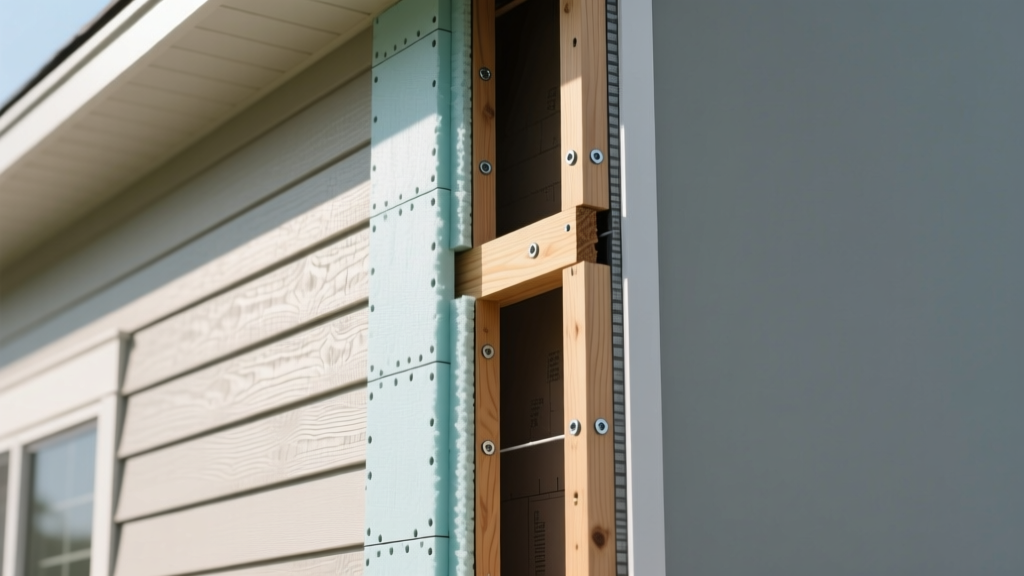
Do not compare siding materials based solely on their intrinsic R-value. Standard cladding materials (wood, fiber cement, metal) possess negligible thermal resistance. The critical metric for 2026 construction is the Effective Assembly R-Value, which measures how the siding material interacts with continuous exterior insulation (ci) to break thermal bridges across the framing. The lowest lifetime cost is achieved by pairing low-intrinsic-R cladding with high-performance rigid foam sheathing, rather than relying on the cladding itself for insulation.
2026 Siding Material Cost & R-Value Matrix
The following matrix breaks down the current installed siding material cost alongside thermal performance metrics. Costs reflect national averages for Q1 2026, including standard labor, housewrap, and basic fasteners, but exclude specialized continuous insulation (ci) upgrades unless noted.
| Cladding Type | Installed Cost (per sq ft) | Intrinsic R-Value | Effective R-Value (with 1" Polyiso CI) | Thermal Bridging Mitigation |
|---|---|---|---|---|
| Standard Vinyl | $4.50 - $6.50 | 0.61 | R-6.5 to R-7.5 | Poor (Requires separate ci layer) |
| Insulated Vinyl (EPS Backed) | $6.50 - $9.50 | 2.0 - 5.3 | R-8.0 to R-11.0 | Good (Contour foam fills stud bays) |
| Fiber Cement (Lap) | $8.00 - $12.00 | 0.15 | R-6.0 to R-7.0 | Excellent (Mandates ci sheathing) |
| Engineered Wood | $7.00 - $10.50 | 0.81 | R-7.0 to R-8.0 | Moderate |
| Metal (Standing Seam/Corrugated) | $11.00 - $16.00 | 0.00 | R-5.5 to R-6.5 | High Risk (Metal conducts heat rapidly) |
Deep Dive: How Insulated Cladding Lowers Lifecycle Costs
Insulated Vinyl Siding: The Integrated Approach
Insulated vinyl siding features a permanently attached expanded polystyrene (EPS) foam backing that contours to the wall sheathing. Leading 2026 product lines, such as Alside Prodigy and Variform by Ply Gem, offer integrated R-values ranging from R-2.0 to R-5.3. While the upfront siding material cost is 30% to 40% higher than traditional hollow-back vinyl, the financial justification lies in labor consolidation and structural rigidity.
Because the EPS backing is pre-applied at the factory, installers do not need to separately measure, cut, and fasten rigid foam boards to the exterior sheathing. This reduces exterior insulation labor costs by approximately 15 to 22 hours on a standard 2,500-square-foot home envelope. Furthermore, the contoured foam backing provides continuous lateral support to the vinyl panels, drastically reducing wind-load deflection and impact cracking, which lowers long-term maintenance and replacement expenditures.
Fiber Cement with Continuous Rigid Insulation
Fiber cement, dominated by brands like James Hardie (Artisan and Prime collections) and Allura, possesses virtually zero intrinsic thermal resistance (R-0.15). However, its heavy, rigid nature makes it the ideal aesthetic cap for high-performance continuous insulation (ci) assemblies. When evaluating the siding material cost for fiber cement, builders must pair it with structural insulated sheathing, such as Huber Zip-R or Owens Corning FOAMULAR ci.
By applying a 1-inch to 2-inch layer of polyisocyanurate or extruded polystyrene (XPS) directly over the wall studs before installing the fiber cement, the assembly achieves an effective R-value of R-11 to R-15 on the exterior alone. This pushes the dew point safely outward, preventing interstitial condensation within the stud cavity—a critical failure mode in mixed-humid climates (IECC Zones 3 and 4) that can lead to catastrophic mold remediation costs exceeding $20,000.
The Thermal Bridging Factor: Where Budget Siding Fails
The most pervasive error in residential envelope design is ignoring thermal bridging. In a standard 2x6 wood-framed wall, the wooden studs, plates, and headers account for approximately 25% of the wall area. Wood has an R-value of roughly 1.25 per inch, meaning a 2x6 stud provides only R-6.88 of resistance, compared to the R-19 to R-21 provided by the cavity insulation.
'When you install standard lap siding directly over studs and housewrap, heat flows through the highly conductive wooden framing 3 to 4 times faster than it does through the insulated cavities. This thermal short-circuit effectively downgrades your entire wall assembly's R-value by up to 20%, rendering a portion of your cavity insulation investment useless.'
— Adapted from Building Science Corporation guidelines on thermal bridging (BSC Digest 112)
To neutralize this, the PNNL Building America Solution Center mandates continuous exterior insulation in modern energy codes. When calculating your siding material cost, you must factor in the price of a minimum 1/2-inch to 1-inch exterior rigid foam layer to break these thermal bridges, regardless of whether you choose wood, metal, or fiber cement cladding.
Regional Decision Framework: Matching Cladding to Climate Zones
The energy ROI of your chosen siding material is heavily dictated by your local IECC climate zone. A high upfront investment in insulated cladding yields vastly different payback periods in Minnesota versus Florida.
- Zones 1-3 (Hot-Humid / Hot-Dry - e.g., Miami, Phoenix): The primary energy load is cooling. Solar reflectance (albedo) is more critical than high R-value. Choose light-colored standard vinyl or fiber cement. The lower siding material cost allows budget reallocation toward high-performance low-E windows and radiant barrier roof sheathing, which yield a faster cooling ROI.
- Zones 4-5 (Mixed-Humid / Cold - e.g., Atlanta, Chicago): These zones experience severe seasonal temperature swings and high moisture loads. Invest in fiber cement or engineered wood over a 1-inch polyiso ci layer. The exterior insulation keeps the sheathing warm in winter, preventing condensation, while the dense cladding resists wind-driven rain.
- Zones 6-8 (Very Cold / Subarctic - e.g., Minneapolis, Anchorage): Heating dominates the energy profile. Maximize exterior R-value. Insulated vinyl siding (R-5.3) combined with 2 inches of exterior XPS sheathing is highly recommended. The higher siding material cost is rapidly offset by the drastic reduction in natural gas or heating oil consumption during 7-month winters.
Calculating Your Specific Payback Period
To determine if a premium, energy-efficient siding material cost is justified for your specific project, use the following HVAC downsizing calculation. According to the Vinyl Siding Institute, upgrading from a standard wall assembly to one featuring insulated siding and continuous sheathing can reduce peak heating and cooling loads by 8% to 12%.
- Calculate Baseline HVAC Cost: A standard 2,500 sq ft home in Zone 5 requires a 4-ton HVAC system (approx. $8,500 installed).
- Apply Load Reduction: A 10% load reduction allows you to downsize to a 3.5-ton system (approx. $7,200 installed).
- Identify Capital Savings: You save $1,300 immediately on HVAC equipment.
- Factor in Monthly Utility Savings: A tighter, thermally broken envelope saves an average of $45 to $65 per month on utility bills in extreme climates ($540 to $780 annually).
- Determine Payback: If the premium siding material cost (e.g., insulated vinyl vs. standard vinyl) adds $4,500 to the project, subtract the $1,300 HVAC savings. The net premium is $3,200. Divided by $660 in annual energy savings, the payback period is just 4.8 years—well within the 50-year lifespan of the cladding.
Ultimately, treating the exterior envelope as an interconnected thermal system, rather than a mere cosmetic finish, transforms the siding material cost from a sunk expense into a high-yield, long-term energy asset.
Written by
David NakamuraDavid Nakamura is a licensed architect (AIA) and construction technology writer focused on sustainable building methods, mass timber engineering, and high-performance building envelopes. He holds a Master of Architecture from the University of Washington and is a certified Passive House Consultant (CPHC). David spent eight years at the Seattle firm Mithun, where he led the design of three LEED Platinum projects, before founding his own practice specializing in net-zero residential design. He serves on the editorial advisory board of GreenBuilder Magazine and has authored peer-reviewed papers on cross-laminated timber (CLT) connections for the Journal of Structural Engineering. In his spare time, David teaches woodworking at Pratt Fine Arts Center and kayaks the Puget Sound.
More from David Nakamura
View all
Construction Cost
Labor Cost to Build a Deck Per Sq Ft: 2026 Installation Guide
Discover the exact labor cost to build a deck per sq ft in 2026. This installation guide breaks down contractor rates, complexity factors, and hidden fees.
Aug 4, 2026

Construction Cost
How Much Does It Cost to Build a 3 Bedroom House? Financing Guide
Learn exactly how much it costs to build a 3 bedroom house and explore 2026 financing options, construction loan types, and budget frameworks for your build.
Aug 4, 2026

Construction Cost
Cost to Build a Tennis Court: 2026 Guide
How much does it cost to build a tennis court in 2026? Breakdowns for asphalt, concrete, and synthetic surfaces plus fencing and lighting.
Jul 30, 2026