Metal Siding Material Showdown: Steel vs Aluminum vs Zinc
Compare steel, aluminum, and zinc metal siding material options. Analyze 2026 costs, gauge specs, PVDF coatings, and failure modes for your build.

The Core Contenders: Steel, Aluminum, and Zinc
Selecting the correct metal siding material requires moving beyond basic aesthetics to evaluate substrate metallurgy, protective coatings, and thermal movement characteristics. The three dominant architectural metals—steel, aluminum, and zinc—each possess distinct mechanical properties that dictate their performance, longevity, and installed cost. In 2026, supply chain stabilization has normalized pricing, but the technical nuances between these materials remain the primary driver of long-term building envelope performance.
| Metal Type | Standard Architectural Thickness | Primary Protective Mechanism | 2026 Installed Cost (per sq. ft.) | Expected Lifespan |
|---|---|---|---|---|
| Steel (Galvalume) | 24-gauge (0.0239") | AZ55 Zinc-Aluminum coating + PVDF paint | $9.00 - $14.00 | 40 - 60 years |
| Aluminum | 0.032" to 0.040" (H32 temper) | Natural aluminum oxide layer + PVDF paint | $11.00 - $16.00 | 50+ years |
| Zinc (Titanium-Zinc) | 0.8mm (0.031") | Self-healing zinc carbonate patina | $28.00 - $45.00 | 80 - 100+ years |
Steel Siding: The Structural Workhorse
Steel remains the most widely specified metal siding material for both agricultural and modern residential applications due to its high tensile strength and cost-efficiency. However, raw steel will oxidize rapidly; its viability relies entirely on its metallic coating and paint system.
Substrate and Coatings: AZ55 vs. AZ50
For exterior cladding, specify Galvalume (an alloy of 55% aluminum, 43.4% zinc, and 1.6% silicon) rather than standard galvanized steel. The industry standard for premium siding is AZ55, which denotes 0.55 ounces of coating per square foot. AZ55 provides superior cut-edge protection and heat reflectivity compared to the cheaper AZ50 often found in big-box retail panels.
Paint Systems: SMP vs. PVDF
The painted finish dictates the siding's color retention. Silicone Modified Polyester (SMP) is economical but prone to chalking and UV degradation within 10 to 15 years. For architectural applications, mandate a PVDF (Polyvinylidene Fluoride) resin system, commonly known by the brand name Kynar 500. PVDF coatings maintain colorfastness and chalk resistance for decades, even in high-UV environments. According to the U.S. Department of Energy, specifying cool-colored PVDF coatings on metal cladding can also significantly reduce cooling loads by reflecting near-infrared solar radiation.
Aluminum Siding: The Coastal and Corrosion Specialist
Aluminum is roughly one-third the weight of steel and possesses a unique metallurgical advantage: it does not rust. When exposed to oxygen, aluminum forms a microscopic, hard layer of aluminum oxide that halts further corrosion. This makes it the undisputed champion for coastal builds, marine environments, and areas with heavy industrial salt spray.
Thickness and Temper Specifications
Unlike steel, which is measured in gauges, architectural aluminum siding is measured in decimal inches. Standard residential thickness is 0.032 inches, while heavy-duty commercial or high-wind applications require 0.040 inches. Equally important is the temper. Specify H32 temper (strain-hardened and stabilized) rather than H14; H32 provides the necessary yield strength to resist denting from minor impacts while maintaining formability for the roll-forming process.
The Denting Vulnerability
Aluminum's primary weakness is its lower yield strength compared to steel. Hail exceeding 1.5 inches in diameter or impacts from heavy landscaping equipment will permanently dent 0.032" aluminum panels. To mitigate this in hail-prone regions, specify heavier 0.040" stock with a stucco-embossed texture, which visually masks minor surface deformations far better than smooth finishes.
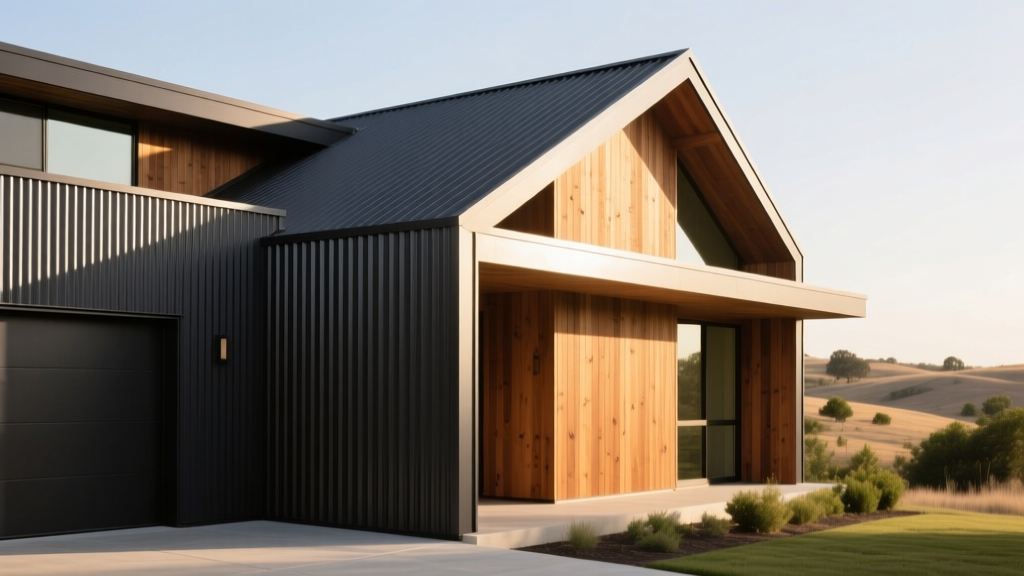
Zinc Siding: The Architectural Premium
Zinc (specifically titanium-zinc alloys, such as those produced by VMZINC or RHEINZINK) occupies the ultra-premium tier of metal cladding. It is an architectural choice driven by its organic, living finish and century-long lifecycle.
The Self-Healing Patina
Uncoated zinc reacts with atmospheric moisture and carbon dioxide to form a dense zinc carbonate patina. This patina is not merely cosmetic; it is self-healing. If the surface is lightly scratched, the patina will naturally reform over the exposed metal, effectively erasing the blemish over time. This eliminates the need for field-applied touch-up paint, which is a chronic issue with scratched steel or aluminum.
Runoff and Detailing Constraints
Zinc runoff is slightly acidic and can cause severe staining on porous materials like unsealed concrete, limestone, and light-colored masonry. When detailing zinc siding, it is critical to integrate concealed gutters, drip edges, and proper slope planning to direct runoff away from vulnerable adjacent materials. Furthermore, zinc requires specialized detailing for thermal movement; it expands and contracts less than aluminum but still requires slotted clip holes to prevent stress buckling.
Hidden Installation Costs and Failure Modes
The material cost is only one variable in the metal siding equation. Improper installation is the leading cause of premature cladding failure, regardless of the metal chosen. The Metal Construction Association (MCA) publishes extensive guidelines on avoiding these common pitfalls.
Mitigating "Oil Canning"
Oil canning refers to the visible waviness or stress ripples that appear in the flat pan areas of metal panels. It is an inherent characteristic of thin-sheet metal caused by thermal expansion, coil memory, and improper fastening. To minimize oil canning:
- Use Striations: Specify panels with flat-rolled beads, striations, or stiffening ribs in the pan area to break up flat visual planes.
- Low-Gloss Finishes: High-gloss PVDF paints reflect light uniformly, highlighting every ripple. Specify a matte or low-gloss finish (under 20 gloss units) to diffuse light and hide imperfections.
- Proper Clip Engagement: Installers must never over-drive concealed clips or force panels into place. Fasteners in slotted holes must be centered to allow lateral thermal movement.
Galvanic Corrosion (Dissimilar Metals)
When two dissimilar metals come into contact in the presence of an electrolyte (rainwater, condensation), the less noble metal will corrode rapidly.
Rule of Thumb: Never allow copper flashings, untreated steel fasteners, or lead to directly touch aluminum or zinc siding. Always use compatible fasteners (e.g., stainless steel or hot-dipped galvanized for steel panels; aluminum or stainless for aluminum panels) and separate dissimilar metals using EPDM tape, butyl separators, or nylon washers.
Decision Framework: Selecting Your Metal Siding Material
Use this practical decision matrix to align your project parameters with the correct metal siding material.
Choose Steel (Galvalume AZ55) If:
- Your budget is constrained to the $9–$14/sq. ft. installed range.
- You require high impact resistance (hail, agricultural equipment, heavy foot traffic).
- The design utilizes exposed-fastener corrugated profiles for an industrial or modern-agrarian aesthetic.
Choose Aluminum (0.040" H32) If:
- The build is located within 1,500 feet of a saltwater coastline or in a heavy industrial zone.
- Weight restrictions on the structural framing mandate a lightweight cladding solution.
- You are retrofitting over existing masonry where heavy steel loads would require supplemental structural ties.
Choose Zinc (0.8mm Titanium-Zinc) If:
- The project is a legacy architectural build with a 100-year design intent and a premium budget ($30+/sq. ft.).
- You desire a natural, unpainted, evolving facade that integrates with organic surroundings.
- Maintenance access to the facade will be difficult or impossible post-construction, necessitating a self-healing, zero-paint material.
Written by
Elena RodriguezElena Rodriguez is a civil engineer and technical writer specializing in concrete technology, masonry systems, and ASTM/ACI compliance. She earned her B.S. in Civil Engineering from Texas A&M University and spent a decade at a materials testing laboratory, performing over 2,000 concrete compressive strength tests and masonry prism evaluations. Elena is an ACI-certified Field Testing Technician (Grade I) and a member of ASTM Committee C12 on Natural Building Stone. She currently consults on forensic engineering cases involving concrete failures and moisture intrusion. Based in San Antonio, TX, Elena is a proud member of the Society of Women Engineers (SWE) and coaches her daughter's FIRST Robotics team.
More from Elena Rodriguez
View all
Walls & Panels
Cost Analysis: Light Gauge Steel Framing Advantages and Disadvantages
Evaluate light gauge steel framing advantages and disadvantages through a strict cost analysis lens, comparing material, labor, and lifecycle expenses.
Aug 4, 2026

Walls & Panels
Gypsum Board Types: Exact Specifications, Thickness & Dimensions
Compare standard, Type X, and moisture-resistant gypsum board types. Get exact specifications, thicknesses, dimensions, and ASTM standards for your project.
Aug 4, 2026

Fire Resistance
Best Fire-Resistant Outdoor Decking Materials: 2026 Buyer Guide
Discover the best fire-resistant outdoor decking materials for 2026. Compare Class A PVC, aluminum, and hardwood options for WUI compliance and safety.
Aug 4, 2026