Georgia Pacific Gypsum Board vs USG & National Gypsum Compared
Compare Georgia Pacific gypsum board against USG and National Gypsum. Analyze DensArmor, ToughRock, pricing, and fiberglass mat performance.

The Core Contenders in Commercial and Residential Drywall
Specifying the correct gypsum panel requires navigating a matrix of fire ratings, moisture exposure limits, and structural weights. While USG (Sheetrock) and National Gypsum (Gold Bond) dominate the traditional paper-faced market, Georgia Pacific (GP) gypsum board has carved out a distinct sector of dominance through its proprietary fiberglass-mat technology and specialized fire-rated cores. For architects, general contractors, and procurement managers, choosing between GP, USG, and CertainTeed is rarely about finding a "better" brand overall; it is about matching specific chemical and physical properties to the environmental realities of the job site.
This analysis breaks down the technical specifications, installation edge cases, and 2026 material costs of GP’s primary product lines against their direct market alternatives, providing a definitive framework for material selection.
Head-to-Head Specification and Pricing Matrix
The following matrix compares GP’s flagship panels against their direct competitors across three critical performance categories. Pricing reflects Q1 2026 wholesale commercial averages per square foot (material only, excluding freight surcharges).
| Performance Category | Georgia-Pacific Option | Primary Alternative | Core Technical Difference | Avg. Cost / Sq. Ft. |
|---|---|---|---|---|
| Standard / Fire-Rated | ToughRock Fireguard 45 | USG Sheetrock Firecode C | GP achieves 45-min rating at 1/2" thickness; USG requires 5/8" Type X. | GP: $0.58 | USG: $0.52 |
| Interior Mold/Moisture | DensArmor Plus High-Performance | USG Mold Tough / National Gypsum XP | GP uses inorganic fiberglass mat (ASTM C1658); competitors use treated paper. | GP: $0.82 | USG: $0.65 |
| Exterior Sheathing / Shaftliner | DensGlass Shaftliner | CertainTeed GlasRoc / USG Securock | GP offers 12-month weather exposure warranty; competitors typically cap at 6 months. | GP: $1.15 | CT: $1.08 |
| Lightweight Standard | ToughRock Ultralight | USG Sheetrock UltraLight Panels | USG maintains a 25% weight advantage and superior score-snap dust profile. | GP: $0.41 | USG: $0.44 |
Product Line Breakdown: Where GP Wins and Loses
1. Fire-Rated Assemblies: The Thickness vs. Weight Trade-off
In multi-family and commercial corridor construction, achieving a 1-hour or 45-minute fire rating traditionally mandated heavy 5/8-inch Type X panels. GP disrupted this with ToughRock Fireguard 45. By altering the core formulation with specialized vermiculite and glass fiber reinforcements, GP engineered a 1/2-inch panel that meets ASTM E119 standards for 45-minute assemblies.
The Advantage: A standard 4x12 sheet of 5/8-inch Type X weighs roughly 90 lbs. GP’s 1/2-inch Fireguard 45 weighs approximately 65 lbs. Over a 50,000 sq. ft. corridor project, this reduces total material hoisted by drywall crews by nearly 14 tons, significantly lowering fatigue-related fastener errors and worker compensation risks.
The Alternative: USG’s Sheetrock Firecode C remains the benchmark for 1-hour and 2-hour rated assemblies where 5/8-inch thickness is structurally required for sound attenuation (STC ratings) alongside fire resistance. If acoustic isolation is a secondary requirement, USG’s heavier, thicker panels are the superior choice.
2. The Fiberglass Mat Revolution: DensArmor vs. Treated Paper
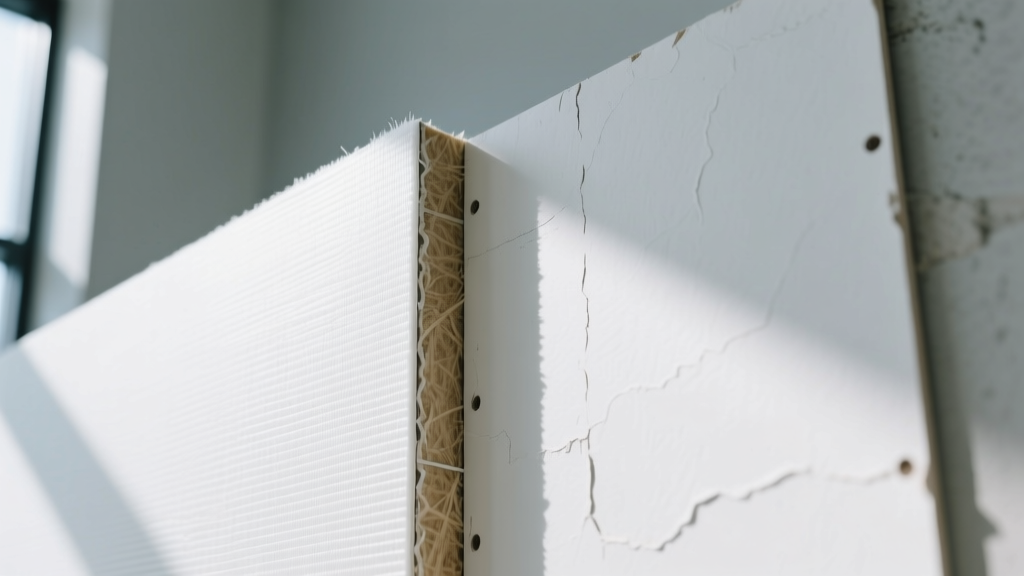
The most significant differentiator in the GP lineup is the DensArmor Plus series. While USG Mold Tough and National Gypsum XP rely on chemically treated paper facers to inhibit mold growth, GP utilizes an inorganic fiberglass mat embedded into a moisture-resistant silicone-treated core.
According to testing standards outlined by the Gypsum Association, fiberglass mat panels conforming to ASTM C1658 are mandatory for high-humidity environments like commercial kitchens, indoor pool enclosures, and unconditioned construction phases where the building envelope is not yet sealed.
3. Exterior Sheathing and Shaftliners
For exterior substrates behind rain screens and elevator shaftliners, GP’s DensGlass is the industry default. Its primary advantage over USG Securock and CertainTeed GlasRoc is its documented weather exposure limit. DensGlass can withstand direct UV and precipitation exposure for up to 12 months during construction delays without degrading the mat integrity or core cohesion. Competing products generally require weather-barrier installation within 60 to 180 days to maintain their manufacturer warranties.
Installation Realities and Job-Site Edge Cases
Specifying GP’s fiberglass mat products requires adjusting installation protocols. Contractors accustomed to USG’s paper-faced Sheetrock often encounter friction when transitioning to DensArmor or DensGlass.
- Cutting and Snapping: Paper-faced drywall requires a single score on the face, a snap, and a cut on the back paper. Fiberglass mat panels require scoring both the front and back mats to achieve a clean break. Failure to score the back mat results in jagged, frayed edges that require heavy sanding and create excessive airborne glass particulates.
- Fastener Pull-Through: The silicone-treated core of DensArmor is slightly more brittle at the edges than standard USG cores. Fasteners placed within 3/8" of the panel edge on GP mat boards have a 15% higher rate of "blow-out" or pull-through. Crews must strictly adhere to a 1/2" edge margin.
- Finishing Compound Adhesion: Fiberglass mats are highly porous. When applying Level 4 or Level 5 finishes, the first coat of joint compound must be applied with higher moisture content, or the mat will flash-set the compound, leading to micro-cracking along the seams. GP recommends using setting-type compounds (e.g., Durabond) for the taping coat rather than standard all-purpose pre-mix.
Cost Analysis and Supply Chain Realities
When evaluating material budgets, procurement teams must look beyond the per-sheet invoice price. While GP’s DensArmor Plus commands a 25% to 30% premium over USG’s paper-faced Mold Tough (averaging $0.82/sq. ft. vs $0.65/sq. ft. in 2026), the total installed cost often evens out in commercial sectors.
Because DensArmor can be installed before the building’s HVAC is operational and before the building is fully weather-tight, general contractors can overlap the drywall schedule with exterior cladding and roofing trades. With treated paper boards, contractors must wait for the building to be "dried in" and climate-controlled to prevent core saturation and paper delamination. The schedule acceleration provided by GP’s weather-resilient boards frequently offsets the initial material premium on projects exceeding 20,000 square feet.
Decision Framework: When to Specify GP Over Alternatives
Use the following logic tree to finalize your gypsum board specifications for upcoming bids:
Specification Decision Matrix
Choose Georgia-Pacific (ToughRock Fireguard) IF:
You are framing multi-family corridors or stairwells where a 45-minute fire rating is required, but reducing dead-load weight and hoisting fatigue is a primary safety and scheduling concern.
Choose Georgia-Pacific (DensArmor Plus) IF:
The project is a healthcare facility, indoor aquatic center, or a fast-track commercial build where drywall installation must precede the completion of the exterior weather barrier and HVAC commissioning.
Choose USG (Sheetrock UltraLight / Mold Tough) IF:
You are executing a residential or light-commercial interior fit-out in a fully dried-in, climate-controlled environment where minimizing material cost, reducing cutting dust, and maximizing score-and-snap speed are the highest priorities.
Choose National Gypsum (Gold Bond XP / Hi-Abuse) IF:
The project requires extreme impact resistance (e.g., school hallways, hospital gurney corridors) where National’s specialized dense-core Hi-Abuse panels outperform standard GP and USG offerings in point-load impact testing.
Final Procurement Guidance
Georgia Pacific gypsum board is not a blanket replacement for traditional drywall; it is a specialized toolkit designed to solve specific liability and scheduling problems. By leveraging GP’s fiberglass mat technology for high-moisture and exterior applications, and utilizing their Fireguard line for weight-sensitive fire assemblies, project managers can mitigate mold-related litigation risks and accelerate critical path schedules. Always verify current ASTM testing standards and local building codes regarding exposure limits and fire assembly UL designs before finalizing your submittal packages.
Written by
Elena RodriguezElena Rodriguez is a civil engineer and technical writer specializing in concrete technology, masonry systems, and ASTM/ACI compliance. She earned her B.S. in Civil Engineering from Texas A&M University and spent a decade at a materials testing laboratory, performing over 2,000 concrete compressive strength tests and masonry prism evaluations. Elena is an ACI-certified Field Testing Technician (Grade I) and a member of ASTM Committee C12 on Natural Building Stone. She currently consults on forensic engineering cases involving concrete failures and moisture intrusion. Based in San Antonio, TX, Elena is a proud member of the Society of Women Engineers (SWE) and coaches her daughter's FIRST Robotics team.
More from Elena Rodriguez
View all
Walls & Panels
Cost Analysis: Light Gauge Steel Framing Advantages and Disadvantages
Evaluate light gauge steel framing advantages and disadvantages through a strict cost analysis lens, comparing material, labor, and lifecycle expenses.
Aug 4, 2026

Walls & Panels
Gypsum Board Types: Exact Specifications, Thickness & Dimensions
Compare standard, Type X, and moisture-resistant gypsum board types. Get exact specifications, thicknesses, dimensions, and ASTM standards for your project.
Aug 4, 2026

Fire Resistance
Best Fire-Resistant Outdoor Decking Materials: 2026 Buyer Guide
Discover the best fire-resistant outdoor decking materials for 2026. Compare Class A PVC, aluminum, and hardwood options for WUI compliance and safety.
Aug 4, 2026