CertainTeed Gypsum Board Impact and Moisture Resistant Selection Guide
Compare CertainTeed gypsum board impact and moisture resistant options. Learn product specs, costs, and installation methods for high-traffic wet areas.

The Specification Challenge: Combining Impact and Moisture Resistance
Specifying drywall for environments that demand both high impact resistance and strict moisture control requires navigating a complex product matrix. Corridors in hospitals, school locker rooms, commercial kitchens, and high-end residential wet areas subject wall assemblies to simultaneous threats: physical abuse from carts, equipment, and foot traffic, alongside high ambient humidity or direct water exposure.
When evaluating CertainTeed gypsum board impact and moisture resistant options, the primary misconception among general contractors is assuming a single paper-faced product can achieve top-tier ratings in both categories. In reality, paper-faced moisture-resistant boards (like standard green or purple board) offer minimal structural reinforcement against hard-body impacts. Conversely, standard abuse-resistant boards lack the chemical and physical treatments required to prevent mold proliferation in wet environments. To solve this, specifiers must turn to specialized fiberglass-mat panels or engineered multi-layer assemblies.
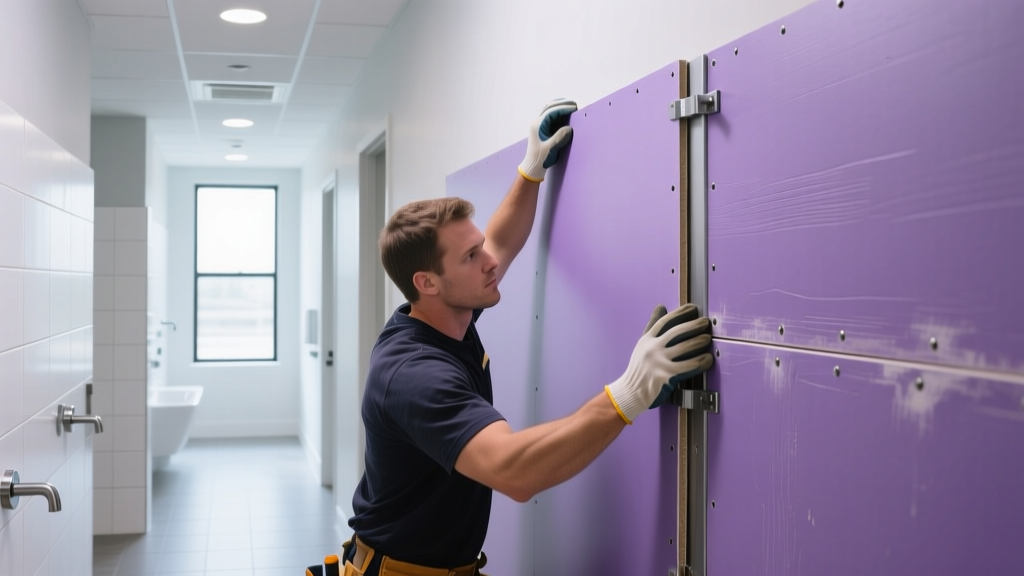
Decoding the CertainTeed Product Matrix
CertainTeed segments its high-performance gypsum panels into distinct categories. Understanding the core composition and facing material of each is critical for passing both ASTM C1629 (Abuse Resistance) and ASTM C1396 (Moisture Resistance) standards.
| Product Line | Facing Material | Core Type | Moisture/Mold Rating | Impact Rating (ASTM C1629) | Est. Cost (5/8" 4x8) |
|---|---|---|---|---|---|
| M2Tech Moisture & Mold | Treated Paper | Moisture-Resistant Gypsum | ASTM D3273 (Score 10) | Level 1 (Low) | $21.00 - $24.00 |
| DensArmor Plus | Fiberglass Mat | Moisture-Resistant Gypsum | ASTM D3273 (Score 10) | Level 2-3 (Moderate/High) | $29.00 - $34.00 |
| ToughRock Abuse Resistant | Heavy-Duty Paper/Mat | Dense Reinforced Core | Standard (Not MR Rated) | Level 3-4 (High/Severe) | $38.00 - $45.00 |
| DensGlass Sheathing | Fiberglass Mat | Moisture-Resistant Gypsum | Superior (Exterior Rated) | Level 3 (High) | $32.00 - $38.00 |
The Fiberglass-Mat Advantage: DensArmor Plus
For interior applications requiring a hybrid of moisture and impact resistance, DensArmor Plus is the premier selection. By replacing the traditional paper facing with an inorganic fiberglass mat, the panel eliminates the primary food source for mold. Furthermore, the fiberglass mat provides superior tensile strength compared to paper, distributing point-load impacts across a wider surface area. While it may not achieve the extreme Level 4 hard-body impact rating of dedicated abuse-resistant boards, it comfortably handles Level 2 and Level 3 impacts (such as stretcher bumps in hospital corridors or luggage strikes in hotel bathrooms) while maintaining a perfect 10/10 score on the ASTM D3273 mold resistance test.
The Dedicated Impact Option: ToughRock Abuse Resistant
If the project demands Level 4 impact resistance (e.g., a correctional facility wet area or a high-traffic commercial loading dock), ToughRock Abuse Resistant is required. However, because standard abuse-resistant boards are not inherently moisture-resistant, specifiers must pair this product with a secondary moisture barrier or utilize it in a double-layer assembly behind a tile backer board in wet zones.
Decision Framework: Selecting the Right Panel
Use the following framework to determine the optimal CertainTeed panel based on the specific environmental stressors of your project.
Scenario A: High Moisture, Moderate Impact (Hotel Bathrooms, School Restrooms)
Recommendation: 5/8" DensArmor Plus. The fiberglass mat prevents mold growth behind vinyl wallcoverings or tile, and the reinforced core withstands daily maintenance cart traffic and door swings.
Scenario B: High Moisture, Extreme Impact (Hospital Corridors, Locker Rooms)
Recommendation: Double-layer assembly. Use a base layer of 5/8" M2Tech for baseline moisture resistance, topped with a face layer of 5/8" ToughRock Abuse Resistant. Alternatively, specify specialized fiberglass-mat abuse-resistant panels if available through commercial distribution channels.
Scenario C: Standard Residential Wet Areas (Master Showers, Laundry Rooms)
Recommendation: 5/8" M2Tech Moisture & Mold Resistant. Impact loads in residential settings rarely exceed Level 1. The treated paper facing and moisture-resistant core provide adequate protection behind ceramic tile and waterproofing membranes at a lower cost point.
Understanding ASTM C1629 Impact Testing
To accurately specify CertainTeed gypsum board impact and moisture resistant products, you must understand how the ASTM C1629 standard categorizes abuse resistance. The standard divides testing into two distinct methodologies:
- Soft-Body Impact: Simulates a person falling against a wall or a heavy canvas bag striking the surface. Tests measure surface indentation and core damage. Most moisture-resistant boards pass Level 1 and 2 soft-body tests.
- Hard-Body Impact: Simulates a stretcher, steel cart, or equipment striking the wall with a concentrated point load. Tests measure penetration and structural failure. Only specialized dense-core or multi-layer assemblies pass Level 3 and 4 hard-body tests.
Expert Insight: Never specify a standard paper-faced MR board for a hospital corridor based solely on its moisture rating. The hard-body impact from a gurney wheel will easily penetrate the 5/8" core, compromising the assembly's fire and moisture barriers.
Installation Nuances for High-Stress Wet Areas
Selecting the correct panel is only half the battle. The Gypsum Association's GA-216 application guidelines dictate strict fastening and finishing protocols for high-performance assemblies. Failure to follow these will void the impact and moisture warranties.
Framing and Fastener Protocols
Impact-resistant drywall relies heavily on the rigidity of the underlying framing. For commercial applications utilizing DensArmor Plus or ToughRock Abuse Resistant:
- Stud Gauge: Minimum 20-gauge (0.033" design thickness) steel studs. 25-gauge studs flex too much under impact, transferring the kinetic energy directly to the gypsum core and causing fastener pops or core crushing.
- Spacing: Maximum 16 inches on center (o.c.) for walls. While 24" o.c. is code-compliant for standard drywall, impact-rated assemblies require 16" o.c. to minimize deflection.
- Fastener Schedule: Use 1-5/8" Type S fine-thread drywall screws. Space screws a maximum of 8 inches o.c. along the edges and 12 inches o.c. in the field. For Level 3 and 4 abuse-resistant boards, edge spacing must be reduced to 6 inches o.c.
Joint Treatment for Impact Zones
The weakest point in any impact-resistant wall is the tapered joint. Standard all-purpose joint compound lacks the compressive strength to survive hard-body strikes.
- Tape: Use fiberglass mesh tape or heavy-duty paper tape embedded in setting-type compound.
- First and Second Coats: Apply a high-strength setting-type compound (e.g., ProForm Easy Sand 45 or 90). These chemical-set compounds cure to a rock-hard density that resists indentation.
- Finish Coat: Apply a lightweight all-purpose compound only for the final skim coat to ensure a smooth Level 4 or Level 5 finish.
Cost Analysis and Project ROI
While upgrading from standard CertainTeed M2Tech to DensArmor Plus or a double-layer abuse-resistant assembly increases upfront material costs by 35% to 80%, the return on investment in commercial environments is substantial. Facility maintenance records consistently show that drywall repair in high-traffic wet areas accounts for up to 22% of annual interior maintenance budgets. By specifying the correct impact and moisture resistant hybrid panel, facility managers typically recoup the initial material premium within 36 months through eliminated patching, repainting, and mold remediation costs.
For precise commercial pricing and local availability, always consult the official CertainTeed drywall catalog or your regional commercial building materials distributor, as bulk pallet pricing and regional freight surcharges will significantly affect the final per-square-foot cost.
Written by
James ThorntonJames Thornton is a construction industry veteran with 25 years of hands-on experience in wood framing, lumber grading, and residential building codes. He started as a framing carpenter in rural Oregon, earned his ICC Residential Building Inspector certification, and eventually became a senior plan reviewer for the City of Portland Bureau of Development Services. James holds a B.S. in Wood Science & Technology from Oregon State University and is a certified lumber grader through the West Coast Lumber Inspection Bureau (WCLIB). He has inspected over 3,000 residential construction sites and authored the city's internal guide on advanced framing techniques (2x6 at 24" O.C.). James lives in Bend, OR, where he builds custom timber-frame cabins and competes in lumberjack sports.
More from James Thornton
View all
Insulation
Best Home Insulation Materials: Complete 2026 Guide
Compare top home insulation materials for 2026. Find R-values, installed costs per square foot, and best uses for fiberglass, spray foam, and mineral wool.
Aug 4, 2026

Sustainable Building
Certify Your Green Building Material for LEED and WELL
Step-by-step guide to certifying a green building material for LEED v5 and WELL v2. Master EPDs, HPDs, and VOC limits for 2026 project specifications.
Aug 4, 2026

Stone & Masonry
Veneer Stacked Stone Panels: Interior Design & Style Showcase
Discover how veneer stacked stone panels transform interiors. Explore modern design profiles, material pairings, and technical installation specs.
Aug 4, 2026