2026 Drywall Gypsum Board Product Guide: Types & Specs
Compare drywall gypsum board types, including standard, Type X fire-rated, and moisture-resistant options, with 2026 pricing and ASTM specs.

The Anatomy and Manufacturing of Modern Drywall Gypsum Board
At its core, drywall gypsum board is an engineered panel consisting of a noncombustible calcium sulfate dihydrate core encased in durable facers. While historically manufactured using mined natural gypsum, over 85% of the North American market now utilizes synthetic flue-gas desulfurization (FGD) gypsum—a byproduct of coal-fired power plant emissions scrubbing. According to the Gypsum Association, this shift has not only diverted millions of tons of waste from landfills but also yielded a purer, more consistent crystalline structure for modern panels.
The manufacturing process begins with calcination, where raw gypsum is heated to approximately 350°F to drive off 75% of its chemically combined water, creating calcium sulfate hemihydrate (stucco). This stucco is then mixed with water, fiberglass (for fire-rated boards), and proprietary additives before being sandwiched between facers and rehydrated in a continuous kiln. This precise thermal cycling is what gives drywall gypsum board its inherent fire-resistive properties; when exposed to fire, the remaining 20% of water in the core turns to steam, actively cooling the panel and delaying heat transfer.
All structural drywall gypsum board sold in the United States must comply with ASTM C1396 Standard Specification, which dictates minimum values for core hardness, nail pull resistance, flexural strength, and water absorption. Understanding these baseline metrics is critical for selecting the correct panel for specific architectural and environmental demands.
Core Product Categories and Performance Profiles
Standard Regular Board (White Board)
Standard drywall gypsum board is the workhorse of interior construction, typically featuring a gray or white paper facing. For 2026 construction standards, 1/2-inch thickness is the baseline for interior walls framed at 16 inches on-center (OC). However, for ceiling applications, 5/8-inch is strongly recommended to prevent sagging, unless utilizing specialized lightweight formulations like USG Sheetrock UltraLight, which allows 1/2-inch panels to span 24-inch OC ceiling joists without deflection.
Type X and Type C Fire-Rated Board
Type X drywall gypsum board is engineered with glass fibers integrated directly into the gypsum core to delay structural collapse during a fire. The standard 5/8-inch Type X panel provides a 1-hour fire-resistance rating when installed on wood framing. Type C panels feature a denser core with a higher concentration of glass fibers and specialized additives, allowing them to achieve 2-hour or 3-hour ratings in multi-layer assemblies. These are mandatory for garage-to-living-space separations, elevator shafts, and commercial corridor enclosures.
Moisture and Mold-Resistant Board (Green/Purple Board)
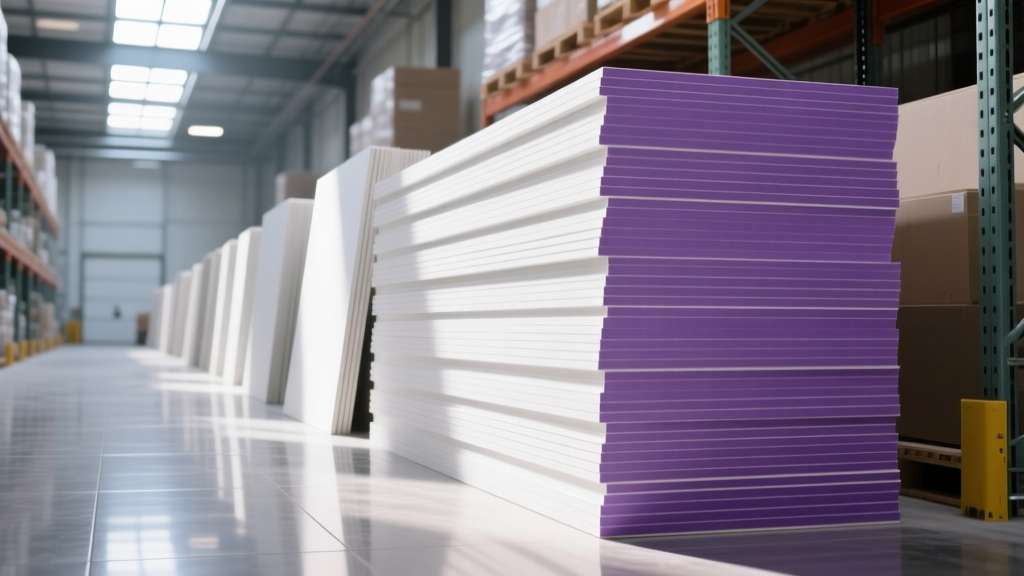
Recognizable by their green or purple paper facers, these panels feature a moisture-resistant core and treated facers that inhibit mold growth (achieving ASTM D3273 test standards). They are required in high-humidity areas like bathrooms and laundry rooms. Critical Edge Case: Moisture-resistant drywall gypsum board is not waterproof. It must never be used as a direct substrate in continuous wet zones, such as shower pans or steam rooms, where cementitious backer boards or foam panels are required.
2026 Pricing Matrix: Material and Installed Costs
| Board Category | Standard Thickness | Material Cost (per Sq Ft) | Installed Cost (per Sq Ft) | Primary Application |
|---|---|---|---|---|
| Standard Regular | 1/2 inch | $0.45 - $0.55 | $1.80 - $2.20 | Interior walls, low-humidity zones |
| UltraLight Standard | 1/2 inch | $0.55 - $0.65 | $1.90 - $2.40 | Ceilings (24" OC), high-rise logistics |
| Type X Fire-Rated | 5/8 inch | $0.65 - $0.80 | $2.10 - $2.60 | Garages, fire separations, shafts |
| Moisture-Resistant | 1/2 inch | $0.70 - $0.90 | $2.30 - $2.80 | Bathrooms, kitchens, laundry rooms |
| Glass Mat Exterior | 5/8 inch | $1.20 - $1.50 | $3.50 - $4.20 | Exterior sheathing, tile backers |
Note: Installed costs include hanging, taping, mudding (Level 4 finish), and standard labor rates for 2026. Regional variances in union vs. non-union labor can shift installed costs by up to 30%.
Sustainability, Recycled Content, and LEED Credits
For commercial projects targeting LEED v4.1 certification, drywall gypsum board is a highly advantageous material. Major North American manufacturers utilize cores composed of 90% to 99% recycled content (primarily synthetic FGD gypsum and post-consumer recycled paper facers). When specifying products for green building projects, contractors should request Environmental Product Declarations (EPDs) from manufacturers. These EPDs detail the global warming potential (GWP) and lifecycle impacts of the panels, which are critical for earning Materials and Resources (MR) credits in sustainable construction frameworks.
Specialty Drywall Gypsum Board Options
Glass Mat Gypsum Panels
Replacing paper facers with fiberglass mats creates a panel impervious to moisture and mold. Products like DensGlass or National Gypsum Gold Bond XP are utilized as exterior sheathing behind rainscreen claddings, as well as interior tile backers in commercial wet areas. The glass mat facers possess a high perm rating, allowing the assembly to breathe while preventing bulk water intrusion.
Acoustic and Soundproofing Board
Standard drywall gypsum board has a poor Sound Transmission Class (STC) rating. Acoustic panels, such as QuietRock 510, utilize a viscoelastic polymer core sandwiched between two thin gypsum layers. This constrained-layer damping technology dissipates sound wave energy, allowing a single 1/2-inch panel to achieve an STC rating of 52—equivalent to a wall built with eight layers of standard drywall.
Edge Profiles and Dimensional Tolerances
Drywall gypsum board is manufactured with specific edge profiles designed to hide fasteners and joints. The most common is the Tapered Edge, where the long edges are thinned to accommodate joint compound and tape, creating a seamless monolithic surface. Square edges are typically reserved for repair patches or multi-layer base plies where the joint will be covered by a subsequent face layer.
Dimensional tolerances under ASTM C1396 allow for a variance of +/- 1/8 inch in width and +/- 1/4 inch in length. In high-end custom builds requiring Level 5 finishes, installers must account for these variances by dry-fitting panels and pre-cutting openings for electrical boxes rather than relying on field measurements, which can compound framing inaccuracies.
Decision Framework: Matching Board to Application
- Standard Interior Walls (Wood Framing, 16" OC): Use 1/2-inch Standard Regular Board.
- Ceilings (Wood Joists, 24" OC): Use 1/2-inch UltraLight or 5/8-inch Standard to prevent gravitational sagging.
- Garage-to-House Separation: Use 5/8-inch Type X on the garage side to meet 1-hour fire code requirements.
- Bathroom Walls (Outside Shower Tub): Use 1/2-inch Moisture-Resistant (Green/Purple) board.
- Shower/Tub Surround Substrate: Do NOT use gypsum board. Use cement board or foam tile backer.
- Home Theater / Bedroom Sound Isolation: Use 1/2-inch Acoustic Damped Board or double-layer standard with Green Glue.
The most common failure in drywall gypsum board installation is fastener popping, caused by lumber shrinkage pushing the panel away from the stud. To mitigate this in 2026 framing practices, use 1-1/4 inch coarse-thread drywall screws for 1/2-inch board and 1-5/8 inch screws for 5/8-inch board. Space screws 8 inches OC on ceilings and 12 inches OC on walls. Always drive the screw head just below the paper surface without breaking the paper facing.
Common Installation Failures and Edge Cases
Beyond fastener popping, installers frequently encounter joint ridging and corner cracking. Joint ridging occurs when the gypsum core absorbs ambient humidity during the taping phase, causing the tapered edges to expand. This is prevented by conditioning the building environment to 65°F and maintaining relative humidity below 50% before applying joint compound.
Another critical edge case involves the use of Type X board in curved applications. Standard 5/8-inch Type X is highly rigid and will snap if forced around a radius. For curved walls or archways, builders must utilize 1/4-inch flexible drywall gypsum board, installed in two laminated layers with adhesive, or score-and-water standard 1/2-inch panels to relax the gypsum core before bending.
Written by
David NakamuraDavid Nakamura is a licensed architect (AIA) and construction technology writer focused on sustainable building methods, mass timber engineering, and high-performance building envelopes. He holds a Master of Architecture from the University of Washington and is a certified Passive House Consultant (CPHC). David spent eight years at the Seattle firm Mithun, where he led the design of three LEED Platinum projects, before founding his own practice specializing in net-zero residential design. He serves on the editorial advisory board of GreenBuilder Magazine and has authored peer-reviewed papers on cross-laminated timber (CLT) connections for the Journal of Structural Engineering. In his spare time, David teaches woodworking at Pratt Fine Arts Center and kayaks the Puget Sound.
More from David Nakamura
View all
Construction Cost
Labor Cost to Build a Deck Per Sq Ft: 2026 Installation Guide
Discover the exact labor cost to build a deck per sq ft in 2026. This installation guide breaks down contractor rates, complexity factors, and hidden fees.
Aug 4, 2026

Construction Cost
How Much Does It Cost to Build a 3 Bedroom House? Financing Guide
Learn exactly how much it costs to build a 3 bedroom house and explore 2026 financing options, construction loan types, and budget frameworks for your build.
Aug 4, 2026

Construction Cost
Cost to Build a Tennis Court: 2026 Guide
How much does it cost to build a tennis court in 2026? Breakdowns for asphalt, concrete, and synthetic surfaces plus fencing and lighting.
Jul 30, 2026