Fire-Rated Alternatives to Gypsum Board: A Code Compliance Guide
Explore code-compliant alternatives to gypsum board for fire-rated and moisture-prone assemblies. Compare cement board, glass mat, and MgO options.

Code Triggers: When Standard Type X Gypsum Fails
Standard paper-faced Type X gypsum board (ASTM C1396) is the prescriptive baseline for fire-resistance-rated assemblies in the International Building Code (IBC). Under IBC Chapter 7, a 5/8-inch Type X panel typically provides a 1-hour fire rating when tested to ASTM E119 or UL 263. However, paper-faced gypsum is fundamentally vulnerable to continuous high humidity, direct water exposure, and high-impact physical abuse. When building conditions exceed these limitations, architects and contractors must specify alternatives to gypsum board that maintain strict fire-resistance ratings without degrading in harsh environments.
The transition from standard gypsum to an alternative material is rarely a simple one-to-one swap. Alternative materials possess different thermal conductivities, structural weights, and fastening requirements, all of which directly impact the assembly’s ability to pass both the structural fire test and the temperature transmission limits mandated by IBC Section 713 for shaft walls and fire barriers.
Top Code-Compliant Alternatives to Gypsum Board
Selecting the right material requires matching the environmental threat to the material’s chemical and physical properties while ensuring the assembly holds a valid code evaluation.
1. Fiber-Cement Panels (ASTM C1186 & C1325)
Fiber-cement boards, such as James Hardie HardieBacker 500 or USG Durock Brand Cement Board, are the premier choice for exterior-exposed fire shafts, parapet walls, and high-moisture commercial wet areas. Composed of Portland cement, silica sand, and cellulose fibers, these panels are entirely impervious to water damage and mold.
- Fire Performance: Fiber-cement is non-combustible (ASTM E136). However, because it lacks the calcined gypsum core that releases chemically bound water (calcination) to delay heat transfer, fiber-cement assemblies often require the addition of mineral wool insulation or multiple layers to achieve 1-hour or 2-hour fire ratings.
- Code Approval: Fiber-cement is not prescriptively listed in IBC Table 721.1(2) for fire ratings. Assemblies must be justified using specific UL Fire Resistance Directory designs or an active ICC Evaluation Service (ICC-ES) report.
2. Magnesium Oxide (MgO) Board
MgO boards (e.g., MagPanel, DragonBoard) are manufactured from magnesium oxide cement and reinforced with fiberglass mesh. They offer exceptional fire resistance and are highly resistant to mold and insects, making them popular in humid coastal climates and healthcare facilities.
3. Glass Mat and Fiber-Reinforced Gypsum (FRG)
While technically containing a gypsum core, glass mat panels (ASTM C1177, e.g., USG DensGlass) and fiber-reinforced gypsum (ASTM C1278, e.g., USG Fiberock) are the direct alternatives to paper-faced gypsum. They replace the vulnerable paper facing with embedded fiberglass mats, providing superior moisture and mold resistance while retaining the calcination benefits of a gypsum core for highly efficient fire ratings.
Fire-Resistance and Performance Matrix
The following matrix compares standard Type X against the primary alternatives to gypsum board across critical performance metrics required for commercial compliance.
| Material Type | Governing ASTM | Max Typical Fire Rating | Moisture Tolerance | Thermal Conductivity |
|---|---|---|---|---|
| Standard Type X | C1396 | 1-Hour (per layer) | Low (Paper degrades) | Low (Calcination delays heat) |
| Fiber-Cement | C1186 / C1325 | 2-Hour (Multi-layer/Insulated) | Excellent (Impervious) | High (Transfers heat faster) |
| MgO Board | ICC-ES ESR Specific | 2-Hour (Specific Assemblies) | High (If properly formulated) | Moderate |
| Glass Mat Gypsum | C1177 | 1-Hour (per layer) | High (Water-resistant core) | Low (Calcination delays heat) |
Navigating ICC-ES Evaluation Reports and Thermal Limits
Unlike standard Type X gypsum, which is prescriptively recognized in the IBC, alternatives to gypsum board generally rely on ICC Evaluation Service (ICC-ES) reports to prove code compliance. When reviewing an ICC-ES Evaluation Report, contractors must look beyond the headline fire rating and scrutinize the ‘Conditions of Use’ section.
The Temperature Transmission (‘T’) Rating Trap
IBC Section 713 mandates that fire-resistance-rated shaft walls must not only maintain structural integrity during a fire but also limit heat transfer. The unexposed surface of the wall cannot rise more than 250°F above ambient temperature. Because fiber-cement and MgO boards lack the endothermic calcination process of gypsum (which absorbs massive amounts of heat energy as water vapor is released), they transfer heat to the unexposed side much faster.
Expert Insight: A 1-hour fire-rated shaft wall utilizing fiber-cement panels may require a 2-inch layer of mineral wool batt insulation inside the stud cavity to pass the ‘T’ rating, whereas a standard Type X gypsum assembly achieves the same rating with an empty cavity. Failing to include the insulation specified in the UL design or ESR report will result in a failed fire inspection, even if the structural fire test criteria are met.
Installation Realities: Cost, Labor, and OSHA Compliance
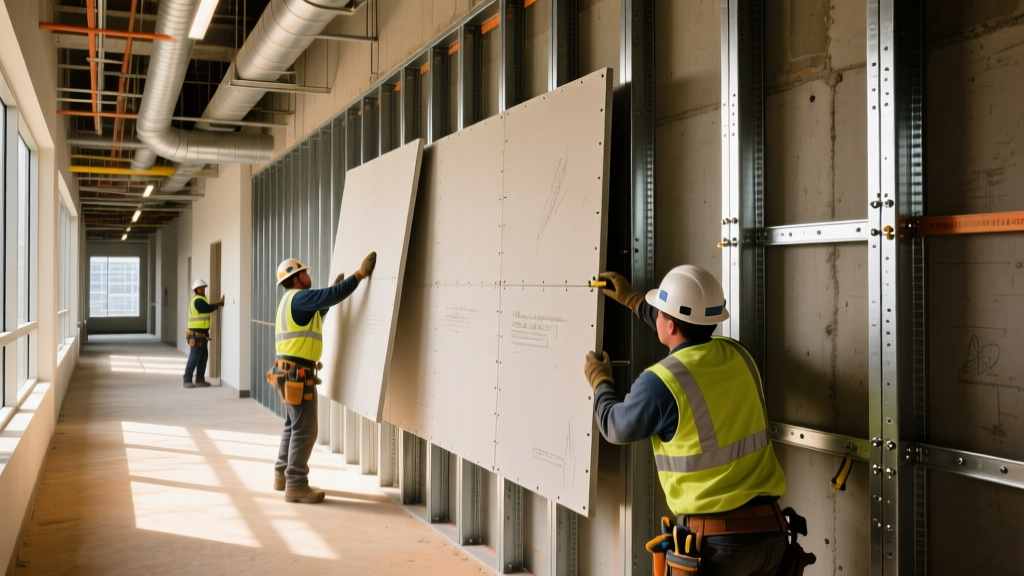
Specifying alternatives to gypsum board fundamentally alters the job site workflow, safety requirements, and budget. Project managers must account for these variables during the estimating phase.
Material and Labor Cost Breakdown (2026 Estimates)
- Standard 5/8" Type X Gypsum: $0.55 – $0.75 per sq. ft. (Material only)
- 1/2" Fiber-Cement Board: $1.60 – $2.40 per sq. ft. (Material only)
- 1/2" MgO Board: $2.10 – $3.50 per sq. ft. (Material only)
- Labor Premium: Expect a 30% to 50% increase in installation labor for cementitious alternatives due to the weight of the panels and the time required for cutting and fastening.
OSHA Silica Dust Compliance
Cutting fiber-cement and certain MgO boards generates respirable crystalline silica. Under OSHA’s Respirable Crystalline Silica Standard (29 CFR 1926.1153), dry-cutting these materials with a circular saw without engineering controls is a severe violation. Contractors must utilize saws equipped with integrated HEPA vacuum dust collection systems or employ wet-cutting methods. Failure to budget for HEPA vacuums and specialized PPE will result in project delays and heavy OSHA fines.
Assembly Selection Decision Framework
Use this step-by-step logic to determine the correct fire-rated panel for your specific building condition:
- Is the assembly exposed to weather prior to enclosure or located in a continuous high-humidity environment (e.g., exterior shaft, pool enclosure)?
- Yes: Eliminate paper-faced and standard FRG gypsum. Proceed to Step 2.
- No: Standard Type X or Glass Mat Gypsum is likely sufficient and most cost-effective.
- Is the assembly an exterior fire wall or parapet requiring high impact and weather resistance?
- Yes: Specify Fiber-Cement Board (ASTM C1186). Ensure mineral wool insulation is specified to meet the ‘T’ rating for heat transmission.
- Is the assembly an interior wet-area shaft (e.g., commercial kitchen, hospital hydrotherapy) where silica dust cutting restrictions are prohibitive?
- Yes: Specify Glass Mat Gypsum (ASTM C1177) or a verified, non-leaching MgO board. Verify the ICC-ES report for the specific MgO brand to ensure salt-leaching resistance.
- Have you verified the UL Design or ICC-ES ESR report for the exact stud gauge, spacing (16" vs 24" o.c.), and fastener schedule?
- Action: Never assume the fastening schedule for Type X gypsum applies to cementitious alternatives. Cement boards typically require corrosion-resistant, self-drilling screws with specific head designs (e.g., ribbed wafer heads) to prevent blowout.
Final Code Verification
When utilizing alternatives to gypsum board, the burden of proof shifts from the prescriptive code tables to tested assembly data. Always cross-reference the Gypsum Association’s Fire Resistance Design Manual or the specific manufacturer’s UL directory for the exact assembly design number. Submit the specific UL design or ICC-ES report to the Authority Having Jurisdiction (AHJ) during the plan review phase to ensure the proposed alternative is accepted before materials are ordered and installed.
Written by
James ThorntonJames Thornton is a construction industry veteran with 25 years of hands-on experience in wood framing, lumber grading, and residential building codes. He started as a framing carpenter in rural Oregon, earned his ICC Residential Building Inspector certification, and eventually became a senior plan reviewer for the City of Portland Bureau of Development Services. James holds a B.S. in Wood Science & Technology from Oregon State University and is a certified lumber grader through the West Coast Lumber Inspection Bureau (WCLIB). He has inspected over 3,000 residential construction sites and authored the city's internal guide on advanced framing techniques (2x6 at 24" O.C.). James lives in Bend, OR, where he builds custom timber-frame cabins and competes in lumberjack sports.
More from James Thornton
View all
Insulation
Best Home Insulation Materials: Complete 2026 Guide
Compare top home insulation materials for 2026. Find R-values, installed costs per square foot, and best uses for fiberglass, spray foam, and mineral wool.
Aug 4, 2026

Sustainable Building
Certify Your Green Building Material for LEED and WELL
Step-by-step guide to certifying a green building material for LEED v5 and WELL v2. Master EPDs, HPDs, and VOC limits for 2026 project specifications.
Aug 4, 2026

Stone & Masonry
Veneer Stacked Stone Panels: Interior Design & Style Showcase
Discover how veneer stacked stone panels transform interiors. Explore modern design profiles, material pairings, and technical installation specs.
Aug 4, 2026