Acoustic Gypsum Board Specs: Dimensions, STC Ratings & Core Density
Technical specifications for acoustic gypsum board, including STC and OITC ratings, core density, dimensional tolerances, and assembly requirements.

Core Composition and Constrained Layer Damping (CLD)
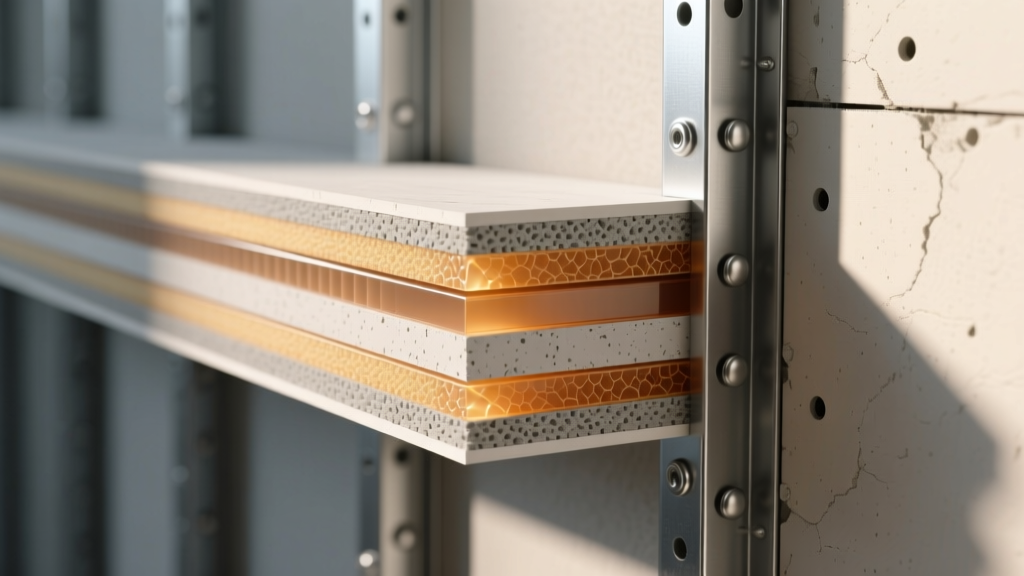
Acoustic gypsum board achieves superior sound attenuation not merely through added mass, but via advanced core engineering. While standard 5/8-inch drywall relies on a uniform gypsum core weighing approximately 1.6 to 1.8 pounds per square foot (psf), acoustic variants utilize Constrained Layer Damping (CLD) technology or high-density formulations that increase the weight to between 2.4 and 3.5 psf.
The most effective acoustic panels feature a viscoelastic polymer layer sandwiched between two dense gypsum matrices. When sound waves strike the panel, they induce microscopic bending vibrations. The viscoelastic polymer converts this mechanical vibrational energy into trace amounts of thermal energy, effectively neutralizing the sound wave before it can transmit through the assembly. This damping mechanism is particularly critical for mitigating low-frequency resonance, which traditional mass-loaded barriers fail to stop.
Standard Dimensions, Thickness, and Weight Tolerances
Acoustic gypsum board is manufactured to the same dimensional footprints as standard drywall to maintain compatibility with existing framing grids (16-inch and 24-inch on-center). However, thickness tolerances are strictly controlled to ensure uniform mating with acoustic sealants and isolation clips.
| Specification | 1/2-Inch Acoustic (12.7mm) | 5/8-Inch Acoustic (15.9mm) |
|---|---|---|
| Standard Widths | 48 inches (1220 mm) | 48 inches (1220 mm), 54 inches (1370 mm) |
| Standard Lengths | 8 ft, 9 ft, 10 ft, 12 ft | 8 ft, 9 ft, 10 ft, 12 ft, 16 ft |
| Thickness Tolerance | ± 1/64 inch | ± 1/64 inch |
| Weight (per sq. ft.) | 2.2 - 2.6 lbs | 2.8 - 3.5 lbs |
| Weight (per MSF) | 2,200 - 2,600 lbs | 2,800 - 3,500 lbs |
Acoustic Performance Metrics: STC vs. OITC
Specifying acoustic gypsum board requires a precise understanding of testing standards. The industry relies on two primary metrics governed by the ASTM E90 and ASTM E336 standards. Confusing these two metrics is the most common cause of acoustic design failure in multi-family and commercial construction.
Sound Transmission Class (STC)
STC measures a partition's ability to block airborne sound across the 125 Hz to 4,000 Hz frequency spectrum. This range correlates primarily with human speech and mid-frequency noise. A standard 5/8-inch drywall assembly on wood studs yields an STC of roughly 34 to 38. By upgrading to a 5/8-inch CLD acoustic board, the single-layer assembly STC jumps to 45-50, and when paired with resilient channels or decoupling clips in a staggered-stud wall, system STC ratings routinely achieve 55 to 65+.
Outdoor-Indoor Transmission Class (OITC)
OITC measures sound attenuation across a lower frequency spectrum, starting at 80 Hz up to 4,000 Hz. This metric is critical for blocking low-frequency rumble from HVAC systems, elevators, traffic, and heavy bass from entertainment systems.
2026 Market Specifications: Leading Acoustic Panels
The acoustic drywall market has consolidated around three primary product lines, each offering distinct core technologies, edge profiles, and pricing structures. Below is a technical comparison of the dominant specifications available for current construction projects.
| Product Model | Core Technology | Score & Snap? | Est. Cost (4x8 Sheet) |
|---|---|---|---|
| PABCO QuietRock 545 | Dual-core CLD viscoelastic polymer | No (Requires cutting tools) | $65.00 - $85.00 |
| CertainTeed SilentFX QuickCut | Viscoelastic polymer with reinforced facers | Yes (Score and snap capable) | $48.00 - $60.00 |
| National Gypsum SoundBreak XP | High-density gypsum with moisture resistance | Yes (Standard scoring) | $42.00 - $55.00 |
When sourcing materials, note that National Gypsum's SoundBreak XP integrates moisture-resistant additives (meeting ASTM C1396 for water-resistant gypsum board), making it the optimal specification for acoustic partitions in bathroom corridors, commercial kitchens, or high-humidity multi-family demising walls where standard CLD boards might degrade.
Fastener Specifications and Installation Clearances
The acoustic performance of a high-STC panel is instantly compromised by rigid mechanical connections that create flanking paths. Fastener selection and placement must strictly adhere to the following specifications:
- Screw Type: Use Type S (fine-thread) for light-gauge steel studs (up to 20 gauge) and Type G (coarse-thread) for wood framing. Do not use standard drywall screws that lack the bugle head required to dimple the acoustic facer without tearing the paper.
- Screw Length: Minimum 1-1/4 inch for 1/2-inch boards; minimum 1-5/8 inch for 5/8-inch boards. The screw must penetrate the framing member by at least 5/8 inch.
- Field Spacing: Maximum 12 inches on-center (O.C.) for ceiling applications; maximum 16 inches O.C. for wall applications.
- Edge/Perimeter Spacing: Maximum 8 inches O.C. along all edges and ends.
- Clearance: Maintain a 3/8-inch gap from all panel edges to adjacent panels or perpendicular surfaces. This gap is non-negotiable and must be filled with acoustic sealant.
Perimeter Isolation and Flanking Path Mitigation
Specifying a 5/8-inch CLD acoustic board with an STC 55 rating is useless if the perimeter is hard-attached to the structural deck. Sound will flanking through the rigid connection, dropping the effective field STC to 40 or lower. To maintain the tested assembly rating, the following isolation specifications must be enforced on-site:
- Acoustic Sealant: Apply a continuous 3/8-inch bead of ASTM C834 compliant, non-hardening acoustic sealant at the top and bottom tracks, and at all vertical corner joints.
- Electrical Boxes: Never install electrical boxes back-to-back on opposite sides of an acoustic partition. Offset boxes by a minimum of 24 inches horizontally. Wrap all recessed boxes in loaded vinyl putty pads (minimum 1 lb/sq ft density) to restore the mass interrupted by the cutout.
- Resilient Channel / Isolation Clips: For assemblies targeting STC 60+, the acoustic board must be mounted to decoupling clips (e.g., RSIC-1) and hat channel, rather than directly to the studs. When using resilient channel (RC-1), fasten the channel perpendicular to the studs at 24 inches O.C., and attach the acoustic board to the channel only—never drive a screw through the channel into the stud, which will short-circuit the decoupling.
Written by
David NakamuraDavid Nakamura is a licensed architect (AIA) and construction technology writer focused on sustainable building methods, mass timber engineering, and high-performance building envelopes. He holds a Master of Architecture from the University of Washington and is a certified Passive House Consultant (CPHC). David spent eight years at the Seattle firm Mithun, where he led the design of three LEED Platinum projects, before founding his own practice specializing in net-zero residential design. He serves on the editorial advisory board of GreenBuilder Magazine and has authored peer-reviewed papers on cross-laminated timber (CLT) connections for the Journal of Structural Engineering. In his spare time, David teaches woodworking at Pratt Fine Arts Center and kayaks the Puget Sound.
More from David Nakamura
View all
Construction Cost
Labor Cost to Build a Deck Per Sq Ft: 2026 Installation Guide
Discover the exact labor cost to build a deck per sq ft in 2026. This installation guide breaks down contractor rates, complexity factors, and hidden fees.
Aug 4, 2026

Construction Cost
How Much Does It Cost to Build a 3 Bedroom House? Financing Guide
Learn exactly how much it costs to build a 3 bedroom house and explore 2026 financing options, construction loan types, and budget frameworks for your build.
Aug 4, 2026

Construction Cost
Cost to Build a Tennis Court: 2026 Guide
How much does it cost to build a tennis court in 2026? Breakdowns for asphalt, concrete, and synthetic surfaces plus fencing and lighting.
Jul 30, 2026