True Cost of Cutting Gypsum Board: Manual vs Power Tool Waste
Analyze the true cost of cutting gypsum board. Compare manual scoring, rotary routers, and track saws based on material waste, labor time, and tool ROI.

The Hidden Economics of Drywall Fabrication
On a residential or commercial job site, cutting gypsum board is often treated as a low-skill, low-impact task. However, when analyzing construction margins at scale, the method used to dimension drywall sheets directly dictates material waste rates, labor throughput, and downstream finishing costs. A flawed cut does not merely waste a $16 sheet of standard board; it costs the contractor 15 minutes of journeyman labor to remeasure, recut, and rehang, alongside the hidden expense of additional joint compound required to fix blown-out edges.
This cost analysis breaks down the financial realities of cutting gypsum board across three primary methodologies: manual scoring and snapping, rotary power routing, and guided track sawing. By evaluating tool depreciation, consumable wear, edge failure rates, and labor velocity, contractors can align their fabrication strategy with their specific project scale and material type.
Manual Scoring and Snapping: The Baseline Cost
The traditional utility knife and drywall T-square remain the industry baseline. The capital expenditure is negligible, but the operational costs are entirely loaded into labor time and material degradation. A standard heavy-duty utility knife (such as the Stanley 99E) costs under $20, and a 100-pack of high-carbon steel snap-off blades costs approximately $14. The consumable cost per cut is effectively zero.
The Edge Blowout Penalty
The primary financial drawback of manual cutting is the 'back-paper blowout.' When snapping the gypsum core after scoring the face paper, the un-scored back paper frequently tears unevenly, leaving a ragged edge that requires heavy pre-filling with setting-type joint compound (e.g., USG Durabond 90). According to installation guidelines published by the Gypsum Association, all edges must be tight and uniformly butted. Ragged manual cuts force tapers to consume up to 15% more joint compound per linear foot of seam, adding material cost and extending the drying time before the next skim coat.
Power Tool Cutting: Rotary Routers vs. Track Saws
For high-volume commercial framing, manual scoring is too slow. Contractors typically upgrade to either handheld rotary routers or guided track saws. The cost profiles of these two power methods are radically different.
Rotary Routers and Spiral Bits
A dedicated drywall router (like the DeWalt DWP611 or Bosch 1617EVS) costs between $140 and $220. The ongoing expense lies in the 1/4-inch spiral upcut bits. Priced at $8 to $14 each, these bits aggressively eject gypsum dust but degrade quickly when encountering the fiberglass mesh embedded in Type X fire-rated boards. On standard 1/2-inch regular board, a single bit will cleanly cut roughly 25 to 30 sheets before the cutting edge dulls and begins tearing the face paper. On Type X or moisture-resistant boards, bit life drops to 12 to 15 sheets.
Track Saws with Dust Extraction
Track saws (such as the Festool TS 55 or Makita SP6000J1) represent a high capital expenditure, with kits including the guide rail and HEPA dust extractor ranging from $750 to $1,100. However, the consumable cost is remarkably low. A 48-tooth fine-finish blade ($65) will easily dimension 500+ sheets of standard gypsum board before requiring replacement. More importantly, a track saw yields a factory-perfect, zero-blowout edge every time, completely eliminating the pre-fill penalty and reducing taping labor.
Material Waste and Edge Failure Rates
To quantify the true cost of cutting gypsum board, we must look at the failure rate of the cut itself. The following table illustrates the expected edge failure rates and associated rework costs based on a 1,000-sheet project (approx. 32,000 sq. ft. of coverage).
| Cutting Method | Edge Failure Rate | Wasted Sheets (1k run) | Extra Compound/Tape Cost |
|---|---|---|---|
| Manual Score & Snap | 4.5% | 45 sheets ($810) | +$140 (Pre-fill labor/mat) |
| Rotary Router (Freehand) | 2.0% | 20 sheets ($360) | +$45 |
| Guided Track Saw | < 0.5% | 5 sheets ($90) | $0 (Zero pre-fill needed) |
Specialized Boards: When Manual Cutting Fails
The cost calculus changes entirely when the project specifies specialized gypsum products. Standard manual scoring relies on snapping a brittle, unreinforced gypsum core. When contractors encounter glass-mat gypsum sheathing (such as Georgia-Pacific DensGlass) or high-density abuse-resistant boards (like CertainTeed SilentFX or USG Fiberock), the core is heavily reinforced with fiberglass or polymers.
Critical Warning: Attempting to score and snap glass-mat gypsum board results in severe edge delamination and core fracturing. These materials must be cut using heavy-duty aviation snips, specialized carbide-tipped scoring tools, or power shears. Factoring in the $40 to $55 per sheet cost of glass-mat boards, a single ruined sheet due to improper cutting methodology wipes out the profit margin of hanging three standard sheets.
Labor Throughput and True Cost Per Sheet
In 2026, the average burdened labor rate for a journeyman drywall hanger ranges from $55 to $72 per hour, depending on regional union agreements and prevailing wage requirements. Time is the most expensive variable in the cutting process.
- Manual Scoring: Averages 2.5 to 3 minutes per complex cut (e.g., cutting around an electrical box or window header). Throughput: ~20 cuts/hour.
- Rotary Router: Averages 45 seconds to 1 minute per complex plunge cut. Throughput: ~60 cuts/hour.
- Track Saw: Averages 30 seconds for long linear rips, but requires setup time for guide rails on complex plunge cuts. Best utilized for long, straight dimensioning rather than intricate outlet cutouts.
For a commercial interior requiring 500 intricate cuts around HVAC diffusers and recessed lighting, switching from a utility knife to a rotary router saves approximately 1.5 hours of pure cutting time. At $65/hour, that is $97.50 in direct labor savings on a single floor, easily justifying the $150 cost of the router and a multi-pack of spiral bits.
Dust Mitigation: The Invisible Cost Factor
Any cost analysis of power cutting must account for dust mitigation. Gypsum board dust contains trace amounts of crystalline silica from the raw gypsum and mica additives. The Occupational Safety and Health Administration (OSHA) strictly enforces Permissible Exposure Limits (PEL) for respirable crystalline silica. Freehand routing generates massive airborne dust clouds, requiring workers to wear N95 or P100 respirators and forcing site superintendents to deploy temporary air scrubbers to maintain visibility and code compliance.
Integrating a HEPA-certified dust extractor (costing $400 to $600) directly to a rotary router or track saw captures up to 95% of particulate matter at the source. While this adds to the initial tooling budget, it prevents the secondary costs of daily site cleanup, protects HVAC systems from drywall dust infiltration during construction, and mitigates the risk of OSHA citations, which can exceed $16,000 per violation.
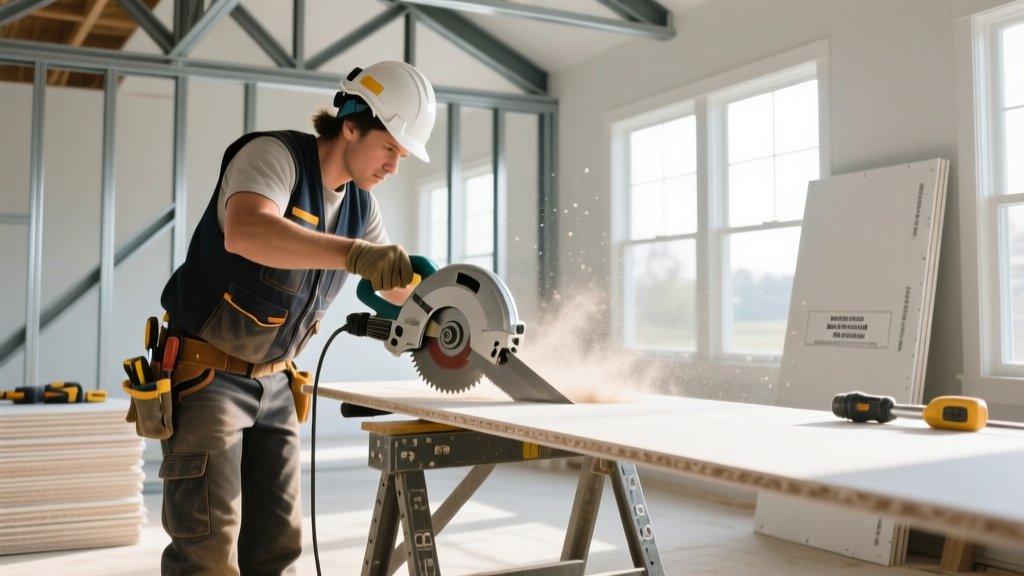
Project Scale Decision Matrix
Contractors should not rely on a single cutting method across all projects. Use the following framework to match your tooling investment to the job's scale and material specifications:
1. Small Residential / Patch Work (Under 1,500 sq. ft.)
Method: Manual Score and Snap.
Rationale: Tool ROI is impossible to achieve at this scale. Accept the 4% waste rate and minor edge blowout; the cost of pre-filling is lower than mobilizing and maintaining power dust extraction systems.
2. Mid-Size Commercial / Multi-Family (1,500 to 15,000 sq. ft.)
Method: Rotary Router with HEPA Vacuum.
Rationale: High volume of outlet and fixture cutouts makes manual scoring a severe labor bottleneck. The speed of the router pays for itself in labor velocity, while the HEPA vac keeps the site clean and compliant.
3. Large Scale / Specialty Boards (Over 15,000 sq. ft. or Glass-Mat/Type X)
Method: Guided Track Saw (Linear cuts) + Rotary Router (Plunge cuts).
Rationale: When hanging expensive abuse-resistant or exterior glass-mat sheathing, zero edge failure is mandatory. The track saw guarantees perfect factory edges for long seams, drastically reducing the taper's finishing time and material consumption.
Optimizing how your crew approaches cutting gypsum board transforms a mundane site task into a controlled, measurable process. By calculating the true cost of consumables, edge waste, and labor velocity, estimators and project managers can accurately bid jobs and protect their bottom lines against the hidden friction of poor fabrication practices.
Written by
Marcus ChenMarcus Chen is a licensed structural engineer (PE) and building materials analyst with over 12 years of experience across residential, commercial, and industrial construction. He holds a Master of Science in Civil Engineering from UC Berkeley and spent six years at Thornton Tomasetti before transitioning to independent consulting and technical writing. Marcus specializes in material selection for seismic-prone regions, concrete reinforcement strategies, and lifecycle cost analysis. His work has been cited by the American Concrete Institute (ACI) and the Structural Engineers Association of California (SEAOC). When he is not on a job site or at his desk, you will find him hiking the Sierra Nevada or restoring a 1920s craftsman bungalow in Oakland, CA.
More from Marcus Chen
View all
Construction Cost
How Much Did the Eiffel Tower Cost to Build?
How much did the Eiffel Tower cost to build in 1889? We adjust for inflation and compare its budget to modern skyscraper construction.
Aug 4, 2026

Fire Resistance
What Is a Fire Resistant Material? Testing & Certification Guide
Discover what is a fire resistant material through ASTM and UL testing. Learn how fire ratings, certifications, and assemblies work in construction.
Aug 4, 2026

Construction Cost
How Much Did the Burj Khalifa Cost to Build?
How much did the Burj Khalifa cost to build? We break down the $1.5B project and extract 5 money-saving strategies for your next build.
Jul 30, 2026