Sheetrock vs Gypsum Board: Code Compliance Spec Guide
Understand the Sheetrock vs gypsum board distinction for code compliance. Learn ASTM standards, fire ratings, and how to specify drywall correctly.

The Core Distinction: Trademark vs. Material Standard
When navigating building codes and architectural specifications, the debate of sheetrock vs gypsum board is fundamentally a misunderstanding of terminology rather than a comparison of two different materials. 'Sheetrock' is a registered trademark of USG Corporation for its specific brand of drywall. 'Gypsum board' is the generic, industry-standard term for the manufactured panel consisting of a noncombustible core primarily of gypsum with paper surfacing.
From a code compliance perspective, this distinction is critical. The International Building Code (IBC) and International Residential Code (IRC) never mandate the use of 'Sheetrock.' Instead, they mandate the use of 'gypsum board' that meets specific performance standards established by ASTM International. Specifying a brand name in construction documents can lead to restrictive bidding, substitution disputes, and potential compliance failures if the specified brand's exact product line is discontinued or altered.
How Building Codes Reference Gypsum Materials
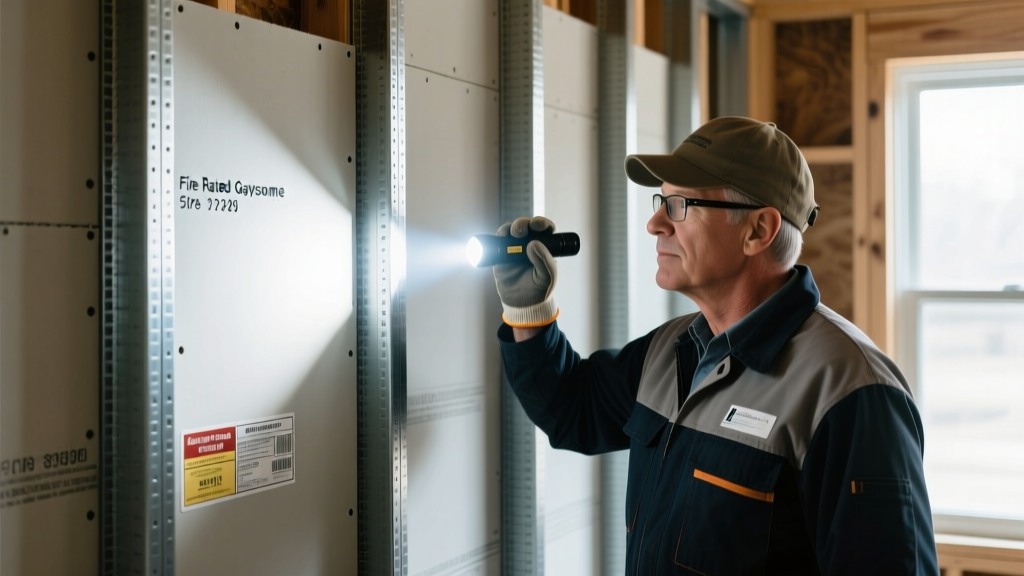
As jurisdictions adopt the 2024 and upcoming 2027 International Building Code (IBC) cycles through 2026, the reliance on standardized testing remains the backbone of drywall compliance. IBC Section 2506 specifically governs gypsum board, dictating that all panels must conform to recognized ASTM standards. Inspectors do not look for a brand logo; they look for the manufacturer's edge stamp that certifies the board meets the referenced ASTM standard.
Primary ASTM Standards for Compliance
To ensure your materials pass framing and drywall inspections, you must map your material orders to the correct ASTM standard. The Gypsum Association provides comprehensive guidelines on these classifications.
| ASTM Standard | Material Description | Common Code Application |
|---|---|---|
| ASTM C1396 | Standard Specification for Gypsum Board (Regular, Type X, Water-Resistant) | Interior walls, ceilings, fire-rated shaft enclosures |
| ASTM C1658 | Standard Specification for Glass Mat Gypsum Substrate | Exterior sheathing, high-moisture interior areas |
| ASTM C1381 | Standard Specification for Mold-Resistant Gypsum Board | Bathrooms, basements, HVAC closets |
Fire-Rated Assemblies: Type X, Type C, and UL Designs
Fire resistance is the most heavily scrutinized aspect of gypsum board compliance. When a code requires a 1-hour or 2-hour fire-resistance rating, it is not the gypsum board alone that provides the rating, but the entire tested assembly (studs, fasteners, spacing, and board). The Gypsum Association Fire Resistance Design Manual and the UL Fire Resistance Directory are the authoritative sources for these assemblies.
Type X vs. Type C: What Inspectors Look For
Type X gypsum board (minimum 5/8 in. thick) contains glass fibers and other additives in the core to retain structural integrity longer when exposed to the extreme heat of a fire (tested per ASTM E119). Type C is an enhanced formulation that offers even greater fire resistance, often allowing for fewer layers in multi-layer shaft wall assemblies.
Inspector Insight: If the approved architectural plans specify a UL Design (e.g., U419 for a 1-hour wood-stud wall), the inspector will verify that the edge stamp on the installed board explicitly states 'Type X' or 'Type C' and matches the thickness required by the UL design. Substituting standard 1/2 in. board, even if doubled up, will fail inspection unless the specific UL design permits it.
Moisture and Mold Compliance in Wet Areas
Historically, 'green board' (water-resistant gypsum board) was used as a tile backing in showers. Modern codes have drastically restricted this practice. Under current IRC and IBC guidelines, standard water-resistant gypsum board is prohibited as a tile backing board in continuous wet areas like shower stalls and bathtub surrounds unless specific waterproofing membranes are applied over it.
For general high-humidity areas (bathroom ceilings outside the shower, laundry rooms), mold-resistant gypsum board (often faced with purple paper or fiberglass mats) is highly recommended and increasingly mandated by local health and building amendments. Ensure the product meets ASTM D3273 for mold resistance scoring.
Specification Matrix: Matching Board to Code Requirement
Use this decision matrix to ensure your material procurement aligns with the International Code Council (ICC) requirements for common building scenarios.
| Building Scenario | Code Requirement | Required Material Specification |
|---|---|---|
| Garage / Living Space Separation | Minimum 1/2 in. gypsum board applied to garage side (IRC R302.6) | 1/2 in. Standard Gypsum Board (ASTM C1396) |
| Elevator Shaft Enclosure | 2-Hour Fire Resistance Rating (IBC 713) | Multiple layers of 5/8 in. Type X or Type C (ASTM C1396) |
| Exterior Sheathing (Non-combustible) | Water and mold resistance, fire rating per assembly | 5/8 in. Glass Mat Gypsum Sheathing (ASTM C1177) |
| Acoustic Separation (Multi-family) | Minimum STC 50 (IBC 1207) | Specialized acoustic gypsum board or multi-layer standard with resilient channel |
Pre-Inspection Checklist for Contractors
Failing a drywall inspection due to material mismatches causes severe project delays. Before calling the municipal inspector for your pre-drywall or final framing inspection, verify the following on-site:
- Locate the Edge Stamps: Every sheet of gypsum board features an end tape or edge stamp printed by the manufacturer. This stamp lists the thickness, fire rating (Type X/C), and ASTM standard.
- Cross-Reference Submittals: Compare the edge stamp data against the approved project submittals and architectural drawings. If the plans call for 5/8 in. Type X, but the stamp reads 1/2 in. Standard, the wall must be torn down.
- Verify Fastener Patterns: Codes dictate screw spacing (typically 12 inches on center for ceilings, 16 inches for walls in fire-rated assemblies). Ensure the fastener type (e.g., Type S for steel, Type W for wood) matches the UL design.
- Check for Proper Blocking: Fire-rated and shear walls require specific wood or steel blocking at horizontal joints and edges. Missing blocking is an immediate code violation, regardless of the gypsum board type used.
By treating 'gypsum board' as a strict performance category rather than a generic synonym for Sheetrock, construction professionals can eliminate specification errors, pass inspections on the first attempt, and ensure the life-safety integrity of the building envelope.
Written by
David NakamuraDavid Nakamura is a licensed architect (AIA) and construction technology writer focused on sustainable building methods, mass timber engineering, and high-performance building envelopes. He holds a Master of Architecture from the University of Washington and is a certified Passive House Consultant (CPHC). David spent eight years at the Seattle firm Mithun, where he led the design of three LEED Platinum projects, before founding his own practice specializing in net-zero residential design. He serves on the editorial advisory board of GreenBuilder Magazine and has authored peer-reviewed papers on cross-laminated timber (CLT) connections for the Journal of Structural Engineering. In his spare time, David teaches woodworking at Pratt Fine Arts Center and kayaks the Puget Sound.
More from David Nakamura
View all
Construction Cost
Labor Cost to Build a Deck Per Sq Ft: 2026 Installation Guide
Discover the exact labor cost to build a deck per sq ft in 2026. This installation guide breaks down contractor rates, complexity factors, and hidden fees.
Aug 4, 2026

Construction Cost
How Much Does It Cost to Build a 3 Bedroom House? Financing Guide
Learn exactly how much it costs to build a 3 bedroom house and explore 2026 financing options, construction loan types, and budget frameworks for your build.
Aug 4, 2026

Construction Cost
Cost to Build a Tennis Court: 2026 Guide
How much does it cost to build a tennis court in 2026? Breakdowns for asphalt, concrete, and synthetic surfaces plus fencing and lighting.
Jul 30, 2026