Gold Bond SoundBreak XP Gypsum Board: 2026 Selection Guide
Compare STC ratings, 2026 costs, and installation specs for Gold Bond SoundBreak XP gypsum board against double-drywall damping assemblies.

The Engineering Behind Gold Bond SoundBreak XP
Gold Bond SoundBreak XP, manufactured by National Gypsum, is a specialized acoustic drywall designed to mitigate airborne sound transmission without the labor overhead of multi-layer assemblies. The panel features a constrained-layer damping (CLD) core: a viscoelastic polymer sandwiched between two high-density gypsum layers. When sound waves hit the board, the polymer core converts acoustic energy into negligible thermal energy through shear deformation.
The 'XP' designation indicates that the board is treated for moisture and mold resistance, meeting ASTM D3273 standards. This makes it uniquely suited for high-humidity acoustic environments where standard soundboard would degrade, such as multi-family residential bathroom demising walls, hotel corridors, and indoor pool mechanical rooms. According to the Gypsum Association, integrating moisture resistance into acoustic panels eliminates the need for secondary cementitious backer boards in specific wet-area acoustic partitions.
STC Performance Matrix: Standard vs. SoundBreak XP
Sound Transmission Class (STC) is the primary metric for evaluating airborne sound blocking. Below is a comparative matrix of common interior partition assemblies tested under ASTM E90 standards. Data reflects 5/8-inch panel configurations on standard 2x4 wood framing at 16 inches on center (OC).
| Assembly Configuration | Cavity Insulation | Estimated STC | Best Application |
|---|---|---|---|
| Standard 5/8" Type X (1 layer each side) | None | 34 - 36 | Basic interior non-rated walls |
| Standard 5/8" Type X (1 layer each side) | R-13 Fiberglass | 39 - 41 | Standard bedroom partitions |
| SoundBreak XP 5/8" (1 layer each side) | R-13 Fiberglass | 52 - 54 | Multi-family demising walls, home theaters |
| SoundBreak XP 5/8" + Resilient Channel | R-13 Mineral Wool | 58 - 61 | Recording studios, luxury hotel suites |
Note: Achieving STC 50+ is generally the minimum threshold required by the International Building Code (IBC) for dwelling unit separations. SoundBreak XP achieves this in a single-layer application, whereas standard drywall requires double-layering or decoupling clips.
2026 Cost vs. Labor: SoundBreak XP vs. Double Drywall
A common specification dilemma is choosing between a single layer of SoundBreak XP versus a double layer of standard 5/8" drywall with a viscoelastic damping compound (e.g., Green Glue). In the 2026 construction market, labor constraints heavily favor the single-layer acoustic board.
Cost Breakdown per 100 Sq. Ft. (Material + Labor)
- Double 5/8" Drywall + Damping Compound: Material costs average $115 (two sheets of standard Type X plus one tube of damping compound per 32 sq. ft.). Labor requires two separate hanging passes, mudding the first layer, applying the compound, and hanging the second layer. Total installed cost: $380 - $440.
- Single Layer 5/8" SoundBreak XP: Material costs average $190 (approx. $60 per 4x8 sheet). Labor requires only a single hanging pass, identical to standard drywall. Total installed cost: $260 - $310.
Verdict: SoundBreak XP yields a 25-30% reduction in total installed cost for comparable STC ratings, primarily by eliminating the second hanging pass and the curing time required for damping compounds.
Specification Guide: Where to Deploy and Where to Skip
SoundBreak XP carries a premium material cost. Specifying it universally across a project will unnecessarily inflate the budget. Use this decision framework to allocate the product effectively.
High-ROI Applications (Specify SoundBreak XP)
- Dwelling Unit Demising Walls: Condominiums and apartments where IBC Section 1206 requires STC 50 minimums.
- Plumbing Chase Walls: The XP moisture resistance protects against condensation and minor leaks while dampening the broadband noise of PVC/cast-iron drain lines.
- Home Theaters & Media Rooms: Where floor space is at a premium, a single-layer 5/8" board saves 1.5 inches of room depth compared to double-layer assemblies.
- Elevator Shaft Corridors: High-traffic areas requiring both impact noise reduction and abuse resistance.
Low-ROI Applications (Use Standard Type X)
- Interior Closet Liners: Acoustic separation is unnecessary.
- Commercial Office Plenums: Ceiling plenums require acoustic ceiling tiles and deck-to-deck barriers, not premium wall board.
- Garage Separations: Fire rating (Type X) is the priority here; standard 5/8" firecode board is sufficient unless the garage abuts a bedroom.
Critical Installation Protocols: Avoiding Acoustic Short-Circuits
The highest-performing acoustic board will fail if installed incorrectly. Acoustic flanking and rigid connections will bypass the viscoelastic core. Follow these strict protocols based on National Gypsum technical bulletins:
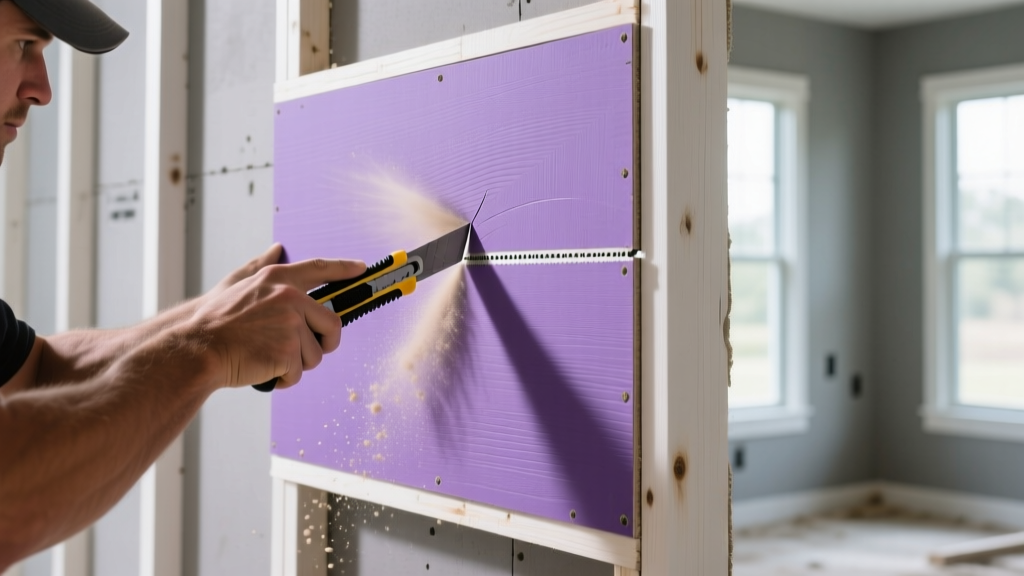
- Cutting the Core: Do not attempt to score-and-snap SoundBreak XP like standard drywall. The polymer core will not snap. You must score the face paper, snap the first gypsum layer, and then use a heavy-duty utility knife or specialized acoustic saw to cut through the polymer layer and back paper. Alternatively, use a router with a dust-extraction shroud.
- Fastener Selection: Use only coarse-thread drywall screws for wood framing (1-5/8" for 5/8" board). Warning: Do not over-drive the screws. Breaking the face paper destroys the localized damping capability and creates a direct vibration path to the stud. The screw head should sit just below the paper surface without tearing it.
- Perimeter Isolation: Leave a 1/4-inch gap at the floor and ceiling. Fill this gap with an ASTM C920 compliant acoustical sealant. Never let the drywall rest directly on the subfloor or hard-ceiling structure, as impact vibrations will travel directly into the panel.
- Electrical Box Treatment: Stagger electrical outlets on opposite sides of the wall so they do not share the same stud bay. Apply acoustical putty pads to the back of all electrical boxes to maintain the mass and airtight seal of the partition.
Competitor Cross-Reference
When supply chain constraints affect National Gypsum distributors, you may need to evaluate equivalent alternatives. Here is how SoundBreak XP compares to other leading constrained-layer damping boards:
| Product | Manufacturer | Core Technology | Moisture Resistant? | Relative Price Index |
|---|---|---|---|---|
| SoundBreak XP | National Gypsum | Viscoelastic Polymer | Yes (XP Treatment) | Baseline (1.0x) |
| QuietRock 545 | PABCO Gypsum | Viscoelastic Polymer | No (Standard) | 1.15x |
| SilentFX | CertainTeed | Viscoelastic Polymer | Yes (M2Tech option) | 1.05x |
While QuietRock offers marginally higher STC ratings in specific decoupled assemblies, SoundBreak XP remains the preferred choice for high-humidity environments due to its integrated moisture treatment, eliminating the need to source specialized moisture-resistant acoustic variants.
Technical FAQs
Can I hang cabinets directly on SoundBreak XP?
No. The viscoelastic polymer core is designed to shear under stress. Hanging heavy loads directly on the drywall will cause the face layer to delaminate from the core. All cabinetry and heavy fixtures must be anchored directly into the wall studs or structural blocking using lag screws.
Does SoundBreak XP require a specific joint compound?
Standard setting-type and ready-mixed joint compounds are compatible. However, because acoustic walls require an airtight seal to prevent sound leakage, ensure all joints are taped and finished to a minimum Level 4 finish. Any pinholes or unsealed gaps will severely degrade the STC rating.
Is it fire-rated?
SoundBreak XP 5/8" is recognized in numerous UL fire-rated designs as a direct substitute for standard 5/8" Type X gypsum board, providing the same 1-hour and 2-hour fire resistance ratings when used in tested assemblies.
Written by
Marcus ChenMarcus Chen is a licensed structural engineer (PE) and building materials analyst with over 12 years of experience across residential, commercial, and industrial construction. He holds a Master of Science in Civil Engineering from UC Berkeley and spent six years at Thornton Tomasetti before transitioning to independent consulting and technical writing. Marcus specializes in material selection for seismic-prone regions, concrete reinforcement strategies, and lifecycle cost analysis. His work has been cited by the American Concrete Institute (ACI) and the Structural Engineers Association of California (SEAOC). When he is not on a job site or at his desk, you will find him hiking the Sierra Nevada or restoring a 1920s craftsman bungalow in Oakland, CA.
More from Marcus Chen
View all
Construction Cost
How Much Did the Eiffel Tower Cost to Build?
How much did the Eiffel Tower cost to build in 1889? We adjust for inflation and compare its budget to modern skyscraper construction.
Aug 4, 2026

Fire Resistance
What Is a Fire Resistant Material? Testing & Certification Guide
Discover what is a fire resistant material through ASTM and UL testing. Learn how fire ratings, certifications, and assemblies work in construction.
Aug 4, 2026

Construction Cost
How Much Did the Burj Khalifa Cost to Build?
How much did the Burj Khalifa cost to build? We break down the $1.5B project and extract 5 money-saving strategies for your next build.
Jul 30, 2026