Gypsum Board Glue Code Compliance: ASTM Standards and Fire Ratings
Master gypsum board glue code compliance. Learn ASTM C557 standards, fire-rated assembly restrictions, and VOC limits for drywall adhesives.

Navigating the Code Landscape for Drywall Adhesives
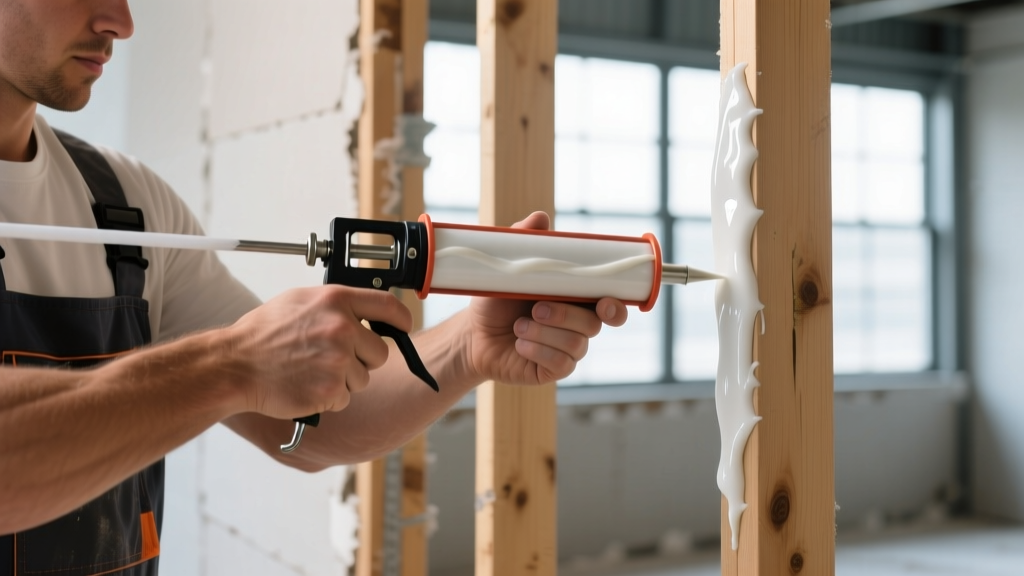
Using gypsum board glue (drywall adhesive) offers undeniable performance benefits: it stiffens wall assemblies, reduces fastener pops, and minimizes air infiltration. However, integrating adhesives into commercial and multi-family residential projects triggers strict building code, fire safety, and environmental compliance requirements. Structural engineers, fire marshals, and LEED consultants scrutinize adhesive applications because altering the fastening schedule or introducing organic compounds between the framing and the gypsum core fundamentally changes the assembly's tested behavior. This guide details the exact code parameters governing gypsum board glue in modern construction, referencing current International Building Code (IBC) standards, ASTM testing protocols, and environmental regulations.
The Core Material Standard: ASTM C557 Explained
Before any gypsum board glue can be specified on a compliant project, it must meet ASTM C557 (Standard Specification for Adhesives for Fastening Gypsum Panel Products to Wood Framing). This standard does not merely test initial stickiness; it evaluates the long-term structural integrity of the bond under severe environmental stress. Code officials will reject any adhesive that lacks independent third-party certification to this standard.
ASTM C557 Minimum Performance Thresholds
| Test Parameter | Methodology | Minimum Passing Criteria |
|---|---|---|
| Tensile Strength (7-Day) | Pull-test on wood-to-gypsum bond after 7 days standard curing. | 200 psi (1.38 MPa) minimum |
| Tensile Strength (28-Day) | Pull-test after 28 days standard curing. | 200 psi (1.38 MPa) minimum |
| Humidity Cycling Durability | 3 cycles of 90% relative humidity followed by 50% RH. | No delamination; maintains 150 psi minimum |
| Shear Strength | Lateral load applied parallel to the glue line. | 150 psi (1.03 MPa) minimum |
| Temperature Cycling | Cycling between -20°F and 120°F. | No cracking or bond failure |
Specifiers must verify that the Technical Data Sheet (TDS) of the chosen adhesive explicitly states compliance with ASTM C557. Generic construction adhesives (such as those meeting only ASTM D3498 for subfloors) are code violations when used for vertical gypsum panel attachment.
Fire-Rated Assemblies: When Glue is Prohibited
The most frequent compliance failure involving gypsum board glue occurs in fire-rated partitions. Type X and Type C gypsum boards rely on the calcination process—the slow release of chemically bound water within the gypsum core—to delay heat transfer during a fire. Introducing a continuous layer of adhesive between the wood or steel stud and the gypsum board alters the thermal dynamics of the assembly.
Why Adhesive Voids Standard UL Designs
- Thermal Bridging and Fuel Load: Many standard drywall adhesives are elastomeric or acrylic-based. Under extreme heat, these organic compounds can degrade, melt, or off-gas, creating a localized fuel layer that accelerates the failure of the paper facing.
- Delamination Mechanics: In a standard screw-only assembly, the mechanical fasteners hold the calcined, brittle gypsum core in place even after the paper burns away. Adhesive bonds primarily to the paper facing. Once the paper chars and separates from the core, the entire sheet can collapse prematurely, exposing the stud cavity to flames.
- Intumescent Interference: Some specialized fire-stopping adhesives contain intumescent chemicals, but standard drywall glue does not. Applying standard glue in a shaft wall or area separation wall will fail the hose-stream test required by UL Product IQ listings.
Shear Wall and Structural Bracing Restrictions
In light-frame construction, gypsum board is frequently used as structural bracing to resist lateral wind and seismic loads. The International Residential Code (IRC Table R602.10.1) and the International Building Code (IBC Section 2305.3) provide strict fastener schedules (nail or screw spacing) to achieve specific nominal shear capacities (e.g., 100 to 200 pounds per linear foot).
Building codes do not recognize gypsum board glue as a method to increase the shear capacity of a braced wall panel. Structural engineers calculate lateral resistance based entirely on the mechanical fasteners yielding and the board bearing against the framing. In fact, applying a rigid adhesive bead can make the assembly overly stiff, altering the failure mode from ductile fastener yielding to brittle gypsum crushing. Consequently, on engineered shear walls, adhesive is either strictly prohibited or explicitly ignored in the structural calculations. Always default to the mechanical fastener schedule stamped on the structural drawings.
VOC Limits and Indoor Air Quality Compliance
Environmental codes and green building standards strictly regulate the Volatile Organic Compound (VOC) content of wet-applied adhesives. Because drywall adhesive is applied in massive quantities (a standard 28 oz tube covers roughly 300 linear feet, and a commercial floor may require dozens of tubes), the off-gassing potential is significant.
Regulatory Thresholds for 2026 Projects
Compliance requires adherence to the most stringent local or project-specific baseline. The prevailing standards include:
- SCAQMD Rule 1168: The South Coast Air Quality Management District limits VOC content for drywall and panel adhesives to 50 g/L. This is the baseline for most commercial specifications nationwide.
- CARB ATCM: The California Air Resources Board enforces similar limits, requiring third-party certification for any adhesive sold or used within the state.
- LEED v4.1 & WELL Building Standard: These frameworks require adhesives to meet SCAQMD Rule 1168 limits and additionally mandate that the product passes CDPH Standard Method v1.2 for indoor air quality emissions testing (ensuring low formaldehyde and acetaldehyde off-gassing).
Actionable Step: Reject any solvent-based contact cements or high-VOC polyurethane adhesives for interior gypsum board attachment. Specify only water-based acrylic or elastomeric formulations that carry a Green Guard Gold or SCAQMD 1168 compliance certificate on the manufacturer's TDS.
Acoustic Assemblies and STC Ratings
In multi-family and commercial hospitality projects, achieving target Sound Transmission Class (STC) ratings of 50 or higher is a code requirement for tenant separation. The use of gypsum board glue in acoustic assemblies requires precise execution.
According to the Gypsum Association's GA-216 guidelines, applying a continuous, unbroken bead of adhesive along the top and bottom plates, as well as the studs, creates a rigid mechanical bridge. This 'short-circuits' acoustic isolation clips or resilient channels, transferring vibrational energy directly from the drywall to the framing and drastically reducing the STC rating. To maintain code compliance in acoustic designs, adhesive must be applied only in intermittent dabs or strictly limited to the perimeter plates, avoiding any contact with the isolated field of the wall.
Decision Matrix: Screw-Only vs. Screw-and-Glue
Use the following matrix to determine if gypsum board glue is permissible and advantageous for your specific wall assembly.
| Wall Assembly Type | Adhesive Permitted? | Code / Performance Rationale |
|---|---|---|
| Standard Interior Non-Rated (Wood Framing) | Yes | Reduces screw pops, stiffens wall, allows wider screw spacing in field (up to 24" o.c. per some manufacturer specs). |
| Standard Interior Non-Rated (Steel Framing) | No | ASTM C557 is for wood framing. Adhesives do not bond reliably to galvanized steel studs under shear stress. |
| Fire-Rated (Type X / Type C) | Rarely | Only if explicitly listed in the UL/ULC design. Otherwise, voids fire rating due to altered thermal degradation. |
| Engineered Shear Walls | Ignored/No | Does not contribute to lateral load capacity; may cause brittle failure. Rely on mechanical fastener schedule. |
| Acoustic / STC-Rated Separation Walls | Conditionally | Permitted only on perimeter plates. Continuous stud beads will short-circuit resilient channels and fail STC tests. |
| Moisture-Resistant (Green/Purple Board) | Yes | Ensure adhesive is formulated for high-humidity environments to prevent mold growth at the bond line. |
Final Compliance Verification Checklist
Before authorizing the use of gypsum board glue on site, the project manager must verify the following documentation:
- The adhesive TDS explicitly cites ASTM C557 compliance.
- The VOC content is documented at ≤ 50 g/L per SCAQMD Rule 1168.
- The project's fire-stopping and rated-assembly details have been cross-referenced with the UL Product IQ database to ensure adhesive is not prohibited.
- The structural engineer of record has confirmed that adhesive application will not interfere with the IBC shear wall fastening schedules.
Written by
Marcus ChenMarcus Chen is a licensed structural engineer (PE) and building materials analyst with over 12 years of experience across residential, commercial, and industrial construction. He holds a Master of Science in Civil Engineering from UC Berkeley and spent six years at Thornton Tomasetti before transitioning to independent consulting and technical writing. Marcus specializes in material selection for seismic-prone regions, concrete reinforcement strategies, and lifecycle cost analysis. His work has been cited by the American Concrete Institute (ACI) and the Structural Engineers Association of California (SEAOC). When he is not on a job site or at his desk, you will find him hiking the Sierra Nevada or restoring a 1920s craftsman bungalow in Oakland, CA.
More from Marcus Chen
View all
Construction Cost
How Much Did the Eiffel Tower Cost to Build?
How much did the Eiffel Tower cost to build in 1889? We adjust for inflation and compare its budget to modern skyscraper construction.
Aug 4, 2026

Fire Resistance
What Is a Fire Resistant Material? Testing & Certification Guide
Discover what is a fire resistant material through ASTM and UL testing. Learn how fire ratings, certifications, and assemblies work in construction.
Aug 4, 2026

Construction Cost
How Much Did the Burj Khalifa Cost to Build?
How much did the Burj Khalifa cost to build? We break down the $1.5B project and extract 5 money-saving strategies for your next build.
Jul 30, 2026