Yellow Gypsum Board: Code Compliance for Abuse-Resistant Drywall
Navigate IBC codes for yellow gypsum board. Learn ASTM C1629 impact ratings, foil-backed vapor retarder rules, and commercial installation specs.

Decoding the Color: What Yellow Gypsum Board Actually Means
In commercial and high-end residential construction, drywall color coding is a critical shorthand for inspectors, architects, and contractors. While white denotes standard panels and green signifies moisture resistance, yellow gypsum board occupies a highly specific, dual-purpose niche in the building materials market. Depending on whether the yellow is on the face or the back, it signals two entirely different code compliance pathways: Abuse-Resistant/Impact-Resistant panels (yellow-faced) and Foil-Backed Vapor Retarders (yellow kraft-backed).
Misidentifying or misapplying these panels is a frequent source of failed municipal inspections and costly tear-outs. Under the 2021 and 2024 editions of the International Building Code (IBC), specifying the correct panel type for high-traffic corridors or specific climate zones is not merely a best practice—it is a strict life-safety and building envelope mandate. This guide breaks down the exact ASTM standards, IBC sections, and installation protocols required for yellow gypsum board systems.
IBC Code Requirements for Abuse-Resistant (Yellow-Faced) Panels
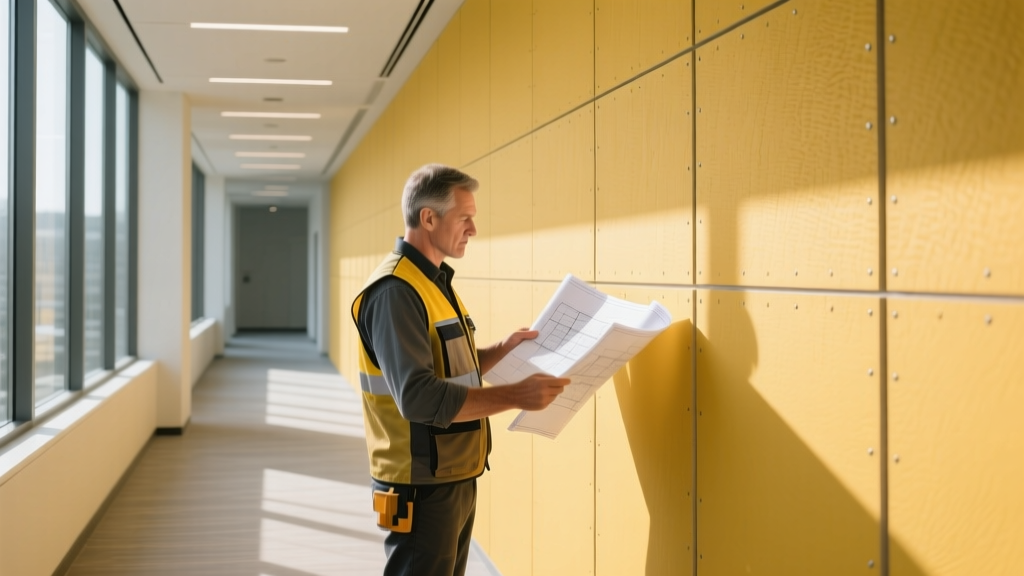
Yellow-faced gypsum board, such as CertainTeed’s ToughRock Abuse-Resistant line or similar commercial impact panels, is engineered with a dense, fiber-reinforced core and a heavy-duty yellow face paper. The IBC mandates the use of abuse-resistant panels in specific high-traffic and egress areas to maintain the integrity of fire-rated assemblies and protect structural framing from mechanical damage.
Compliance is governed by ASTM C1629 (Standard Classification for Abuse-Resistant Nondecorated Interior Gypsum Panel Products). This standard categorizes panels into three distinct performance levels based on soft-body impact, hard-body impact, and surface abrasion resistance. Inspectors will verify that the installed yellow board matches the architect’s specified ASTM level for the given occupancy type.
| Classification Level | Impact & Abrasion Profile | Typical IBC Mandated Applications | Required Core Thickness |
|---|---|---|---|
| Level 1 | Low-impact; resists minor scuffs and soft-body contact. | Standard commercial corridors, retail back-rooms, low-traffic stairwells. | 1/2" or 5/8" |
| Level 2 | Medium-impact; resists hard-body strikes and moderate abrasion. | Hospital corridors, school hallways, hotel service elevators, dormitories. | 5/8" Type X |
| Level 3 | Severe-impact; maximum resistance to forced entry and heavy equipment. | Elevator shaft enclosures, stairwell fire barriers, secure detention facilities. | 5/8" Type X or dual-layer |
For Level 2 and Level 3 applications, the IBC (Section 2508) requires that the yellow abuse-resistant board be paired with a reinforced joint treatment system. Standard paper tape is insufficient; inspectors will look for fiberglass mesh tape embedded in setting-type joint compound (e.g., 45-minute or 90-minute hot mud) to prevent seam fracturing upon impact.
Foil-Backed Yellow Board: Vapor Retarder Code Compliance
When the yellow material is on the back of the panel—specifically a yellow-brown kraft paper laminated with an aluminum foil layer—the product serves as a Class I vapor retarder. Foil-backed gypsum board has a perm rating of less than 0.05, effectively blocking moisture diffusion through the wall cavity.
Code compliance for foil-backed yellow board is dictated by IECC Section C402.5 and IBC Section 1403.3, which regulate vapor retarder usage based on climate zones. Installing a Class I vapor retarder in the wrong climate zone is a catastrophic code violation that traps moisture inside wall cavities, leading to concealed mold growth and structural rot.
Foil-backed (yellow-backed) gypsum board is strictly prohibited on the interior side of wall assemblies in hot, humid climates (IECC Climate Zones 1, 2, and 3, and marine Zone 4). In these zones, exterior moisture drives inward due to air conditioning; a Class I interior vapor barrier traps this moisture against the drywall core. Foil-backed panels are only code-compliant on the interior warm-in-winter side of walls in Climate Zones 5, 6, 7, and 8.
Approved Applications for Foil-Backed Yellow Board
- Exterior Wall Assemblies in Northern Climates: Zones 5 through 8, installed directly behind interior finishes to prevent winter interior moisture from migrating into cold sheathing.
- Shaft Liners and Chase Walls: Where unconditioned vertical shafts abut conditioned, humidity-controlled spaces (e.g., indoor pool enclosures in cold climates).
- Below-Grade Foundation Walls: As part of a comprehensive interior drainage and insulation system, provided local amendments permit Class I retarders below grade.
Framing and Fastening Codes for High-Impact Areas
The performance of yellow abuse-resistant gypsum board is entirely dependent on the substrate to which it is fastened. The Gypsum Association’s GA-216 (Application and Finishing of Gypsum Panel Products) outlines strict framing tolerances for impact-rated assemblies.
"Abuse-resistant panels installed over non-rigid or improperly braced framing will fail under hard-body impact testing, regardless of the panel's ASTM C1629 rating. The framing must absorb and distribute the kinetic energy."
— GA-216 Technical Guidelines, Framing Rigidity Standards
Steel Framing Specifications: For commercial corridors requiring Level 2 or Level 3 abuse resistance, 25-gauge steel studs are generally rejected by structural engineers. Code-compliant assemblies require a minimum of 20-gauge steel studs (or 16-gauge for elevator shafts) spaced at a maximum of 16 inches on center (o.c.).
Fastener Schedules: Under ASTM C1002, yellow abuse-resistant panels must be secured using 1-1/4" or 1-5/8" Type S bugle-head screws. In impact zones, the fastener schedule is tightened: screws must be placed every 8 inches on center along the perimeter and intermediate framing, compared to the standard 12-inch o.c. spacing used for standard white board. Perimeter screws must be kept at least 3/8" from the panel edge to prevent blowouts that compromise the reinforced core.
Common Code Violations and Inspection Failures
Municipal building inspectors frequently flag yellow gypsum board installations for the following specific violations:
- Mismatched Joint Compounds: Using pre-mixed all-purpose (drying-type) compound on the face of abuse-resistant panels in high-traffic corridors. Code requires setting-type (chemical-curing) compounds for the tape and fill coats to match the impact resistance of the yellow face paper.
- Improper Cutouts in Shaft Liners: When yellow 1-inch core shaft liner panels are used in elevator chases, inspectors will reject any cutouts for electrical boxes that are not properly fire-stopped with intumescent caulk, as the abuse-resistant core alters the standard fire-caulk penetration ratios.
- Foil-Backed Punctures: Installing foil-backed yellow board but subsequently puncturing the vapor barrier with unsealed electrical outlets or plumbing penetrations. Every penetration in a Class I retarder must be sealed with acoustic/vapor sealant to maintain the <0.1 perm rating.
- Missing Edge Sealing: When cutting yellow foil-backed board on-site, the exposed gypsum core at the cut edge must be sealed with foil tape or vapor-retarding mastic. Leaving the edge exposed violates the continuous vapor barrier requirement of IECC C402.5.
Sourcing, Specifications, and 2026 Market Expectations
Procuring specialized yellow gypsum board requires advance planning. Unlike standard 1/2" white board, which is stocked in bulk at every commercial lumberyard, abuse-resistant and foil-backed panels are often made-to-order or held in limited regional distribution centers.
As of early 2026, contractors should expect to pay a premium of 45% to 70% over standard drywall for yellow-faced abuse-resistant panels, translating to approximately $0.85 to $1.20 per square foot for the material alone. Foil-backed panels carry a similar premium due to the laminated kraft/foil backing process. Lead times for Level 3 impact panels or 1-inch thick yellow shaft liner boards can stretch to 3–4 weeks in secondary markets. Always verify the manufacturer’s UL Design number (e.g., U419 or U465) on the delivery tickets against the approved architectural fire-rating schedules before installation begins to ensure seamless inspection sign-offs.
Written by
Elena RodriguezElena Rodriguez is a civil engineer and technical writer specializing in concrete technology, masonry systems, and ASTM/ACI compliance. She earned her B.S. in Civil Engineering from Texas A&M University and spent a decade at a materials testing laboratory, performing over 2,000 concrete compressive strength tests and masonry prism evaluations. Elena is an ACI-certified Field Testing Technician (Grade I) and a member of ASTM Committee C12 on Natural Building Stone. She currently consults on forensic engineering cases involving concrete failures and moisture intrusion. Based in San Antonio, TX, Elena is a proud member of the Society of Women Engineers (SWE) and coaches her daughter's FIRST Robotics team.
More from Elena Rodriguez
View all
Walls & Panels
Cost Analysis: Light Gauge Steel Framing Advantages and Disadvantages
Evaluate light gauge steel framing advantages and disadvantages through a strict cost analysis lens, comparing material, labor, and lifecycle expenses.
Aug 4, 2026

Walls & Panels
Gypsum Board Types: Exact Specifications, Thickness & Dimensions
Compare standard, Type X, and moisture-resistant gypsum board types. Get exact specifications, thicknesses, dimensions, and ASTM standards for your project.
Aug 4, 2026

Fire Resistance
Best Fire-Resistant Outdoor Decking Materials: 2026 Buyer Guide
Discover the best fire-resistant outdoor decking materials for 2026. Compare Class A PVC, aluminum, and hardwood options for WUI compliance and safety.
Aug 4, 2026