Gypsum Board Adhesive Selection Guide: Types and Substrates
Choose the right gypsum board adhesive for wood, metal, or masonry. Compare acoustic, standard, and high-strength drywall mastics.

The Mechanical and Acoustic Purpose of Drywall Adhesives
Relying solely on mechanical fasteners to secure gypsum panels to framing is an outdated practice that leaves walls vulnerable to fastener pops, racking, and acoustic flanking. Integrating a high-quality gypsum board adhesive into your installation protocol transforms the wall assembly into a monolithic, laminated structure. According to the Gypsum Association's GA-216 guidelines, continuous adhesive application increases the racking strength of wood-framed shear walls by up to 100% and significantly reduces the incidence of nail or screw pops caused by seasonal lumber shrinkage.
Beyond structural rigidity, adhesives play a critical role in acoustic decoupling and damping. By eliminating the air gap between the gypsum panel and the framing member, you reduce the drum-like resonance that degrades Sound Transmission Class (STC) ratings. However, selecting the correct formulation is not a one-size-fits-all decision. The wrong adhesive on an incompatible substrate will result in bond failure, thermal cracking, or voided fire ratings.
Decoding ASTM Standards for Gypsum Board Adhesive
When evaluating product data sheets, you must verify compliance with ASTM C557, the Standard Specification for Adhesives for Fastening Gypsum Wallboard to Wood Framing. This standard dictates rigorous testing for tensile strength, shear strength, and accelerated aging.
Key Testing Metrics in ASTM C557
- Tensile Adhesion: Measures the pull-off strength perpendicular to the framing. Minimum requirement ensures the paper facing of the drywall tears before the adhesive bond breaks.
- Shear Strength: Evaluates the adhesive's resistance to lateral sliding forces, critical for multi-story shear wall assemblies.
- Open Time: The maximum window between adhesive application and panel placement before the mastic skins over and loses tack.
Substrate Compatibility Matrix
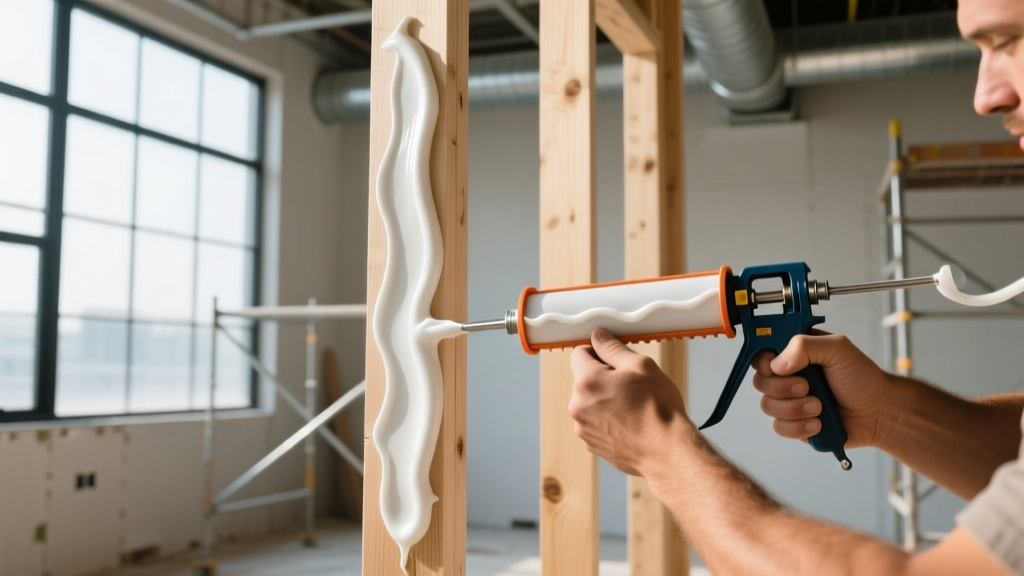
The most common cause of drywall adhesive failure is substrate mismatch. The porosity, thermal expansion rate, and surface energy of the framing material dictate which chemical base (acrylic, elastomeric, or polyurethane) is required.
| Substrate Material | Recommended Adhesive Type | Critical Considerations |
|---|---|---|
| Wood Studs (SPF, Douglas Fir) | Elastomeric or Acrylic Drywall Mastic | Must accommodate wood shrinkage without losing bond. Requires 3/8" continuous bead. |
| Light-Gauge Metal Studs | NOT RECOMMENDED for field bonding | Differential thermal expansion causes bond failure. Use acoustic sealant at perimeter tracks only. |
| Masonry / Concrete (CMU) | Polyurethane Construction Adhesive or Furring Mastic | Requires rigid, high-tack masonry adhesives. Standard drywall adhesive will fail on alkaline concrete surfaces. |
| Existing Gypsum / Plaster | Acrylic Laminate Adhesive | Surface must be scuff-sanded and primed. Fasteners still required for laminating layers. |
Product Breakdown: Standard vs. Acoustic vs. Masonry
Standard Elastomeric Drywall Adhesives
For standard wood-framed residential and commercial construction, elastomeric adhesives are the industry baseline. Products like USG Sheetrock Brand Adhesive or OSI Pro-Series Drywall Adhesive are formulated to remain flexible after curing. This flexibility is non-negotiable; as wood studs twist and shrink during the first two years of a building's life, a rigid adhesive would crack and transfer that stress to the drywall joints, causing tape ridging. These adhesives typically feature a low-VOC, water-based cleanup profile and an open time of 15 to 30 minutes.
Acoustic and Perimeter Sealants
While not used for full-panel field bonding, acoustic sealants are a vital part of the adhesive ecosystem for sound-rated assemblies. Tremco Acoustical Sound Sealant is applied in a 1/2-inch bead at the intersection of the drywall and the floor/ceiling tracks, as well as around electrical boxes. Unlike standard mastics, acoustic sealants do not harden into a structural bond; they remain permanently pliable to decouple vibration and block airborne flanking noise.
High-Strength Masonry and Foam Adhesives
When direct-bonding gypsum board to CMU block or insulating foam sheathing, standard drywall mastics lack the chemical bite required. Polyurethane-based foaming adhesives (like Loctite PL Premium Polyurethane) expand slightly into the pores of the masonry, creating a mechanical lock. Note that direct-to-masonry bonding requires the concrete to be fully cured and free of efflorescence, and the drywall must be a moisture-resistant (green/purple) variant if below grade.
Critical Application Variables and Failure Modes
Even the highest-grade gypsum board adhesive will fail if application parameters are ignored. Installers frequently encounter three primary failure modes:
If the adhesive is exposed to air for longer than its rated open time (usually 15 minutes in low humidity), a microscopic skin forms on the bead. Pressing a drywall panel against skinned adhesive results in a false bond that will delaminate within weeks. Always apply adhesive to no more than two studs at a time before hanging the panel.
- Bead Profile and Size: A continuous 3/8-inch to 1/2-inch bead is required. Applying the adhesive in "dabs" or "ribbons" leaves void spaces that harbor acoustic resonance and reduce fire-resistance ratings by allowing hot gases to channel behind the panel during a fire.
- Temperature Constraints: Water-based acrylic and elastomeric adhesives must not be applied to surfaces below 40°F (4°C). Freezing before the emulsion cures destroys the polymer matrix, turning the adhesive into a chalky, non-bonding powder.
- Fastener Reduction Limits: While adhesive allows for a reduction in field fasteners (e.g., spacing screws at 24 inches on-center instead of 16 inches), perimeter fasteners at the top and bottom plates, and at all panel edges, must still be installed at standard 8-inch to 12-inch intervals to clamp the board tightly while the adhesive cures.
Coverage Rates and 2026 Material Costs
Budgeting for drywall adhesive requires understanding linear coverage versus tube waste. The data below reflects standard 28-ounce cartridge yields based on a 3/8-inch continuous bead profile.
| Adhesive Category | Average Yield (28oz Tube) | Est. Cost per Tube (2026) | Cost per Linear Foot |
|---|---|---|---|
| Standard Elastomeric (e.g., USG Sheetrock) | 28 - 32 linear feet | $6.50 - $8.00 | $0.23 / ft |
| High-Tack Acrylic (e.g., OSI Pro-Series) | 25 - 28 linear feet | $7.50 - $9.50 | $0.31 / ft |
| Acoustic Perimeter Sealant (e.g., Tremco) | 18 - 22 linear feet | $9.00 - $12.00 | $0.50 / ft |
Frequently Asked Questions
Can I use drywall adhesive on metal stud framing?
No. Standard drywall adhesives are designed for porous, dimensionally unstable substrates like wood. Light-gauge steel studs expand and contract significantly with temperature fluctuations and do not absorb the moisture from water-based adhesives. Applying field adhesive to metal studs will inevitably result in bond failure and visible telegraphing. For metal studs, rely entirely on mechanical drywall screws and use acoustic sealant only at the perimeter tracks.
Does using adhesive void the fire rating of a Type X wall assembly?
When applied correctly in a continuous bead, gypsum board adhesive actually enhances the fire resistance of a wall assembly by eliminating air gaps where hot gases could penetrate and accelerate the degradation of the wood framing. However, you must ensure the specific adhesive carries a UL classification or is explicitly listed in the fire-rated assembly design (such as those published by UL or Intertek). Never substitute a non-rated construction adhesive in a designated fire partition.
How long does it take for drywall adhesive to fully cure?
While the initial "grab" occurs within minutes, allowing the installer to remove temporary bracing, full cross-linking and cure of elastomeric drywall adhesives typically takes 7 to 14 days, depending on ambient humidity and the moisture content of the wood studs. Joint taping and mudding can proceed immediately after the mechanical fasteners are seated, but heavy impact loads should be avoided during the initial two-week cure window.
Written by
Elena RodriguezElena Rodriguez is a civil engineer and technical writer specializing in concrete technology, masonry systems, and ASTM/ACI compliance. She earned her B.S. in Civil Engineering from Texas A&M University and spent a decade at a materials testing laboratory, performing over 2,000 concrete compressive strength tests and masonry prism evaluations. Elena is an ACI-certified Field Testing Technician (Grade I) and a member of ASTM Committee C12 on Natural Building Stone. She currently consults on forensic engineering cases involving concrete failures and moisture intrusion. Based in San Antonio, TX, Elena is a proud member of the Society of Women Engineers (SWE) and coaches her daughter's FIRST Robotics team.
More from Elena Rodriguez
View all
Walls & Panels
Cost Analysis: Light Gauge Steel Framing Advantages and Disadvantages
Evaluate light gauge steel framing advantages and disadvantages through a strict cost analysis lens, comparing material, labor, and lifecycle expenses.
Aug 4, 2026

Walls & Panels
Gypsum Board Types: Exact Specifications, Thickness & Dimensions
Compare standard, Type X, and moisture-resistant gypsum board types. Get exact specifications, thicknesses, dimensions, and ASTM standards for your project.
Aug 4, 2026

Fire Resistance
Best Fire-Resistant Outdoor Decking Materials: 2026 Buyer Guide
Discover the best fire-resistant outdoor decking materials for 2026. Compare Class A PVC, aluminum, and hardwood options for WUI compliance and safety.
Aug 4, 2026